Showing posts with label thailand. Show all posts

Sunday, March 02, 2008

Thai political drama continues

The Thai political drama has resumed with the sudden return of former PM Thaksin Shinawatra and the lifting of the country's badly-implemented capital controls.

The two developments may seem unrelated but they have the combined effect of showing the continued influence of the man who was embroiled in the controversial deal with Singapore government investment arm Temasek Holdings in 2006.

Despite criticisms against Thaksin over a host of issues, the Thai strongman had run the country better than a bunch of generals.

Although the Thai election has concluded, Thaksin could still play a significant role in the national political theater through his proxies. He's got strong and interesting ideas like owning Manchester City Football Club, where he is the chairman. And he has plenty of money, especially from the Temasek deal, to bankroll any fresh campaign.

While the Thai saga continues, some of the basic questions about the Shin deal may re-surface. Why did Temasek buy Shin in the first place? Although Singapore politicians had said ad nauseam that it was simply a commercial deal, nobody was convinced.

As mentioned earlier, there was one sexy theory that could help explain the whole saga. According to the theory, the payment of S$3 billion by Temasek and partners to Thaksin for his holding company was part of a quid pro quo to abandon Thailand's long-cherished dream to build the Kra Canal.

According to one wit, Thaksin had wanted to build the canal and resolve two issues at one go -- turn Thailand into a major shipping hub, and isolate the Islamic separatist movement in southern Thailand. A canal will literally divide Thailand into two distinct regions.

Will Thaksin stick to the purported deal? Or will the Kra Canal idea resurface? Any such deal would have been conditional on Thaksin remaining in power.

But Thaksin the civilian businessman can now theoretically push for the construction of the canal, which will enable ships to bypass Singapore and sail from South China Sea to Andaman Sea and Indian Ocean.

After all, nobody expected a 'commercial' deal to trigger a military coup that toppled the country's leader.

Note: The p
ix from the website of Singapore's BT showing Thaksin paying homage to his country outside the airport in Bangkok on Feb 28.

Monday, November 19, 2007

Temasek not guilty

As expected, Singapore government investment arm Temasek Holdings has been found guilty of unfairly dominating and manipulating Indonesia's telco market.

Temasek issued a terse but strong statement to say it is not guilty of the charges and will appeal the sentence.

Simon Israel, Temasek’s executive director, stated: “We are not guilty. The decision makes no sense. It ignores the facts. The charge against Temasek is groundless – Temasek has no shares in Indosat and Telkomsel, and we play no role in their business decisions and operations.

Telkomsel is controlled by the Indonesian Government which also has a golden share in Indosat. The telecommunications industry in Indonesia is regulated. It is inconceivable that the Indonesian government and the telecommunications regulator would allow the prices to be fixed or cause a loss to the consumer. Temasek will fight this decision.”

Sophie's World agrees that the Indonesian ruling doesn't quite make sense as the Indonesian government has a bigger say than Temasek in the two Indonesian telcos. The ruling will no doubt dent Indonesia's image among foreign investors. Will leave it to Indonesian experts to talk about this.

Temasek is technically correct though to say it doesn't own shares in the two telcos. The shares are held through two Temasek subsidiaries. Temasek owns 56 per cent of Singapore Telecommunications which in turn owns 35 per cent of Telkomsel, Indonesia's largest mobile phone carrier. Temasek owns all of Singapore Technologies Telemedia which, along with Qatar Telecom, owns a 41.9 per cent stake in Indosat, the second-largest telecommunications company in the country.

Although Temasek is probably sound on the technical and legal fronts, the ruling has wider implications on Temasek as a sovereign wealth fund. This is not the first time that Temasek has had missteps in the region.

Last year, Temasek caused an uproar in Thailand when it acquired Shin Corporation from the family of former PM Thaksin Shinawatra. The Thai court ruled against a unit of Temasek-controlled Shin following the takeover by Temasek.

Thailand is still involved in the protracted review of its foreign ownership rules to ascertain whether Temasek did indeed breach the rule in the deal, which subsequently triggered a military coup that ousted Thaksin.

It seems that some quarters are determined to whack Temasek at all cost as it is seen as the vehicle of the Singapore government.

There is definitely no shortage of volcanic problems within the Asean family.

Saturday, November 17, 2007

Asean a happy family?

The ten Asean members will sign a charter in Singapore to mark yet another commitment to build a stronger community with over 500 million people.

According to news reports, the charter marks the first time that the 40-year-old bloc, which has often been described as a family by its member nations, will codify its basic principles and organisational rules.

The Straits Times said the 31-page Charter includes provisions for leaders to meet twice a year, new rules for settling disputes peacefully, more flexible decision-making processes, and steps to beef up the organisational structure of the grouping so that it is able to monitor and implement what members have agreed to do together.

Sophie's World has not seen the implementation details but is curious about the provision to resolve disputes. Will it be a motherhood statement about the need to resolve disputes peacefully without resorting to violence? Or will the charter spell out something concrete like all neighbourly disputes be referred to an international court or arbitrator if affected parties are unable to come to terms after 10 years of bilateral negotiations?

The provision is definitely an important point because there is no shortage of disputes within the so-called Asean family. Some of the family tiffs include:

1. Asean members' inability to rehabilitate the dumb generals and killers of Myanmar;
2. Malaysia and Singapore are crossing swords at the ICJ over a rock known as Pedra Branca or Pulau Batu Putih in the South China Sea;
3. Singapore and Malaysia still can't resolve their bilateral problems after nearly two decades;
4. Malaysia and Indonesia are still banning sale of sand to Singapore;
5. Indonesia and Singapore couldn't seal a treaty to extradite any Indonesian criminal in Singapore;
6. Singapore and Indonesia could not seal a defence cooperation agreement;
7. Nearly all Asean members are pissed off with Indonesia's annual haze;
8. Thailand is still seething over Singapore government investment arm Temasek Holdings' controversial deal with former Thai PM Thaksin Shinawatra's Shin Corp;
9. Indonesia and Malaysia have not fully embraced each other after another round of Konfrontasi;
10. Malaysia and Singapore can't even agree on a new overhead bridge to replace the old causeway to help improve the massive cross-border flow of goods and people, although Asean dreams about a region with free movement of goods, services, investment, skilled labour and freer flow of capital by 2015.

The Singapore charter is definitely a step in the right direction to set up a proper framework for the interaction of its ten family members.

But individual members of the Asean family must look at wider interests, not just their narrow self-interest.


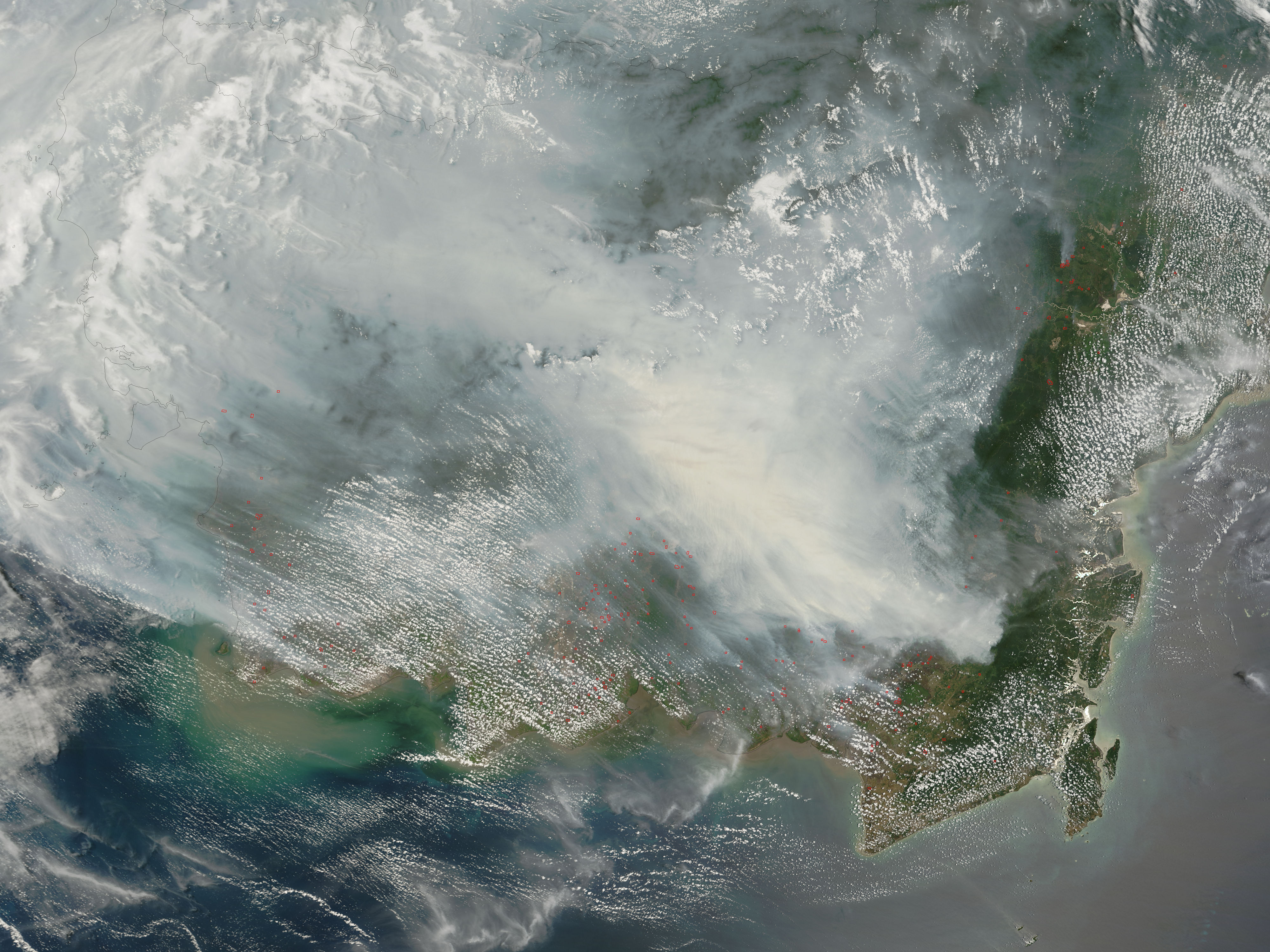
Sophie's Note: Wikipedia
entry showing
satellite image of the 2006 Southeast Asian haze over Borneo.

Tuesday, April 24, 2007

Updated: Brothers again?

Singapore is suddenly back on good terms with its two immediate neighbours -- Indonesia and Malaysia.

The Straits Times ran a page one story today on Singapore striking a deal with Indonesia to resolve the protracted extradition treaty. The paper also ran a picture of Singapore Foreign Minister George Yeo (back to camera in the ST pix) hugging his Indonesian counterpart Hassan Wirajuda after the agreement was announced.

The signing of the extradition and defence pacts will take place in the Indonesian island of Bali. Singapore PM Lee Hsien Loong and Indonesian President Susilo Bambang Yudhoyono will witness the actual signing of the agreements.

This will definitely come as a relief to the two countries after two long years of negotiation. But details of the two agreements have not been disclosed yet.

ST said Indonesia has said previously that an extradition pact is crucial in its fight against corruption and would pave the way for going after Indonesians allegedly involved in graft cases who fled the country. The Defence Cooperation Agreement was proposed to restore defence cooperation after Indonesia froze the use of a joint military training area in 2003.

And there are signs of warming ties between Singapore and Malaysia. Hsien Loong and several ministers will visit Malaysia next month. Earlier this month, the National University of Singapore awarded an honorary doctorate to the Sultan of Johor.

Is the rapprochement real and lasting? Will it translate into real balance of benefits for Singapore and its two close neighbours? Can Singapore also resume strong ties with Thailand following the Shin-Temasek debacle? Will Singapore resolve its myriad outstanding bilateral problems, especially with Malaysia?

Will big brothers Indonesia and Malaysia finally resume the sale of sand to Singapore?


Update (17 November 2007): The proposed extradition and defence pacts between Indonesia and Singapore have since been unraveled.

Sunday, February 04, 2007

Dented Thai Pride


A father carries his young son to cheer for Thai football team in the Cup final against Singapore on Sunday. Photo by Narin Kruaklai of The Nation.

Thailand should have won the Asean Football Championship in Bangkok tonight, playing more aggressively than the Lions of Singapore. The home team was also aided by a very vocal and nationalistic crowd. Nearly two thousand Singapore fans didn't show up amidst possible fear of backlash arising from the bilateral tension.

There was a banner saying Thailand doesn't cheat, an obvious reference to the controversial penalty given to Singapore in the first leg of the finals last week. Was banner also referring to the state of political ties between Thailand and Singapore?

The draw in the second leg was enough for the Lions to win the cup but everyone will continue to talk about the undeserved penalty in the Singapore leg and the unforgivable walk-out by the Thai team last week.

Thailand needs a moral booster badly after a real bad year.

Singapore are Asean football champions
Singapore 1-1 Thailand (Full time)
Feb 04, 2007 AsiaOne

The Singapore Lions have won the Asean Football Championship after a tie-match in the second-leg final at the Supachalasai Stadium in Thailand.

Clearly struggling throughout the match, it did not help that Singapore were without star striker Indra Sahdan.

Thailand took the early lead with a Pipat Tonkanya goal at 35th minute of the first half. However, Singapore managed to equalised in the second half through a Mohd Khairul Amri goal at the 80th minute.

At full time the score was 1-1, giving Singapore the win with an aggregate score of 3-2. Security was tight at the sellout match in Bangkok, which comes amid growing bad blood between the two nations following a series of heated political spats.

Less than a hundred Singapore fans turned up at the stadium although about 2,000 tickets have been designated for Singapore fans.

Thai players and officials were involved in a dramatic walkout at last week's Asean championship final first leg against Singapore, where Singapore was awarded a controversial penalty.

This gave the Lions a 2-1 lead in the first-leg at the Kallang Stadium.

Saturday, February 03, 2007

Singapore-Thailand Clash

Singapore's Mustafic Fahrudin scored the controversial penalty, after an unprecedented walkout by the Thai football team in the emotionally charged game in Singapore last Sunday. Singapore beat Malaysia to reach the finals. Pix source: The Straits Times

All eyes will be on the second leg of the soccer finals in Bangkok tomorrow night between Singapore and Thailand in the Asean Football Championship. Singapore is leading 2-1 following the controversial penalty and the unprecedented walk-out by the Thai football team in protest last Sunday.

Tension is running high, amidst the controversial win and the strained bilateral ties between the two countries. Bilateral ties had been strained by a series of events in the last one year -- Singapore government investment arm Temasek Holdings' purchase of national asset Shin Corp from former Thai PM Thaksin Shinawatra, street protests over the non-payment of tax by the vendor in the deal, the military coup that ousted Thaksin, Temasek's blunders in Thailand, Thai unhappiness over Thaksin's 'private' visit to Singapore, and spying charges levelled against Singapore.

Against this backdrop, security will be stepped up considerably at the Bangkok stadium, which will host at least 2,000 Singapore fans. The two sides will do their utmost to help avert a clash of their fans. A clash of the fans would be an unfortunate and unforgettable personification of the clash between the two countries.

It would be extremely unfortunate if bilateral dealings affect people-to-people relationship. It will truly be sad if football saga does imitate real life, as captured in this tongue-in-cheek article in Bangkok newspaper The Nation today.

Football saga imitates real life
Singapore's dodgy soccer win fires talk of eavesdropping, use of foreign nominees

Even Prime Minister Surayud Chulanont was curious to know whether Temasek United Football Club had used underhand tactics to win the first leg of the Asean Football Championship. The Thai national team lost 2-1 to the Temasek team in a highly emotionally charged atmosphere.

"Were we cheated?" the PM asked reporters yesterday. He had missed the match broadcast from Singapore on Wednesday night.

The latest clash between Thailand and Singapore has turned into a political issue. It comes hot on the heels of deteriorating relations, with the Kingdom suspecting that Singapore is now able to listen in on its calls because the former prime minister sold control of ShinSat, the sole national satellite company, and the country's biggest mobile-phone firm (AIS) last year to Temasek Holdings, a state investment firm in the city-state.

Army chief and coup leader Gen Sonthi Boonyaratglin voiced concern that Thai military information was no longer secure because control of key telecommunications firms had been lost with the controversial Shin deal.

"You pick up the phone and it goes to Singapore," he reportedly remarked. The military installed government is also afraid that the sale of ShinSat might enhance Singapore's capacity to eavesdrop on calls here. Premier Surayud said they were looking into whether Thailand may be able to buy back control of the firm or if a new satellite needs to be launched.

The joke going around the Thai team is that their game plan might have been "discovered" by their opponents prior to the match.

After all, how come the Singaporeans knew that Thai star Kiatisak Senamuang would be absent from the game? And how did the Singaporeans players know just to mark Thai midfielder Dassakorn Thonglao, who became the most frequently fouled play by his opponents? Mmm ......

Well, the loss was not entirely attributed to Malaysian referee C Ravichandran's decision to award that hotly disputed penalty to Singapore with just nine minutes remaining.

Was the referee, like Dr Mahathir Mohamad, the former Malaysian leader, just trying to drive a wedge further between Thailand and Singapore, knowing the penalty would drive us nuts?

A more deserving question may be how the Singaporeans managed to respond so well to our game plan.

But, what's done is done. The Thai team lost and Thai football fans are now left hoping their team can win the second leg on their home turf - on Sunday.

Looking around the pitch though, the Thai national team won't enjoy a huge advantage in the second leg as the physique of the Singaporeans suggests they're in a different league.

Although the title of the tournament described it as a competition for the Asean region, the appearance of some Singaporean players conjured up an image of nominees - as they seem to come from all over the world.

Take the Caucasian-looking guy with the pierced-nose - the tall Mustafic Fahrudin, who scored their winning goal. Fahrudin, formerly Serbian, rewarded his adopted country handsomely with victory from the penalty spot. In fact, Fahrudin is far from the only nationalised player for Singapore. Exceptional skill was not the factor that made Precious Emuejeraye stand out from the crowd. Emuejeraye is black, originally from Nigeria, and towered over everyone on the pitch. Daniel Bennett is not Singapore-born either - but another imported player from the UK wearing Singaporean colours. A fourth - Si Jia Yi - was once Chinese, but is now Singaporean.

These players were influential in providing the backbone for their team's performance. Temasek Holdings has been accused by some of using Thai nominees to acquire control of Shin Corp on behalf of foreigners. And when it comes to football, the Singaporean team has shown the world it can use foreign "nominees" to improve its playing strength.


There is nothing wrong with this. But the next challenge for Temasek is how to truly nationalise Shin Corp without being caught using local nominees. Or… maybe that's just sour grapes.

Wednesday, January 31, 2007

Dr M Soldiers On

Former Malaysian Prime Minister Dr Mahathir Mohamad (pix illustration from kickdefella) is still in his combative mood and has not lost his wit despite his recent heart attack.

According to The Nation newspaper in Thailand this week, he threw his support behind Thailand's diplomatic spat with Singapore, accusing the city-state of interfering in the Thailand's internal affairs and violating diplomatic norms by permitting a senior government official to meet ousted premier Thaksin Shinawatra.

Some observers may feel that the retired Malaysian leader should just shut up like a pensioner. And he should not add fuel to fire in the squabble between neighbours. There is some truth in it.

But there is also the view that Dr Mahathir is a strong Asian voice, often saying things bluntly without fear or favour. After all, who else would say that US President George Bush should be tried for the invasion of Iraq? Please see Dr Mahathir's current mission and earlier postings.

Of course, Dr Mahathir is well positioned to talk about his relationship with Singapore, as mentioned in an earlier posting.

The following is the full transcript of his interview with The Nation's Group Editor Thepchai Yong in Langkawi over the weekend.

Q : How do you see the on-going spat between Thailand and Singapore?
A : Well I hate to say but I think it was unwise for Singapore to seek advantages from Thailand's problems. Because they saw that Thaksin was in need of some help and they extended help not in the way that could be appreciated by the Thai people. And in the present situation, Thaksin's visit to Singapore obviously to discuss this thing, was not very diplomatic.

Q : So Thaksin shouldn't have been welcomed by Singapore's deputy prime minister.
A : Yeah, that was not necessary. There are other places you can meet to discuss business. Because I'm quite sure in order to talk business, that's why they met.

Q : Talking business could be one thing, but knowing that such reception would draw reaction from Thailand. The Thai Foreign Ministry made it clear that they had warned the Singaporean government that there would be reaction if Thaksin met its deputy prime minister. And yet the Singaporeans went ahead with it?
A : Well you see, Singapore does not really care about the opinions of its neighbours, Singapore has been very unfeeling, not sympathetic to the problems of their neighbours. And we have problems with Singapore. In my 22 years in office I tried to resolve them by being friendly but I couldn't solve these problems with Singapore.

Q : Why would Singapore not want to be friendly with Malaysia ?
A : Singapore wants to win and they believe that the most important thing is what profits Singapore. What others get is not relevant.

Q :Profits in what term, business term or diplomatic term?
A : In business term, in diplomatic term, in whatever way, Singapore must be top.

Q : The Thai Foreign Ministry reacted by suspending a visit by the Singaporean foreign minister. Do you think that was the right reaction?
A : Well you know me, I'm very tough in certain things. If I find a foreign minister in another country say nasty thing about my country that is not in the interest of my country, I would have acted very strongly.

Q : Would you have done the same?
A : Probably I would do the same.

Q : Do you think Thailand and Singapore should try to patch things up?
A : Yeah, I think they should, but in a way that is honorable.

Q : Who should take the initiative? The Thais believe that Singapore owes them an apology.
A : I think Singapore should apologize because basically Singapore was interfering in the internal affairs of Thailand, and that was not good. You see, Thaksin has problems with Thailand and its people, not with Singapore. But Singapore comes in, in order to help Thaksin. And I think it didn't work.

Q : In Thailand they say if you want to know how to deal with Singapore, talk to the Malaysians. What can we learn from your experience in dealing with Singapore?
A : Either being nice or being tough, they always think about themselves. And they think you won't be able to touch them. They are beyond any action that you may be able to take. That's the character of Singapore, not one cent for anybody else, unless they gain something.

Q : So you're suggesting that Thailand should continue to be tough with Singapore.
A : You should try to get what is your right from Singapore, but it's going to be difficult. Singapore is likely to ask you for some concessions, here there and everywhere Otherwise you won't get back what is yours by right, but that is the way Singapore deals with people.

Q : Did it surprise you that Thai army chief Gen Sonthi and the coup leader few weeks ago said every phone call in Thailand has been monitored by Singapore?
A : I wouldn't be surprised because that's the kind of things they do.

Q : You mean they eavesdrop on friends?
A : Yes they do, they even spy on friends.

Q :That happens to Malaysia too?
A : Yes, one of my political secretaries was removed and detained because he was known to be associated with somebody from Singapore. Of course, Singapore denied, but our police believe that he was passing information.

Q : But why wire-tapping friends? Neighbours shouldn't do this to each other.
A : Well, but we find friends do tap and listen to what friends talk about, but I think Singapore does it in a much more offensive kind of way.

Q : So Thailand and Singapore should sit down and find ways to get their relations back to normal. But can they be normal again?
A : It will be difficult but I think I believe in trying.

Q : Should Thais make the initiative or should Singapore do it first? Thais have been very angry and feel very strongly about this.
A : I think we need a cooling down period.

Thursday, January 25, 2007

Hiccup in Singapore-Brunei Ties?

Could Singapore be having problems with Brunei -- one of its best friends -- in the midst of its stand-offs with three other bigger neighbours?

In an odd development on Wednesday, Singapore's state-controlled port operator PSA International said it was returning the operations of the Muara Container Terminal in Brunei to the local government prematurely. PSA had only managed the greenfield port in Brunei for six years although the contract was supposed to run for 25 years until 2025. The ostensible reason by PSA was the achievement of its goals and Brunei's on-going review of Muara's longer-term capacity needs.

But it sounds more like a clash of the vision for the port industry in Brunei although PSA had worded the statement nicely. The possible clash could be partly explained by a report that said Brunei's Economic Development Board had identified a nearby island called Pulau Muara Besar in 2002 for another new terminal.

Whatever the real reason for the parting of ways, the development has great political significance as the two countries have very strong and deep-rooted ties.

Brunei is the only country in the world that has its currency pegged to the Singapore dollar. Their currencies are interchangeable. Even the Malaysian currency is no longer interchangeable with the mighty Singapore dollar since the two countries separated in 1965.

In fact, Singapore and Brunei had agreed to join the formation of Malaysia in the 1960s. But Brunei dropped the idea following an internal revolt, while Lee Kuan Yew's Singapore was booted out of the federation by the Malaysian administration of Tunku Abdul Rahman after a brief merger of two years.

Since then, the two small former British colonies have forged very close political and economic ties. They enjoy deep-rooted military and bilateral ties although they are often downplayed. The Sultan of Brunei is known to have many assets in Singapore but the fact is never played up in Singapore.

With the deep ties, one would have expected political considerations to override any differences in the state port deal. In other words, one would have imagined that PSA would continue performing national service regardless of any commercial differences due to the paramount political considerations.

Despite the botched port deal, Singapore and Brunei are expected to continue their warm and friendly ties.

The same cannot be said about Singapore's current soured ties with Thailand, Malaysia and Indonesia.

Wednesday, January 24, 2007

Singapore Besieged

Changi Beach 1934
fairypoint

Singapore has probably never felt so besieged.

Indonesia is the latest neighbour to be cross with the tiny island nation after squabbles with Malaysia and Thailand.

Yesterday, Jakarta Post and other Indonesian papers reported the Indonesian government's decision to ban the sale of land sand, which effectively deprives Singapore the bulk of its sand needs for construction jobs. Singapore is the biggest user of Indonesian sand.

Price of land sand in Singapore will shoot up overnight although the Singapore government is set to release its stockpile of sand to help cap sand price. This is probably the first time that Singapore has publicly said it has a stockpile of sand to deal with contingency. With such meticulous long-term planning, it is not inconceivable that Singapore has massive stockpiles of other essential items like water, oil, gas, rice, sugar and many other seemingly mundane things in life.

Back to the Indonesian ban on sand. The Indonesian move is ostensibly due to environmental concerns but there is also a lingering feeling that it is payback time over the haze issue. The two countries had a diplomatic spat when Singapore raised the perennial Indonesian haze problem, which was driving away investors from the region, at the United Nation last October.

With the latest ban, Singapore won't be able to buy any sand -- land sand (used for concrete in building construction) and sea sand (used for reclamation works) -- from either Indonesia and Malaysia.

Former Malaysian premier Dr Mahathir Mohamad had banned the sale of all types of sand to Singapore during the crisis days in the 1990s. Singapore then turned to Indonesia for land sand as there was still a Indonesian ban on the sale of sea sand, which must be dredged from the seabed.

The Malaysian sand issue cropped up again during the failed talks between Singapore and Malaysia to jointly build a bridge to replace the causeway linking the two countries. As part of the deal, Singapore had wanted the right to buy Malaysian sand and use its airspace.

It was no go for Malaysia, which then scrapped the bridge project completely. The decision incensed Dr Mahathir, who felt that Malaysia had the right to build its half of the bridge, with or without Singapore's nod. He was also upset that Malaysia had even entertained the idea of selling sand to Singapore despite his earlier ban. The sand issue is just the tip of the iceberg in Malaysia-Singapore bilateral ties.

Of course, Singapore is still sorting out the mess in Thailand.

Sunday, January 21, 2007

Singapore's Failed Coup?

So much has happened in Thailand ever since former premier Thaksin Shinawatra sold his flagship Shin Corp to Singapore government investment arm Temasek Holdings last year.

The deal sparked widespread protest over the non-payment of capital gains tax by Thaksin although it was a common practice in Thailand. Bangkok saw widespread protests and the unprecedented burning of effigies of Singapore PM Lee Hsien Loong and wife Ho Ching, who also heads Temasek. Incidentally, Temasek reports to the Finance Ministry, which is headed by PM Lee. The entire Singapore government machinery backed the Temasek deal despite the disastrous outcome.

That's not the end of the saga. The ageing Thai King backed the military in ousting Thaksin in yet another coup d'etat in the country's history. The military-backed government was incensed when Thaksin made a private visit to Singapore last week. Singapore defended its right to host Thaksin although it's highly questionable whether it was indeed a private visit.

While the saga unfolds, the basic question remains unanswered: Why did Temasek buy Shin in the first place? Although Singapore politicians have said ad nauseam that it was simply a commercial deal, nobody was convinced. Why did the Singapore government arm rush into a badly structured deal with the former Thai premier?

One sexy theory has since surfaced that could help explain the whole saga. According to the theory, the payment of $3 billion to Thaksin for his holding company was part of a quid pro quo to abandon Thailand's long-cherished dream to build the Kra Canal.

According to one wit, Thaksin had wanted to build the canal to resolve two issues at one go -- turn Thailand into a major shipping hub, and isolate the Islamic separatist movement in southern Thailand. A canal will literally divide Thailand into two distinct regions.

The canal project, which has been on the drawing board for more than 300 years, will have major impact on Singapore and even Malaysia should it take off. This is because ships can sail from South China Sea to Andaman Sea and Indian Ocean straight, bypassing Singapore and the Straits of Malacca. The role of Singapore as a shipping hub will be greatly diminished should the Thais finally build the canal.

But not everyone buys the theory. One counter argument: The costs outweigh the benefits of such a project. Furthermore, the time saved for shippers and liners is minimal, unlike the more crucial Panama Canal. Another counter argument: It would have been cheaper for Temasek's port operating arm PSA International to take a stake in the Kra Canal project should it materialise.

Whatever the truth is, events in Thailand are truly fascinating. It's got all the right ingredients for a Hollywood movie!

Monday, January 01, 2007

Welcome to 2007!

Pix credit clockwise from top left: Bombing in Bangkok (AFP pix via The Straits Times), Fireworks in Sydney (Reuters pix via The Straits Times), Fireworks at Marina Bay in Singapore (The Business Times), and the hanging of former Iraqi president Saddam Hussein (Iraqi TV footage via CNN).

The new year started rather ominously with mixed images of celebration and suffering. Fireworks across the region were probably eclipsed by the more unforgettable images of the hanging of former Iraqi president Saddam Hussein hours before the new year. Bombs also marred the celebration in Thailand, killing at least two people.

Saturday, December 30, 2006

The Thai Touch

A nice read about a Thai hospital that is making waves in the region, captured in the Raffles Conversation in The Business Times, Singapore, 30 Dec 2006.

Thai hospitality
Curtis Schroeder, the American Group CEO of Bumrungrad International, may be credited with turning the Bangkok hospital into an icon of medical tourism. But he tells ANNA TEO that the service and quality standards that set it apart are quintessentially Thai in origin


HIS early days as the new CEO of Bumrungrad International Hospital - indeed its first non-Thai employee - were a little disconcerting, to say the least. Whenever Curtis Schroeder stepped into the elevator to get to his office, everyone else would scramble out. Nobody would ride with him.

'Because they didn't want to inconvenience the CEO by having to stop at five different floors, I found out later. I thought maybe I had some sort of problem, I didn't know what it was,' he recalls with a soft chuckle. That was his introduction to the Thais' deference to authority. Coming from a background of US hospitals where nurses have no problem unloading on the CEO over lunch in the cafeteria about problems at work, and 'doctors pound on your door and tell you what's wrong', it was perhaps culture shock in reverse.

'In Thailand that's considered very rude. So the doctors never pound on your door, and the nurses - if you try and sit down and have lunch with them, they'd panic. And so it's very difficult to get feedback.'

But it has been 14 years since Mr Schroeder - a veteran hospital administrator of over 30 years who has opened and run hospitals in Saudi Arabia and in the United States, New Orleans and Los Angeles - first arrived in Bumrungrad, and the American has embraced the land, its people and its culture. Thailand is where his two daughters, now 21 and 18 years, grew up, and where he and his wife have built their retirement home.

'It's a great place, good people, and it's been a lot of fun working there,' he tells BT during a recent business trip here. 'My wife said now I can never work in a hospital in the United States again, because the nurses would never treat me like that,' he laughs.

Business tenets

Bumrumgrad is today, of course, one of Thailand's best-known export successes - its opulent setting, plush amenities and legendary turnaround having been featured in stories about the rise of medical tourism in umpteen newspapers and magazines such as Newsweek, Time and Conde Nast Traveller. The statistics are well-touted: It treats more than one million patients a year, of whom about 400,000 come from some 190 countries. Turnover for the listed hospital in 2005 amounted to US$170 million. And Mr Schroeder is credited with having led the hospital on its breakthrough path as an international medical destination - and probably pioneering the way in the region. But ask him about it and he wants to set the record straight.

Bumrungrad opened as a 200-bed facility in 1980, went public on the Stock Exchange of Thailand in 1989, and by the early 1990s, the owners (then mainly Bangkok Bank) were looking to take it further.

'They went out and looked at other hospitals, in Singapore, in the United States; they were looking for models on size and scope and design and look and feel. They discovered that running very large hospitals is quite different from running medium or small-sized hospitals.

'At that time Bumrungrad was a relatively small, family-run hospital, and it had done exceptionally well in the market. It had ridden the wave of the rise in demand by the middle class for private health care in Thailand, and had established a very strong brand name, serving mostly the domestic and local expatriate population, very little fly-in. Thailand was not known in any way in 1990 as a hub destination. I think they had actually done an exceptional job of building a very good-quality product on the basis that it's a service industry, so we have to provide good service, and we have to attract and retain the best doctors we can find.

'I think those two business tenets were what established Bumrungrad in 1980, and to a large extent is still our philosophy today. Health care is a service business, you have to be really good at service. We're not a technology business, we don't make widgets, we don't sell cars, we provide service. And the second is attracting and retaining the best possible medical talent we can. That stays with us today, and that was established long before I came.'

Mr Schroeder was then with National Medical Enterprises, which owned at that time Mount Elizabeth and Eastshore hospitals in Singapore, and which Bumrungrad's owners turned to in its growth venture.

'So they did something that's not terribly normal in Asian family-run businesses - basically back off and say, you hire good people and let them do their jobs. And that's when I came on board in late-1992, and my job initially was to take the first vision, if you will, from a 200-bed, essentially family-run, good brand name hospital and put it on an international standard both in facility, standard operating procedures, accreditation, and make it something that had the potential for further reach.'

But there was no intention to become any medical hub. 'That was not the business plan in 1992, it's not supposed to be a hub of international care,' he says.

The 200-bed facility was torn down and a new one million square feet building came up next to it. 'We opened the hospital in early 1997. Six months later, we were hit by the economic downturn.'

It was the turning point. Subsequently, often asked what led to Bumrungrad's pioneering breakthrough strategy in 1997, Mr Schroeder says he would like to say it was a bunch of MBA-types sitting around a room looking at possible futures of health care.

'But it was much more pragmatic than that. What happened was - the crisis of 1997 put us in a position of having a brand new US$110 million hospital with about $60 million in US dollar loans in an economy that was suddenly in crisis, where local demand at best would be stagnant and probably decline, and we were a business that buys mostly in dollars, Deutsche marks and guilders, but we sell in baht. So our margins got squeezed, our market was shrinking, the paying ability of our customers was slashed, and the cost of our loans doubled overnight,' he now recalls with a wry laugh.

'That's a very, very tough situation to wake up to in the middle of July in 1997. At that time about 9 per cent of our business was international, 91 per cent was Thai. And at that time we said we got to do something very, very different here. I literally in August of 1997 walked into the boardroom and took our well planned-out, neatly typed and tabbed 1997 business plan, and I threw it in the trash, in front of the administrative team to make a point.

'The concept that we had planned, thought out and done all that important MBA-type stuff you should do, was useless. Because the landscape had completely changed. And where we were going to get our growth had changed. I've often said that we would not be the company we are today if we didn't have the crisis in 1997. It fundamentally changed and opened up new things, it forced us, it was a catalyst that was irreversible, we had to go after it, we had to find another way to survive. Because the alternative was bankruptcy. It would have been a very tough time, our shareholders would have wound up, giving up an awful lot of their equity to the banks and the others if we had not found a new market to go after. That new market was international.'

Not that Bumrungrad began to abandon its local patients. 'As a matter of fact, they continued to grow quite nicely through this period. But we needed a much larger playing field. So we looked at ourselves and found - what do we have? We have a new million square feet, internationally designed facility, we had an international management team which at that time in Thailand was unique, that had success in opening proprietary hospitals from Australia to China. We had a very strong, multinationally educated staff, all Thai, and over 200 US board-certified physicians. We were in the centre of a big city. So we said we'd better go and see if we can get patients to come from outside Thailand. And at least the one thing that happens in a devaluation of your currency - at least your exports become more attractive to people outside your country.'

Change of mindset

What was needed, it is now evident, was a mindset shift to begin to look at health care as an export product, which no one had done then, including the Thai government.

Mr Schroeder recalls an exports roadshow with the government in the early days in 1998 to introduce Thai health care along with other products.

'They weren't quite sure what to do with us, because we'd go on these roadshows and there would be people selling Thai jasmine rice and milk powder and fruit and commodities and steel, and we were there, this health-care group. And I remember sitting in the middle of a dirty parking lot in the rain with the dust on the floor in Cambodia, in Phnom Penh, and we were sitting there selling, you know, cardiac catherisations, next to people selling milk powder . . . I said, what are we doing here? Those early days were very much about trying to figure out how to define health care as an export product. And ultimately, I think, we figured out that there was a demand, because the cost had come down so much.

'Bangkok had always been cheaper, but for the first time it dropped much further against world currencies than, for instance, the Sing dollar did. So it widened that gap.

'At the same time we had a brand new fantastic physical plan, we had time for two to three years to get the operations up, and we were ready to rock and roll. And we just hit the market at the right time at the right price. At the same time, all the surrounding Indochinese economies were also hit by the slowdown, so the people in those countries who had traditionally left their countries for health care - I'm talking about Vietnam, Laos, Myanmar, Cambodia, and also Bangladesh, Nepal, Bhutan - they were looking for alternatives. They had a catalyst, they had a reason to look elsewhere. Because they had been going to Singapore, a little bit less to Hong Kong, some to UK, and they were suddenly looking at a very small purse. And Singapore was starting to look pretty expensive. And suddenly here is this other alternative - and it's a third of the price and when they got there, it was pretty good. They liked the service and they liked the people, they liked the facility, and they came.'

From an initial six countries, Bumrungrad expanded its network of overseas offices to 12, and now 18. It receives on its website, set up back in 1997, more than 700 international email enquiries every day, seven days a week, and has a staff of people who do nothing but respond in 17 different languages to the emails, Mr Schroeder says. Its doctors speak as many languages 'on a fluent basis', and there are also some 60 full-time interpreters covering everything from Arabic to Greek and Hebrew.

The Thai doctors tell him that 'it's so much more interesting when you have a Nigerian patient, followed by a Bhutanese, followed by a sheikh from Oman, then you get a Thai from up the street, and next you know, someone comes in from Cambodia'.

It is the most international hospital in the world, and 'if you walk through the lobby it takes you just five seconds to figure it out', he notes. 'The lobby just looks like the United Nations - every kind of dress from Nigeria to Oman to Bhutan to Thai to all the various African dresses and things. They're milling around, they're at Starbucks, they're having sushi. It's fascinating, there's just nothing like it.'

And while its foreign patients - 40 per cent of the total - account for 53 per cent of revenue, Mr Schroeder says Bumrungrad charges everyone, foreign or local, the same rates. 'The foreigners buy more because they are more intense when they come,' he says. 'We charge exactly the same whether you're the Queen of Bhutan or a sheikh in Oman.' Or a businessman in Krabi. 'It's the same price. That's a matter of ethics.'

Service ethic

At the end of the day, Bumrungrad's success stems fundamentally from the Thais' own ethic, he emphasises. Indeed the Thais were worried when he first came on board, wondering how 'Americanised' things would become.

'In fact, there was fundamentally very little to change. It was not a clean-up issue. It was taking what they'd done and moving it to the next level, and systematise it a lot so we could replicate it on a much larger scale.' The hospital was, since its early days, already revolutionary from a service perspective, he says.

'When I was first asked to interview for the job back in 1991, I came to Thailand and I did what most people would do - you ask other people what they think about the hospital without saying what I was there for. And I asked everyone from taxi drivers to hotel managers what they thought of Bumrungrad. The interesting part was - the first thing they said was - it's really good in service. Now I had been in health care for 30 years and I've never ever heard the first things out of a person's mouth when you talk about a hospital, is good service. They could say - good doctors, good equipment or good marketing even, but never 'good service'. I'd never heard that in operating hospitals on four different continents.

'And that, to me, said that they're doing something very, very different in how they approached it. And I think that foundation is what enabled us to do what we could do in later years. Yes, we gave them a nicer building; yes, we gave them lots of policies and procedures; yes, we systematised what they had been doing and formalised it. But the fundamental Thai service ethic, the fundamental approach to understanding medical care as a service business, was Thai from the beginning and is Thai today.

'This isn't some American concept,' he laughs. 'Matter of fact, Americans are very bad at service. Every time I go back to the US, I remind myself how lucky I am to live in Asia, from a service perspective.'


Pie is huge, so don't worry about competition
BUMRUNGRAD is a huge success story and hospitals across the region, including Singapore, are hot on its heels. Or at least are pulling out all stops to get a firm foothold in the medical tourism market. But Curtis Schroeder, Bumrungrad's group CEO, is quite unfazed by any notion of competition.

To begin with, the pie is getting bigger by 20-30 per cent a year, he says. 'In other words, the people travelling outside the borders (for medical care) by most estimates is growing 20-30 per cent a year. This pie is much larger than either Bumrungrad or Thailand can deal with alone. This is a worldwide phenomenon, not a South-east Asian, Indochinese or Asian phenomenon. It's happening in South America, it's happening in Eastern Europe, it's happening in Africa.'

Trends in economic growth, individual affluence and lifestyles, and in how healthcare is reimbursed, is increasingly placing the decision authority back on the patient, Mr Schroeder says. For years, the insurance companies had been the main drivers. But now, 'when people get money in their pockets, when they become discerning shoppers, they shop', he adds. And their shopping is no longer confined to a 20-mile radius of home - they will search and go for value where they find it.

'So the pie is getting much larger. And I've never been concerned about the issue of competition,' he maintains.

Apart from Bangkok, the Bumrungrad group also runs the Asian Hospital and Medical Center in Manila, and is building another in Dubai. The plan is to have between six and 10 hospitals in major markets in the next five years, Mr Schroeder says.

'But these hospitals are not necessarily built on the concept of medical tourism. They may be an element, but to some degree, the ability to be successful on a global basis may depend on where the hospital is. In Dubai, the cost structure is extremely high. I can't really give a quality-value combination that would hit people from Cambodia willing to fly to Dubai, because the cost is going to be too high. I think Thailand will always be around the same pricing as Malaysia; I think Malaysia and Thailand are slightly higher than India by about 10 per cent by most measures.

'Singapore is now closer to about two times Thailand's (prices), it was about three times. A lot of the prices have actually come down. The cost of getting open heart surgery in Singapore is lower than it was five years ago. Competition is good to some degree,' he quips.

But basically he doesn't see any need to worry about competition between Singapore and Thailand in the healthcare arena, he suggests. 'Where Singapore's strength has been is the fact that it has a highly educated workforce, it has a very strong infrastructure, and it has a very strong ethic in terms of investing in research and teaching on the academic side. What people are learning about healthcare is that 95-99 per cent of the healthcare being delivered in any country can be done by any competent operator of a hospital.

'You don't have to be the Mayo Clinic to do an appendectomy, you don't have to be the Mayo Clinic to do open heart quintuple bypass - any one of 10,000 hospitals in the world are competent in doing that. There's been a feeling that there's this whole chunk of medicine that only the top end can do, but with technology, the playing field has levelled substantially over the last 10 to 15 years, and hospitals with competent access to management and medical talent can do 95 per cent of what the average person in the population needs on a day-to-day basis.

'The small eclectic group is usually the purview of large teaching hosps - places like Mayo Clinic and SGH, National University Hospital. These are access to resources in teaching and research that give them a special edge on that top 5 per cent. I think also that Singapore has a strong advantage when it comes to biotechnology development, bringing new products to the market, developing new intellectual property - Singapore has a strong leg up on that.'

So Singapore will find it difficult to compete in the 95 per cent 'mass market' of hospital procedures 'because the price difference - it's not like it's 10 per cent different; it's a hundred per cent, and it's not something you can do by just performing better, you can't just get better at it'.

The fact of the matter is - salaries make up probably half of hospital revenues in Singapore, he reckons. 'In Thailand it's 16 per cent. In our hospitals in Manila, it's 12 per cent. You can't change that.'

He adds: 'I think a lot of people worry about Singapore and Thailand competing, (but) the pie is so big I don't think it's a question of how to beat Bumrungrad or how to beat Apollo in India. I think it's a question of making sure that all of our systems are aligned to respond to the needs of our customers wherever they are coming from, and they're coming from very different backgrounds. What an American is looking for is vastly different than a Bangladeshi or a Bhutanese. Some markets may have more success with those than others.

'And there is an awful lot of business out there, certainly more than we can probably gobble up. So it's a wide open market - a four, five or six billion dollar business sitting out there per year. I'm only doing a couple hundred million a year. So . . .'

Friday, December 22, 2006

Malaysia SOS?


(Pix source: New Straits Times)

The floods in southern and eastern Malaysia have turned out to be worse than expected. There were reports of massive evacuation of more than 60,000 people, stoppage of train service from Singapore to southern Malaysia, and even looting in Johor.

Although the calamity is not on the same scale as the tsunami that ravaged Indonesia and Thailand during Christmas two years ago, Malaysia could still use a helping hand from some of its Asean neighbours now.

Malaysia had helped its neighbours and other countries in times of crisis. Malaysia had sent money, food, relief and even troops to tsunami-hit or war-stricken countries. Singapore had also done the same to help others in the past.

But how come Malaysia's immediate neighbours -- Thailand, Singapore and Indonesia -- have not come to the aid of Malaysia during this disaster? When do neighbours decide to help without being accused of interfering? What is the diplomatic protocol? Wait for the number of casualties to rise?

There are no hard and fast rules. One thing is clear: Malaysia, or any stricken country, is unlikely to reject any humanitarian assistance that comes without any strings attached.

Monday, December 18, 2006

Updated: Capital Controls

It's indeed ironic that Thailand today introduced curbs to stop currency speculators and prevent the baht from appreciating too much -- some 9 years after it tried in vain to prop up the Thai currency against currency traders and hedge fund players like George Soros (Right in the pix. Pix Source: Screenshots).

Dec. 18 (Bloomberg) -- Thailand's regulators required banks to lock up 30 percent of new foreign exchange deposits for a year to curb currency speculation, causing the baht to slump by the most in almost three months.

Overseas investors buying baht starting tomorrow will only be able to invest 70 percent of what they transfer, and only recoup all of their funds if they keep the money in Thailand for more than a year, central bank Governor Tarisa Watanagase told a briefing in Bangkok today. Those who withdraw the reserved amount in less than a year will be penalized 33 percent of that 30 percent portion, she said.

The baht had risen about 16 percent this year to a nine-year high as the economy accelerated and a Sept. 19 coup broke a political stalemate. Exporters including Thai Union Frozen Products Pcl, the world's second-biggest tuna canner, on Nov. 16 asked the central bank to stem baht gains that are undermining their competitiveness.

The Thai move may remind some of what former Malaysian premier Dr Mahathir Mohamad (left in the pix) did to insulate the economy with capital controls in the wake of the Thai baht crisis in 1997 but the schemes are completely different.

While Thailand seeks to prevent too much inflow of money today, Dr Mahathir had erected controls to bar local and foreign capital from fleeing the country in 1998 following the collapse of the Malaysian currency. Almost all the controls, including the freeze on foreign capital from fleeing the country for one year, have since been lifted except for the continued ban on the offshore trading of ringgit.

The controls are longer a hindrance to Malaysia, which has undergone substantial structural changes in the economy since 1998.

Even Dr Mahathir and his former foe -- hedge fund king George Soros -- have patched up, as shown in the pix of the newsworthy meeting last week.

It's well known that Dr Mahathir had called Soros a 'moron' at the height of the regional financial and currency crisis in 1998. In return, Soros had called Dr Mahathir, who looked fine in the pix after his recent heart attack, a 'menace to his country'.

PS: Read Marina Mahathir for her interesting account of the meeting between her dad and Soros.

PS2: Thailand did an about turn on its capital controls hours after they were rolled out. It's highly embarrassing. The damage done will be etched in the minds of investors for a long time, perhaps longer than Dr Mahathir's arguably more well-crafted system of capital controls for Malaysia in 1998.

ST, 20 Dec 2006:
On Monday afternoon, the Bank of Thailand (BOT) - the central bank - announced a 30 per cent reserve requirement on short-term inflows as part of measures to put a lid on the speculative buying of the baht.

This meant a foreign investor planning to invest $100 in Thai assets would have had to bring in $130 - $30 of which had to be deposited with the central bank for zero returns for one year. Selling the $100 investment within a year would have incurred a $10 penalty.

Yesterday, economists, brokers and investors watched in horror as the Thai stock market plummeted as much as 20 per cent in response to the measures. It is estimated that foreign investors sold a whopping US$700 million (S$1.1 billion) worth of Thai shares, Reuters reported.

Then, in an equally stunning reversal, the Thai government abandoned the controls late last night, but only for stock investments.

Wednesday, December 13, 2006

Temasek's Thai Blunder, Part 3

Singapore government investment arm Temasek Holdings has suffered another setback in Thailand following its disastrous foray in acquiring Shin Corp from former Thai prime minister Thaksin Shinawatra this year.

The highest court in Thailand today ordered iTV, which is under Shin, to pay unspecified fines that could lead to the bankruptcy of the country's sole private TV station.

From the website of Bangkok Post today:
iTV loses case - faces fine, bankruptcy
(dpa) - The Supreme Administrative Court this afternoon ruled against iTV - the country's sole private TV channel - in forcing the now Singapore-owned company to pay a higher concession fee and fines. The ruling is likely to bankrupt the operation.

The verdict upheld a decision by the Central Administrative Court of May 9, 2006, that forces iTV to change the news content to 70 per cent, up from 65 per cent, and pay a higher concession fee to the government.

The decision, which was not appealed by iTV, could force the company to pay a fine of up to 94 billion baht ($2.6 billion), effectively bankrupting the company which is now majority-owned by Temasek Holdings, the investment arm of the Singapore government.

ITV was previously owned by Shin Corp, the family-held business conglomerate of former Thai prime minister Thaksin Shinawatra, which sold its 49 per cent holding in Shin Corp to Temasek Holdings for 1.9 billion dollars, tax free, on January 23 of this year.

The purchase outraged many Thais who saw the Shin Corp sale as handing over sensitive nationals assets to a foreign company. Besides iTV, Shin Corp also ran the country's largest mobile phone service and the national satellite network.

Four months after the Temasek purchase of Shin Corp, when the political tide was moving against Thaksin, Thailand's Central Administrative Court overturned an arbitration panel's 2004 decision to lower iTV's concession fee and its news content to 65 per cent. Entertainment shows earn higher advertisement revenue in Thailand.

The iTV saga is rich in recent Thai political history. The channel was intended to be an independent news station providing the public with unbiased reporting. All other TV stations in Thailand are owned by the state.

However, after running into financial difficulties in the wake of the 1997 economic crisis iTV was snapped up by Shin Corp and turned into a pro-government station when Thaksin came to power in 2001.


Please see earlier postings on Temasek's blunders in Thailand. Some observers reckon that the series of missteps in Thailand may have cost Temasek's top deal maker his job.

The Straits Times, 7 Dec 2006
Temasek changes chief investment officer
By BRYAN LEE

TEMASEK Holdings has replaced its all-important chief investment officer, who oversees all of the Singapore firm’s investment decisions.

A check by The Straits Times on Temasek’s corporate website shows that senior managing director Jimmy Phoon has taken the reins from Mr Charles Ong. Mr Ong, also a senior managing director, has assumed the newly-created role of chief strategist.

The move comes as Temasek continues to grapple with its controversy-hit US$3.8 billion (S$5.87 billion) takeover of Thailand’s Shin Corp earlier this year.

It led a group of Thai investors to buy a 50 per cent stake in the telecoms company from the family of former Thai premier Thaksin Shinawatra. The transaction eventually led to a mandatory general offer which saw Temasek and its partners emerge with 96 per cent of Shin.

The acquisition, seen by many Thais as a sell-out of strategic national assets to foreigners, was at the heart of widespread protests in the country. These culminated in a September military coup that toppled Mr Thaksin.

Temasek said yesterday that the senior management moves were not related at all to the Shin deal but were “part of regular and ongoing corporate development efforts”.


The iTV problem is definitely not the end of Temasek's woes in Thailand although Singapore politicians have been trying to defend Temasek and mend fences with Thailand following the Shin debacle.