Showing posts with label lee hsien loong. Show all posts

Friday, September 07, 2007

Cleaning up Johor Straits good for S'pore too
Punggol, which is located on the northeastern part of Singapore, will be given a new lease of life. Singapore's Prime Minister Lee Hsien Loong said during his National Day Rally speech on Aug 19 that the masterplan for the area dubbed 'Punggol 21-plus' is 'back on track'.

'Punggol 21-plus' will boast features like a freshwater lake - and a waterway running through the estate with homes and a town centre built on both banks, according to ST. The north-eastern coastal suburb will also get recreational facilities like water sports, gardens and parks with jogging tracks and eateries for al-fresco dining.

It all sounds great, but Punggol and the rest of the northern part of Singapore will never be as vibrant as the southern region of Singapore. The southern region, which has always been the commercial hub of Singapore, is rapidly being transformed into a more fun place.

The southern part of Singapore will have two world-class integrated resorts with casinos within the next three years or so. The government has awarded the Marina Bay site to Las Vegas Sands, which is building also building the world's biggest casino in Macau, and the Sentosa site to Genting International.

That's not all in the Marina Bay area. The new downtown is taking shape and there will be world-class gardens, a giant fresh-water reservoir, and a huge ferris wheel. There will be plenty of activities around the clean and pristine Marina Bay once all the plans are in place.

While the southern part of Singapore is attracting all the big dollars and attention, the northern part of Singapore will continue to be relatively subdued despite the latest plan to rejuvenate Punggol.

As Singapore is small with 704 square kilometres in area, every inch of Singapore, including the northern part, will have to be spruced up eventually. But it won't be easy to rejuvenate the northern coastline.

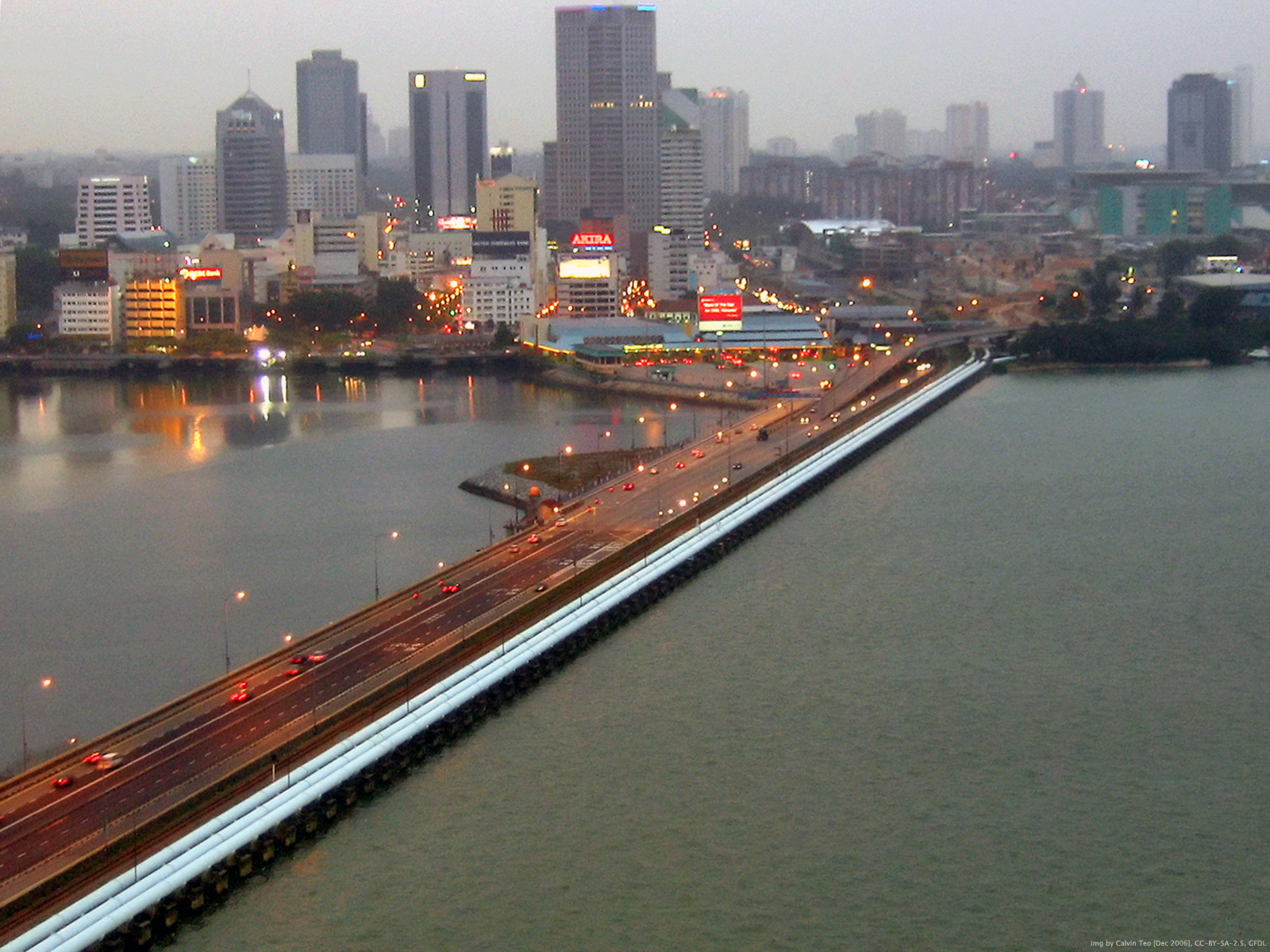
For a start, water off the northern part of Singapore, which is bounded by a strip of water known as Straits of Johor, is very dirty. The straits is a narrow waterway separating Singapore and its close neighbour Malaysia.

The straits is almost like a giant cesspool that has not been flushed for more than 80 years. Why? This is partly because the causeway, which was built on reclaimed land and cuts across the straits to link the two countries, has been blocking the free flow of water in the straits since it was completed by the British in 1924.

Singapore has done its part to reduce further pollution to the straits, spending $7 billion to build massive tunnels to move sewage to two new waste treatment plants in Changi and Tuas, instead of discharging waste into the straits.

Malaysia is also trying to clean up the straits, although not as successful.

In 1996, former Malaysian Prime Minister Mahathir Mohamad proposed an overhead bridge to replace the ageing causeway in a bid to free up the flow of water in the straits. It is part of a grander plan to turn the southern Malaysian state into a transportation hub. The project would have allowed small ships and barges to traverse the straits.

The bridge project has not taken off after ten years, complicated by internal Malaysian politics and disagreements with the Singapore government. Last year, current Malaysian government led by Abdullah Ahmad Badawi, called off the bridge project. Malaysia could not strike a deal with Singapore, which wanted to buy sand and use Johor airspace as part of the quid pro quo to jointly build a new bridge.

The decision to abort the project incensed Dr Mahathir, who is still on a warpath with his successor despite bouts of heart attacks. The Malaysian statesman had early said he would stop his bickering if the bridge is built. He had continued to criticise the bridge issue as reported in malaysia-today.

The bridge project is expected to remain on the backburner for some time, as the two governments have not been able to resolve all their differences since the two countries separated in 1965.

With or without a new bridge to replace the causeway, Malaysia and the Johor state government must step up efforts to clean up the five dirty rivers flowing into the Johor Straits.

But it will be more ideal if a new overhead bridge could be built to replace the over-utilised causeway and allow water in the stagnant straits to circulate more freely.

A cleaner straits will be good for the long-term development of the coastal areas of both Singapore and southern Malaysia, which will have a new development zone called Iskandar Development Region.

A cleaner Johor Straits could also help make northern Singapore, including Punggol, a more thriving hub one day.

Sunday, August 12, 2007

Singapore, Malaysia going to court again?

Are Singapore and Malaysia going to court again to settle old scores?

According to The Straits Times last night, Singapore PM Lee Hsien Loong said that if there are bilateral issues which have to be settled, they should be resolved according to international law and treaties.

Hsien Loong said if they had been easy to resolve, his predecessor, Senior Minister Goh Chok Tong and Dr Mahathir Mohamad, from whom Prime Minister Abdullah Badawi took over in 2003, would already have done so.

"I do not see myself being able to do better than Mr Goh Chok Tong. And I don't think it would be easier for Prime Minister Badawi to do better than Dr Mahathir, because what Dr Mahathir could not give, Datuk Badawi cannot give," he said.

One such issue is the overlapping claim on Pedra Branca or Pulau Batu Putih to Malaysia. The case is still pending the decision of the International Court of Justice. The two countries had also gone to court over Singapore's reclamation issues.

Other unresolved issues include the price of water from Johor, the re-development of Malaysian railway land in Singapore, the use of Malaysian airspace by the Singapore Air Force, a bridge to replace the Causeway, and the release of CPF monies to West Malaysians who no longer work in Singapore.

It's sad that the two close nations, which used to be one country, could not resolve all the outstanding issues behind closed doors without going to the international court. I guess the durian diplomacy in May didn't do much to restore bilateral ties.


Latest post (8 November 2007): Malaysia to reclaim Pedra Branca?

Saturday, July 14, 2007

Maverick sons

The sons of Singapore Prime Minister Lee Hsien Loong are mavericks.

Writers and bloggers have had field day dissecting the chain of events following Li Hongyi's long letter of complaint against a fellow officer in the Singapore Armed Forces for being absent without leave or AWOL on two occasions. He had sent the letter to the Defence Minister, senior governments officials and broadcast the letter to many fellow servicemen who were not involved in the case.

To cut the long story short, Lee's son (pix from Simple is the Reason of My Heart) earned a reprimand for not following the proper channel in lodging his complaint. The other officer was also court martialed and reprimanded.

Public reaction has been mixed. Many praised him for blowing the whistle, but some lambasted him for his brash act.

Another son of Hsien Loong and second wife Ho Ching of Temasek Holdings also came into the limelight during the last elections in 2006. Hsien Loong disclosed that his youngest son Haoyi had attended the rally of the Opposition during the hustings.

The young sons of Hsien Loong appear to be quite independent minded. They are willing to speak up, quite different from many Singaporeans who simply toe the official line. Maybe, they can afford to be different due to their privileged background. To be sure, they are not above the law as shown in the Hongyi case.

There's no doubt that they will go far in the Singapore society, due to their ability and pedigree. But will the third generation of Lees be able to follow the footstep of their PM father and their grandfather -- former PM Lee Kuan Yew?

The jury is still out.

Thursday, June 07, 2007

Double happiness

There is now another similarity between the political leadership of Singapore and Malaysia although the two countries split long time ago in 1965. Their current Prime Ministers, who assumed power after the turn of the millennium, have both remarried following the death of their first wives.

Singapore's Lee Hsien Loong, who succeeded Goh Chok Tong in 2004, married Ho Ching in 1985 following the death of his first wife. Malaysia's Abdullah Ahmad Badawi, who took over from Dr Mahathir Mohamad in 2003, and Jeanne Abdullah will hold their wedding ceremony this Saturday following the death of his wife two years ago.

While Hsien Loong's second marriage is old news, Badawi's badly kept secret has continued to hog the headlines. The Malaysian leader was cited today as saying: 'A happier PM can do a lot of good work.'

Can Badawi now do a lot of good work by resolving all the outstanding bilateral problems with Singapore?

The leaders of the two countries met on the Malaysian island of Langkawi last month as part of what was dubbed "durian diplomacy". There's been a lot of positive rhetoric on both sides of the causeway since then.

But there's been no concrete sign of a new political bridge to link the two countries that used to be one nation.

Wednesday, May 16, 2007

Durian diplomacy

As expected, Malaysia and Singapore didn't resolve any outstanding bilateral problems during the first-ever retreat of the countries' leaders earlier this week.

Instead, the two leaders -- Malaysian Prime Minister Abdullah Ahmad Badawi (left in The Straits Times pix) and Singapore PM Lee Hsien Loong -- held long four-eye chats on a wide range of issues that were not fully disclosed to the public.

They had meals, rode in a buggy together and shared durians, leading Badawi to quip they were enjoying durian diplomacy!

What eventually emerged was their agreement to set up a joint ministerial committee to discuss issues related to Singapore's involvement in the Iskandar Development Region in southern Johor. According to media reports on both sides of the causeway, among the issues that will be discussed is a smart-card access system that will cut down on immigration clearance time when travelling to the IDR. Another issue is how Singapore's expertise in cleaning up rivers can be used in Johor.

That was probably the strongest news point as the two governments didn't make any headway on the bilateral front, at least not publicly.

According to The Star, Hsien Loong hinted that outstanding bilateral issues with Malaysia will be resolved through international arbitration.

Maybe, but he may have also meant that the two governments will seek an international arbiter should current efforts fail to resolve all the issues after a certain time. It's definitely unclear at this juncture if the two governments will go straight to the international court to help unwind all the long outstanding problems. It will seem a bit odd if the two governments decided to go to court immediately over the old bilateral issues after such a cordial public meeting, infused with durian diplomacy.

What is clear is that they will remain thorny problems for some time (pun intended!).

Sunday, January 21, 2007

Singapore's Failed Coup?

So much has happened in Thailand ever since former premier Thaksin Shinawatra sold his flagship Shin Corp to Singapore government investment arm Temasek Holdings last year.

The deal sparked widespread protest over the non-payment of capital gains tax by Thaksin although it was a common practice in Thailand. Bangkok saw widespread protests and the unprecedented burning of effigies of Singapore PM Lee Hsien Loong and wife Ho Ching, who also heads Temasek. Incidentally, Temasek reports to the Finance Ministry, which is headed by PM Lee. The entire Singapore government machinery backed the Temasek deal despite the disastrous outcome.

That's not the end of the saga. The ageing Thai King backed the military in ousting Thaksin in yet another coup d'etat in the country's history. The military-backed government was incensed when Thaksin made a private visit to Singapore last week. Singapore defended its right to host Thaksin although it's highly questionable whether it was indeed a private visit.

While the saga unfolds, the basic question remains unanswered: Why did Temasek buy Shin in the first place? Although Singapore politicians have said ad nauseam that it was simply a commercial deal, nobody was convinced. Why did the Singapore government arm rush into a badly structured deal with the former Thai premier?

One sexy theory has since surfaced that could help explain the whole saga. According to the theory, the payment of $3 billion to Thaksin for his holding company was part of a quid pro quo to abandon Thailand's long-cherished dream to build the Kra Canal.

According to one wit, Thaksin had wanted to build the canal to resolve two issues at one go -- turn Thailand into a major shipping hub, and isolate the Islamic separatist movement in southern Thailand. A canal will literally divide Thailand into two distinct regions.

The canal project, which has been on the drawing board for more than 300 years, will have major impact on Singapore and even Malaysia should it take off. This is because ships can sail from South China Sea to Andaman Sea and Indian Ocean straight, bypassing Singapore and the Straits of Malacca. The role of Singapore as a shipping hub will be greatly diminished should the Thais finally build the canal.

But not everyone buys the theory. One counter argument: The costs outweigh the benefits of such a project. Furthermore, the time saved for shippers and liners is minimal, unlike the more crucial Panama Canal. Another counter argument: It would have been cheaper for Temasek's port operating arm PSA International to take a stake in the Kra Canal project should it materialise.

Whatever the truth is, events in Thailand are truly fascinating. It's got all the right ingredients for a Hollywood movie!