Showing posts with label malaysia. Show all posts

Saturday, March 29, 2008

Did bloggers really create the Malaysian tsunami?
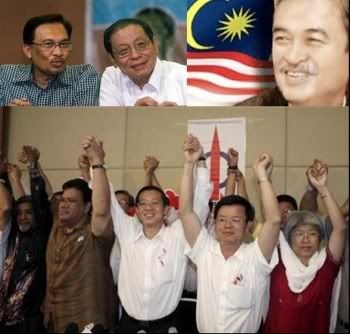
This is a well-written commentary by a former journalist in Singapore's TODAY newspaper today. Cherian George looks at the role of the Internet and blogs during the watershed elections in Malaysia this month.

It's a timely reminder that bloggers only play one part in the big scheme of things. Bloggers on both sides of the causeway will never replace mainstream media, despite general unhappiness with the two governments' mouthpieces on certain key issues.

But ultimately, editors and writers -- whether they are in the mainstream media or blogosphere -- must be credible. Both platforms also need to engage each other more frequently to give a more complete picture to people in Singapore and Malaysia.


Did bloggers really create the tsunami?
Cherian George
March 29, 2008

MALAYSIAN Prime Minister Abdullah Ahmad Badawi's admission this week that his government did not pay enough attention to the Internet is one of the sexiest explanations yet for its shock defeats in the recent elections.

Perhaps bloggers will now replace bomohs as the suspects of choice behind bizarre political phenomena like those witnessed on March 8.

Some of the hype around this admittedly magical technology is justified. By dramatically lowering the barriers to entry for wide communication and collaboration, the Internet is quite simply the most powerful platform for innovation — including political innovation — in the history of civilisation.


However, every sober analysis of its impact since the Internet's mid-1990s "big bang" has come to the same conclusion: The technology is not powerful in isolation; the World Wide Web weaves its wonders only in concert with other old-fashioned forces.

Thus, the vibrancy of Internet politics in Malaysia is very much a reflection of an offline environment of lively opposition politics and civil society activism.
Mr Jeff Ooi — Malaysia's mr brown — could transition from blogger to victorious parliamentary candidate because the Democratic Action Party was well placed to harness his popularity.

Similarly, aliran.com was able to churn out influential reports because it is backed by the established Penang-based human rights non-governmental organisation, Aliran.
Less savoury attributes of Malaysian cyberspace, such as its poison pen practices, are also rooted in the country's offline traditions.

Internet power should also be seen in the context of the wider media environment. While media companies are often wedded to one medium or another, most users are promiscuous by instinct.


They flit between media, each promising its own uses and gratifications — perhaps a newspaper for comprehensive news, television news for its pictures, a blog for personal insight, an activist's website for biting commentary, SMS for the latest gossip or joke, coffeeshop talk to share their own views, rally attendance for a sense of community, and so on.


If people suddenly gravitate towards one medium, it is often because another has failed to meet their expectations. This is certainly the case in Malaysia, where the crippling of the mainstream media by government control is the main reason why Malaysians have flocked online.

Even the editors of the leading independent site Malaysiakini humbly concede that their success isn't because they are so great — they are still resource-poor by news organisation standards — but because their mainstream rivals are found wanting.

Therefore, the government's fundamental mistake was not that it neglected cyberspace, as claimed by the Prime Minister, but that it failed to address offline problems — which were then exposed and exploited by Internet-empowered opponents.

Officials should have learnt from the Reformasi protests of almost a decade ago, when its mainstream media stranglehold resulted in media coverage out of sync with the public mood, with massive losses in newspaper circulation and a windfall for alternative websites such as Malaysiakini and Harakah Daily.


Now, officials are talking of courting independent bloggers or investing in their own. But this will not fix the real problem of inadequate respect for freedom of expression, resulting in a lack of credibility for all media linked to the state.
Comparisons with Singapore — Malaysia's fraternal twin — are irresistible.

If even the Malaysian Prime Minister has acknowledged the political impact of the Internet, does that not make Singapore — with its far greater Internet penetration levels — ripe for its own electoral tsunami? Only if one imagines the Internet to be some kind of magical force, which it isn't.


Distilling more thoughtful analyses of the Malaysian elections, 2008 appears to mark a tipping point at which voters decided that poor governance was no longer tolerable. The ruling alliance — and practically everyone else — had expected racial loyalties and a controlled mass media to compensate for its failures and inefficiencies.

But a threshold appears to have been reached, indicating that ideological advantages are finite, while good governance is all.
Like Malaysia, Singapore is run by a dominant political party that believes that the media's role is not to set the political, social and economic agenda. That is to be left to the elected leaders of the day. Instead, the media is seen as a partner in nation building.

The People's Action Party has generally not used its ideological control as a substitute for performance, but rather to give policy-makers a buffer against interference by interest groups and dissenting voices, allowing them to frame the agenda and manage public opinion in the short term.


Long-term legitimacy has been built on the tangible success of its policies. The drift from the controlled mainstream to freer alternative media has therefore been much less evident in Singapore than in Malaysia.


Another major difference is that Singapore's alternative media doesn't have the thick soil that their Malaysian counterparts thrive in. The political environment in Singapore is more predictable and sanitised in a way that Malaysia's never was.

This is reflected in the two societies' alternative media: Malaysia's are more organised, mobilised and committed.
Malaysia shows that determined activists can amplify their impact with the Internet. But Singapore shows that the Internet cannot electroshock an otherwise quiescent public into action, no matter how well wired it is.

Cherian George is an Assistant Professor at the Wee Kim Wee School of Communication and Information, NTU, and the author of Contentious Journalism and the Internet: Towards Democratic Discourse in Malaysia and Singapore (Singapore University Press, 2006).


Another good commentary: Hope spreads from tsunami, The Star (

Thursday, March 27, 2008

Wanted: New Malaysian PM, Part 3

The noose is tightening. Embattled Malaysian PM Abdullah Ahmad Badawi has lost another tussle in the wake of the disastrous national elections on Mar 8.

He's decided to call a party poll at this end of this year, although one of his strongest supporters had tried to push it to next year to avoid another bloodbath. He also lost the fight with the Malaysian king over the appointment of the chief minister of the oil-rich state of Terengganu.

He's losing grip of his own party, the United Malays National Organisation, his cabinet, and the national ruling coalition Barisan Nasional over a spate of issues.

He has not endeared himself to many Malaysians despite having taken over the country in good shape from former PM Dr Mahathir Mohamad in 2003.

As pointed out by the AFP report, Badawi claimed a mandate to rule despite the election losses, but observers say he is on borrowed time as calls for his resignation persist.

The report added that he won a landslide victory in 2004 elections, but was punished in the latest polls over high inflation, rising crime rates and ethnic tensions in the multicultural nation.

Tuesday, March 25, 2008

Wanted: New Malaysian PM, Part 2

Which former Malaysian Finance Minister will succeed in toppling embattled Prime Minister Abdullah Ahmad Badawi?

In one corner is Anwar Ibrahim, who was the Finance Minister between 1991 and 1998. He was once tipped to be the next premier but his ascent was cut short by former Malaysian PM Mahathir Mohamad.

Anwar has since emerged as the de facto leader of the much-stronger Opposition coalition. The Opposition managed to deny the ruling coalition Barisan Nasional the two-thirds majority it had held since 1969.

And Anwar could still become the new premier. But he must win in an upcoming by-election after April 15 -- he can only run for public office after the expiry of his 5-year ban following his release from jail -- and secure 30 BN defections. Some BN parliamentarians are said to be ready to hop over to the Opposition bandwagon.

The Opposition will end the reign of BN and form the new government should it secure just 30 defections.

In the other corner is Tengku Razaleigh Hamzah, who was Finance Minister during the 1980s. He offered himself for the presidency of the United Malays National Organization (Umno). The president of Umno has traditionally been the Prime Minister of the country. So far, there is resonance to his clarion call although it's still unclear whether he will eventually get a shot at the Umno presidency again.

Of course, one cannot dismiss the ever-so-slick Deputy PM Najib Razak, who has been waiting patiently for his 'heavenly mandate' to run the country like his late father -- the country's second PM, Tun Abdul Razak.

Whatever the scenario, the likelihood of Badawi's political demise is no longer unthinkable since the watershed elections on Mar 8.

The challenges came after BN, which is led by Umno, lost its long-held two-thirds majority in parliament, lost five states to the Opposition, and saw the casualties of many heavyweights. BN and Umno seem to be disarray with the departure of so many disgruntled political bigwigs. Other component parties of BN -- Malaysian Chinese Association, Malaysian Indian Congress and Parti Gerakan Rakyat Malaysia -- are also in a soul-searching mode.

And it doesn't help that two other strong forces are against Badawi. Dr Mahathir has backed Tengku Razaleigh's call for a party post-mortem, while two royal families have openly rebuffed Badawi in his choice of Chief Ministers in BN-controlled Perlis and Terengganu.

It will take a real miracle for the besieged Malaysian premier and his son-in-law to cling on to power.

Saturday, March 22, 2008

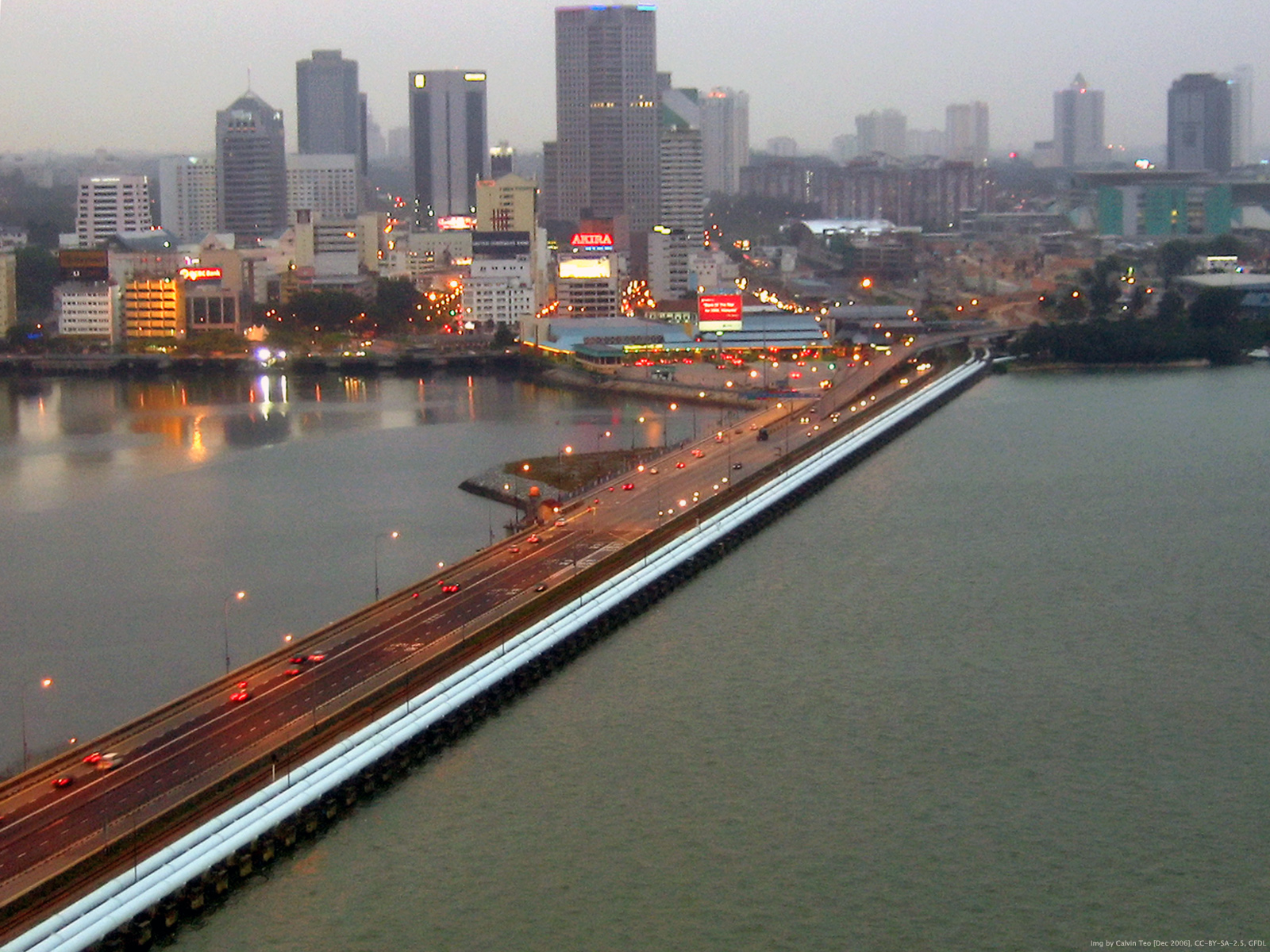
Causeway blues again, Part 3

Note: Image from Intelligent Transport Systems Center, LTA (28 Mar 2008, 9:50am)

Recent reports, including The Straits Times article below, about the massive traffic jam at the causeway tell only half the story. The gridlock at the causeway, as a result of the search for a missing terrorist in Singapore, has merely highlighted current problems faced at the bridge linking Singapore and Malaysia.

Even without the stepped-up security in the search for Mas Selamat Kastari, many people have had to suffer from the daily crawl at the causeway. Sophie's World has long highlighted the less-than-deal situation at the causeway. See early postings such as Missing MRT link, Causeway blues again, Part 2, and Malaysian bullet train going to Singapore?

Will Singapore and Malaysia work together to resolve the traffic woes at the causeway once they manage to nab the terrorist? Or will they think that things will go back to 'normal'?

March 22, 2008
Tighter immigration checks hit JB businesses
Takings dip by up to 75% as S'poreans avoid massive Causeway jams
By Arlina Arshad

ON A typical weekend, many Singapore cars can be seen at the Mobil petrol station close to the Johor Baru immigration checkpoint or heading for the town's malls.

Yesterday, the petrol station was serving more J-plate vehicles than S-plate ones. The town's restaurant owners, retailers and cabbies have also noticed slacker business over the past few weekends.

Three words explain this: Mas Selamat Kastari.

Petrol station cashier Rozana Mohd Din, 33, is certain that the heightened security following the escape of the 48-year-old Jemaah Islamiah terrorist is responsible for this.

The more thorough checks on travellers and vehicles passing through the Woodlands Checkpoint are keeping Singaporeans away.

Ms Rozana noted that the petrol station usually serves 100 Singapore cars on weekdays and 150 on weekends. She is seeing only half of that number now. 'It's so unfair that businesses here have to suffer because of one man,' she said.

Other JB businesses complained that takings had fallen by 20 to 75per cent. All expect this month to go down as one of the worst sales months in recent times.

When The Straits Times visited JB town centre yesterday, business at the food stalls appeared brisk. But stallholders said the customers were not quite as free spending as Singaporeans.

Hawker Ahmed Abdullah, 45, who sells Indian food, said: 'Singapore customers may come only once a week, but they spend a lot. They come with friends and order whatever they fancy on the menu.

'They can spend RM30 (S$13) in one sitting. Malaysian customers take a long time to decide - and when they do, they spend RM3.'

At City Square, cash registers were not ringing despite the ongoing sale. Boutique assistant Lim Kim Moi, 35, whose boss had chided her for the poor sales, said: 'Now, I am forced to be pushy and get the Malaysian customers to buy.'

Taxi drivers, too, were cooling their heels in a long line of cabs outside the JB checkpoint yesterday.

Cabby Masdan Rudin, 35, said: 'On weekends, I usually take 15 Singaporeans to Senai airport and bus terminals. Now, it's down to 10.'

The worst thing for these businesses is not knowing when the jams will ease and the crowds return.

DVD seller W.Y. Tan, who has suffered a 75 per cent drop in takings, said: 'If it's going to be like this for the next two months, I might have to start selling char kway teow.'

Monday, March 17, 2008

A new beginning for Malaysia

The dust has yet to fully settle in Malaysia following the shocking election results on March 8.

Many pundits, analysts and investors are still digesting the news and grappling with the most surreal political landscape since the country’s independence in 1957. They are still coming to terms with the reality that the national ruling coalition Barisan Nasional, which has ruled the roost since 1974, scraped through with its smallest parliamentary majority ever.

And there were many collateral damages that were unprecedented since the watershed year of 1969, which saw bloody racial riots. BN or the National Front lost five state legislatures to the Opposition – the coalition of the Democratic Action Party, Parti Keadilan Rakyat and Parti Islam SeMalaysia. BN also failed to retain the crucial two-thirds mandate needed to amend the constitution.

Political heavyweights – such as Malaysian Indian Congress president S Samy Vellu, Penang chief minister Koh Tsu Koon and Information Minister Zainuddin Maidin – had to make way to political newbies. And the elections saw the political debut of Jeff Ooi, the first blogger to make it to Parliament in Malaysia and possibly Asia. Former deputy PM Anwar Ibrahim has emerged as the kingpin in the opposition camp.

Political pundits correctly described the outcome as ‘revolutionary’, a ‘sea-change’ in Malaysian politics and a ‘political tsunami’. The Malaysian stock market was quick to react too. The stock market barometer tumbled over 10 per cent and triggered a trading halt when trading resumed.

It’s obviously not business as usual in Malaysia.

But is the new political landscape bad for Malaysia? Should foreign investors give Malaysia a wide berth now?

The answer is no, but investors should wait for the dust to settle first.

Many investors are naturally concerned that the new political landscape will result in policy paralysis due to expected political squabbles at both the federal and state levels. This is inevitable as both the establishment and the resurgent Opposition will clash on many key issues and policies.

In particular, as pointed out by academic Yang Razali Kassim in The Straits Times today, Malaysian politics will be in a state of flux. This is based on the writer's valid concern that the Opposition's attempt at undoing the New Economic Policy will be a tricky task. The NEP is the country's affirmative action programme to help the predominant Malay community following the racial riots of 13 May 1969.

"How the NEP is handled - or mishandled - can unravel the peace that we now see," the writer said.

The political drama is still unfolding. According to The Malaysian Insider tonight, de-facto Opposition leader Anwar Ibrahim told Singapore’s Berita Harian that the Opposition will formalise their alliance in a few days and will then replace the NEP with a landmark Malaysian Economic Agenda, a new initiative aimed at lifting the fortunes of all Malaysians.

There is also growing talk that Anwar may eventually become the new PM, should he succeed in securing the cross-over of over 30 BN lawmakers to the Opposition camp. He must also secure a seat in Parliament via a by-election.

While the political landscape is still evolving in Malaysia, the Opposition clearly has the upper hand in five states. They are Selangor (the richest state in the country) Penang (the Silicon Valley of Malaysia), Perak (resource rich state), Kedah (the rice bowl of the country) and Kelantan (the de facto Islamic state in Malaysia).

Decisions made at the state legislatures will have serious ramifications for both local and foreign corporations in the longer term. This is because the state governments have the final say on major issues such as land matters, apart from religious issues and water resources.

This means that the state governments can decide the fate of many development projects, licenses and even manufacturing outfits in their backyard. But the Opposition must tread gingerly as well. They have to downplay the rhetoric to remove the entire NEP as it is a politically and emotionally charged issue in Malaysia.

Instead, it will be politically wiser for them to call for the removal of certain components of NEP. For instance, the DAP has said that it will resort to an open tender system for all government procurements and contracts following its takeover of the state government in Penang.

If implemented correctly, an open tender system will gradually inject greater meritocracy in the Malaysian business sector. Many Malaysian companies have long thrived on the political patronage system: Many contracts were negotiated in the opaque and so-called closed tender exercise or even awarded to politically well-connected companies that didn’t have the necessary track record.

The election outcome has therefore given Malaysia the rare opportunity to chip away the deep-rooted patronage system. This could be the first step to wipe out widespread corruption, cronyism and nepotism in Malaysia.

Even the embattled PM Abdullah Ahmad Badawi could not push through the open tender system on a wide scale since he came into power in 2003. The patronage system was too entrenched. Hence, any attempt to resort to more a competitive and market-driven government tender system will be good for the business climate of the country in the long run.

But investors should also note that state governments are highly dependent on funding from the Federal Government, which is led by BN, as they cannot collect taxes.

Will the Federal Government turn off funding to Opposition-controlled states as part of the new power play? The scenario is not unfathomable, as seen in BN’s attempt to deprive the state of Terangganu from the oil revenue of national oil giant Petronas Nasional following the loss of the state to the theocratic PAS in 1999.

But it will be foolhardy to do so in the current climate. Such an attempt will further alienate voters in the next general election. All parties in the political divide will need to work hard and show that they are friendly to businesses and the population. And both sides must not play the race card so frequently.

Malaysia will emerge stronger, but only when the current political sandstorm blows over.

Friday, March 14, 2008

Selamat caught at Causeway? Part 2

The satire continues. According to a frequent visitor to Sophie's World, a joke is circulating as to why escaped Singapore terrorist Mas Selamat Kastari is likely to be in Malaysia and Indonesia.

The two neighbours of Singapore have clear signs that say "Selamat Datang" to welcome visitors. Selamat Datang is the common Malay phrase for "Welcome" or "Selamat is Coming" in this context.

Of course, there is a clear sign at the causeway that says "Selamat Datang" to all visitors -- legal and illegal -- from Singapore. :-)

Tuesday, March 11, 2008

Wanted: New Malaysian PM

Malaysian cartoonist Lat is so funny, always capturing the mood well with his endearing and offbeat touch. These are just some of the old cartoons painted by Lat. They show the former Malaysian boss -- Mahathir Mohamad -- in past elections. Love him or hate him, he was the best Prime Minister Malaysia ever had.

Malaysia obviously needs a new leader following the disastrous showing of the leadership of Abdullah Ahmad Badawi. He lost the two-thirds majority and four more states -- Selangor, Penang, Perak and Kedah -- to the Opposition. Barisan Nasional has not had such a political rebuke in the entire history of modern Malaysia.

Unfortunately, Dr Mahathir may not have the energy to make a political comeback.

Sunday, March 09, 2008

Revolution in Malaysia

Sophie's World is still surprised but glad with the totally unprecedented electoral outcome in Malaysia. Sophie's World is digesting the latest news and views, and and will provide a more detailed analysis soon.

But the signs are very clear. It's a revolution.

9 March 2008
Malaysia's BN suffers worst upset in national polls
KUALA LUMPUR - MALAYSIA'S ruling party faced its biggest electoral debacle on Sunday, as the opposition won five of 13 states, putting a dark cloud on the prime minister's political future.


Prime Minister Abdullah Ahmad Badawi's multi-racial National Front coalition managed to win just a simple majority in parliament and will form the government at the federal level.

But it lost a crucial two-thirds parliamentary majority it has held for most of its 50-year-long rule, the election body said. That level is needed to change the constitution.

Mr Abdullah dismissed suggestions by a reporter that he would now face pressure from party members to step down.

'I don't know who would pressure me. There is nothing at this time,' he said. 'We suffered a lot of losses tonight,' Mr Abdullah's son-in-law Khairy Jamaluddin told reporters. 'But we are going to fight on. We are not going to quit. It is not the end of the world and we are going to get through this.'

The leftist Chinese-backed Democratic Action Party (DAP) won Penang state, which houses many multinational firms.

The opposition Islamist party PAS scored shock victories in the northern heartland states of Kedah and Perak and easily retained power in its stronghold in northeastern Kelantan state.

DAP and PAS also joined the People's Justice Party, or Parti Keadilan, to take control of the industrial state of Selangor and almost all the seats in capital Kuala Lumpur.

'Tomorrow we will start building a brighter future,' opposition icon Anwar Ibrahim, whose wife heads Parti Keadilan, told reporters. 'This is a new dawn for Malaysia.'

The shock defeat in Penang stirred memories of the last time the ruling coalition failed to win a two-thirds majority, in 1969, when deadly race riots erupted between majority ethnic Malays and minority Chinese.

'This is the biggest defeat ever since our party's founding 40 years ago,' Penang Chief Minister Koh Tsu Koon said.

'I feel sad and surprised. I urge all National Front members to stay calm and not to take any action that could jeopardise peace and security in the state.'

Police vowed to use tough internal security laws against anyone spreading rumours and banned victory processions, one of which had triggered the 1969 violence.

Results from the elections commission as of 2145 GMT (5.45am Singapore time) showed the National Front with 137 seats in the 222-seat parliament versus 82 for the opposition, with 3 seats still being tallied.

Referendum on Abdullah
'This looks like a revolution,' PAS Vice-President Husam Musa said. 'The people have risen and are united. The message to government is, 'Enough is enough.'' The poll, called before it was due in May 2009, was widely seen as a referendum on Mr Abdullah's rule, and Malaysians took the opportunity to administer a stinging rebuke over price rises, religious disputes and concerns over corruption .

'I think the PM will potentially have to resign,' said Bridget Welsh, a Malaysia specialist at Johns Hopkins University in the United States. 'This is unprecedented. The only other time this happened was in 1969 and that's why everybody is very nervous now because of the uncertainty.'

Works Minister Samy Vellu, chief of the Malaysian Indian Congress, one of the National Front parties, lost the seat he had held for nearly 30 years, because many Indians thought he was out of touch with their concerns.

Two other cabinet ministers, both ethnic Malays, also lost.

Detained ethnic Indian activist and lawyer M. Manoharan delivered another slap in the face of the government, winning a parliamentary seat despite being held under internal security laws for organising a major anti-government protest last year.

Chinese and Indians account for a third of the population of 26 million and many complain the government discriminates in favour of Malays when it comes to education, jobs, business and religious policy.

About 70 per cent of Malaysia's 10.9 million eligible voters had cast ballots, the country's top poll official said.

Opposition rallies drew big crowds, especially Chinese and Indian voters unhappy with Mr Abdullah's Malay-dominated coalition.

First-time voter Michael Lim said he voted for an opposition party.

'They have not taken care of the people,' he said in Kuala Lumpur, referring to the ruling coalition. 'A lot of promises were made, but nothing was fulfilled.'

'This is a defining moment, unprecedented in our nation's history,' said opposition leader Anwar Ibrahim. 'The people have voted decisively for a new era where the government must be truly inclusive and recognise that all Malaysians, regardless of race and colour, culture and religion, are a nation of one,' Mr Anwar said.

'This clearly shows Malaysians want an alternative. Going forward Malays, Indians and Chinese all have to work together and make a formidable pact.'

A key issue in the elections was the disillusionment among Malaysia's minority ethnic Chinese and Indian population who have long complained about discrimination, particularly an affirmative action system that gives the majority Muslim Malays preference in jobs, business and education.

The programme was designed 37 years ago to help the Malays catch up with the wealthier Chinese. But minorities complain the programme continues despite rising standards of livings for Malays.

The National Front held 90 per cent of the seats in the outgoing federal parliament. Political experts had predicted Mr Abdullah's continued leadership could be in jeopardy if his majority fell back below 80 per cent, or around 178 seats, in the new 222-seat parliament.

The economy grew 6 per cent last year but inflation and a likely US economic slowdown have fueled worries. -- REUTERS, AP

Saturday, March 01, 2008

Selamat* Asean?

The escape of militant suspect Mas Selamat Kastari (The Straits Times pix) from a top security facility in Singapore has been hogging the headlines in the country for the past few days.

The news has raised plenty of eyebrows in Singapore. Many people wonder how the limping leader of the Al-Qaeda-linked Islamic militant network Jemaah Islamiah's Singapore cell could have walked out of the toilet of a detention centre in security-conscious Singapore.

The mystery is still being solved. In the meantime, it is heartening to read that Singapore, Malaysia and Indonesia are working together to recapture the fugitive who had wanted to blow up the Changi Airport and hijack a Singapore plane.

It is heartening to see the cooperation of the three littoral states of Asean in tracking the fugitive despite many bilateral problems among them.

Sophie's World hopes that the three countries could apply the same urgency to resolve all their outstanding bilateral problems.

* Selamat means save or safety in Malay, obviously a little pun on the name of the fugitive. :-)

Monday, February 25, 2008

Inflationary Asia


Inflation is creeping up across Asia. The headline figure in Singapore has hit a 25-year high with inflation hitting 6.6%.

The figure seems to be higher than expected but the Ministry of Trade and Industry said the January inflation figure was 'consistent' with the government's official inflation forecast.

As pointed out by the AP report, the Singapore government recently raised its inflation forecast for the year to 4.5-5.5%, faster than the 3.5-4.5% announced in November. The Straits Times today said that inflation in Singapore could hit levels not seen since the oil crisis of the late 1970s.

The Singapore government will no doubt think of more ways to contain inflation. An even stronger Singapore dollar is definitely a certain policy option at this stage.

While Singapore's inflation rate seems higher than expected, the Consumer Price Index across the causeway seems too tame in the current environment. According to Bloomberg, Malaysia's inflation is set to hit a 10-month high of 2.9% this year.

Like Singapore, Malaysia has a very open economy. As a result, the two countries do pay the price for imported inflation.

Sophie's World has always had a nagging feeling that the inflation rate in Malaysia is understated. Prices of some items, especially imported goods, in Malaysia seem to be rising more rapidly than those in Singapore.

In many cases, prices of certain items in Malaysia are higher than or equivalent to those in Singapore. This is just Sophie's World unscientific observation. :-)

Even the threat of higher inflation has become an election issue in Malaysia. Check out the Democratic Action Party's campaign song (youtube video above), which includes a pledge to tame inflation in the country. Is there a need to tame it if it is rising at less than 3%?

While inflationary pressure is rising across Asia, the fast-growing region is not expected to see hyperinflation. Asia is still expected to see healthy, albeit slower, growth despite the increasing likelihood of a recession in the United States due to the sub-prime woes.


Earlier postings:
Rising cost of crime, 1 June 2007
Rising cost of living in Malaysia
, 16 Nov 2006
Rising cost of living in Singapore
, 16 Nov 2006

Tuesday, February 19, 2008

Free up Asean skies!

Singapore Airlines (SIA) and Malaysia Airlines (MAS) are not about to slash fares anytime soon for the popular Singapore-KL sector despite the recent entry of budget airlines, according to The Straits Times tonight.

Competition has had minimal impact on yields and traffic, ST cited SIA chief executive officer Chew Choon Seng and MAS head Idris Jala as telling reporters on Monday on the sidelines of the inaugural Singapore Airshow Aviation Leadership Summit.

The report added that it took six years of lobbying for governments on both sides of the Causeway to clear the runway for a total of four budget flights a day between Singapore and KL, which Tiger Airways, Jetstar Asia and Malaysia's AirAsia started operating on Feb 1.

Between them, ST said SIA and MAS operate a total of 13 daily flights, offering more than 21,000 round-trip seats a week - four times the capacity of the budget boys.

Well, Sophie's World has a simple solution: Time to free up the KL-Singapore air sector completely, instead of waiting for the Asean Open Skies pact to take effect by the end of this year.

There is still a massive bottleneck for long-suffering travelers between the two countries.

Wednesday, February 13, 2008

Malaysia's election drama begins!

As widely expected, Malaysia will hold its national election in March following move in dissolving the parliament today.

According to conventional wisdom, the administration of Abdullah Ahmad Badawi, who inherited the premiership from popular Mahathir Mohamad in 2003, is eager to secure another electoral mandate before things get worse next year.

Polls are not due until May 16, 2009. Reuters correctly pointed out that analysts had expected him to seek a fresh mandate before the economy begins to slow and inflation picks up steam.

Another plausible reason is the need to prevent former deputy premier Anwar Ibrahim from taking part in the elections. Due to his past criminal case, charismatic Anwar is not allowed to run for public office until April.

The reasons all sound plausible. It's almost a foregone conclusion that the ruling National Front coalition will form the government again. It's just a matter of the margin of victory.

Reuters puts it elegantly: Opposition parties complain that the electorate is gerrymandered in favor of mainly rural Malays, that the pro-government media gives them short shrift and campaigning rules favor the incumbents.

But there will always be drama in Malaysia's political theatre.

Missing MRT link, Part 3

The JB-Singapore MRT link has not been given the green light yet, contrary to an earlier Chinese newspaper report.

Instead, the governments of Singapore and Malaysia have set up a working group to look at ways to help improve transport links between the two countries. And one option being considered is to extend Singapore’s MRT network into Johor, according to The Straits Times report today that cited Singapore’s Ministry of Transport. The Transport Ministry has not issued a media statement as at blogging time today. :-)

The news is definitely significant as it shows the intention of the two governments to work together to facilitate the massive cross-border flow of people between Malaysia and Singapore.

But can they really come up with a neat solution? The answers are not so clear due to the lack of information. There are many, many questions and issues.

For a start, the ST report said the proposed MRT link could start at Woodlands in Singapore and end at the Iskandar Development Region in Johor. Where exactly is it in IDR?

The IDR covers a huge area, accounting for more than 10% of the land area of the state of Johor, which itself is some 28 times bigger than Singapore. The state capital of JB, which is the closest link to Singapore, itself is in IDR. So is Senai Airport, which is about 30km away from the Malaysia-Singapore border.

It’s more ideal if the MRT link begins in Woodlands as reported and end in the heart of JB itself, instead of somewhere else within the IDR.

And what’s the working group’s plan to improve traffic flow along the causeway – a 1-km land bridge linking Singapore and Malaysia? As mentioned earlier, this is the main bottleneck and the source of much political angst between the two governments.

But building a new bridge for the MRT without resolving the causeway problem won’t be ideal. It is akin to doing a minor heart surgery without treating the main clogged artery.

The clogged artery must go, eventually. In its place, a new overhead bridge must be built to help resolve many problems in one fell swoop as argued in Cleaning up Straits of Johor good for Singapore too last year.

The working group must work out a holistic plan to improve traffic flow between the two countries. They must take into account all ways to improve road, rail and even sea traffic in the dirty Straits of Johor.

The current causeway chokes the straits and does not even allow boats or sampans to sail from the northwestern coast of Singapore to the southeast side of Johor, without making one big detour.

Another missing link is a high-speed train from KL to Singapore. Will Francis Yeoh build another rail bridge to Singapore? Or will he dig a tunnel under the Straits of Johor?

Sophie’s World hopes that the Singapore-Malaysia working group will triumph over their respective internal politics and come up with a holistic transportation blueprint that will benefit people on both sides of the straits.

Hopefully, such a plan will forge closer ties between the two close neighbours and withstand time.

Tuesday, February 12, 2008

Missing MRT link, part 2

Is the Singapore MRT finally going to the southern Malaysian city of Johor Baru?

Forum discussions based on a Chinese newspaper article posted on SingaporeSurf on Feb 9 seem to suggest so.

So far, I have not seen any article on the same issue by mainstream English newspapers on both sides of the causeway. Other parties -- the governments of Malaysia and Singapore, and SMRT -- have not made any announcement to clarify whether it is indeed true that the two governments had given the green light for the significant cross-border project. So it's not quite clear what the real situation is, as my understanding of Chinese is almost zero.

As argued earlier, it is a necessary link in Singapore's MRT blurprint. But there are many complications surrounding such a project, as mentioned in an earlier posting -- JB-Singapore MRT?

Wednesday, February 06, 2008

Same old sight

More than a quarter of the population in Singapore must have headed to Malaysia during the Chinese New Year.

This is based on the figure of about 1.35 million travellers that passed through the Tuas and Woodlands checkpoints on five days of the festivities last year, according to Singapore's Immigration and Checkpoints Authority in a ST report this evening.

And as in previous years, many were caught in a massive crawl at the Singapore-Malaysia border. This is seen in the ST picture showing the gridlock at the causeway, which links Singapore and Johor Baru in Malaysia. The report said vehicles were backed up several kilometres. Horns blared and tempers flared as motorists saw their chances of making it on time for their reunion dinner.

Their need to return for their reunion dinner reflects the close family ties on both sides of the causeway.

A friend had to drive 300km from KL to JB to pick up her husband, who works in Singapore. They then braved another 300km back to KL. This is because he couldn't get ticket for any mode of Singapore-KL transportation -- bus, the slow KTM train or new budget airlines.

*Sigh*

Sorry state of Malaysian affairs

The Malaysian government has apologised to the Hindus over the premature demolition of a temple, which had contributed to the massive outcry, street demonstrations and government crackdown last year.

"The demolition should not have been carried out a week before Deepavali. The relevant authorities could have postponed it one or two months. This was wrong on their part. We are sorry for that," Malaysian Deputy Prime Minister Najib Razak was cited as saying by The Straits Times earlier this week.

He also pledged to ensure the orderly relocation of temples built on private property.

Apart from anger over the destruction of Hindu temples in Malaysia, the Hindu Rights Action Force or Hindraf had organised street protest to make a ridiculous claim of US$4 trillion for the suffering of Indians, whose ancestors were taken to Malaysia by the British as indentured labourers 150 years ago.

Hindraf had also filed a ridicuous petition, claiming 'ethnic cleansing' in Malaysia.

Has Hindraf apologised to the government and Malaysians over the ridiculous monetary claim and petition charging 'ethnic cleansing' following the Malaysian leader's apology this week?

Please ignore this posting if Hindraf has said sorry.

Tuesday, February 05, 2008

Singapore's glittering Autobahn, Part 2

Note: Wikiepedia pix shows the current causeway linking southern Singapore and Sentosa island. The other causeway, which connects northern Singapore and Malaysia, has been retarding the flow of water in the dirty Straits of Johor for more than eight decades.

It's great to read about the latest plan to improve traffic access to the tourist island of Sentosa from Singapore's mainland.

According to The Straits Times, the roads leading to Sentosa, VivoCity and HarbourFront will be widened to cater to an anticipated increase in traffic into the area. With one of Singapore's two integrated resorts opening on Sentosa and new condominiums to be built in the area by 2010, traffic is likely to go up by 30 per cent, said the Land Transport Authority yesterday.

The ST article didn't mention it, but earlier news reports had said that Genting International's Resorts World at Sentosa -- the developer of the integrated resort and casino on Sentosa -- had started work on the second bridge to link Sentosa and the mainland.

The second bridge is aimed at easing visitor traffic as over 15 million of them are expected to visit the Resort when it opens in early 2010 or 2011. The report said the 710-metre, 3-lane bridge will run parallel to the existing causeway which connects Sentosa to the mainland. And when completed in September 2009, both will be merged.

The latest roadwork and the new Sentosa bridge will be a great addition to the new transport blueprint unveiled by the government in the past two weeks. Apart from plans to improve the public transportation system, the government will build the North-South Expressway by 2020. Singapore's Autobahn will cost S$8 billion, or at a stggering S$381 million per km.

Many locals and foreigners will enjoy seamless travel from Sentosa to the rest of Singapore, thanks to the government's transportation blueprint.

But they will almost certainly hit a major road bump should they wish to cross over to the southern Malaysian city of Johor Baru. The two countries have not been able to work together to jointly build a bridge to replace the old and congested causeway. A new and wider overhead bridge, which will have many benefits, shouldn't cost more than S$1 billion each.

This is a rough estimate based on the two countries' construction bill of over RM2.4 billion (slightly more than S$1 billion based on today's exchange rate) to jointly build the longer Second Link bridge when bilateral ties were a lot warmer in the mid-1990s.

Malaysia's bill came up to more than RM1.2 billion. Singapore's portion was last reported to be about S$600 million.

A new bridge to ease the massive cross-border flow between Malaysia and Singapore makes good sense. ST had earlier estimated about 250,000 people enter Malaysia via the causeway every day. This works out to more than 90 million people each year, which is a staggering number as it is nearly 20 times the population of Singapore. The traffic volume at the causeway is 6 times higher than the projected number of visitors to Sentosa.

It will be ideal if one could travel from Sentosa all the way to Malaysia seamlessly one day via two wide bridges and the glittering S$8-billion Autobahn.

Sunday, February 03, 2008

S'pore-KL budget flights take off but...

The long-protected Singapore-KL air route has finally been opened up, slightly.

Singapore and Malaysia newspapers highlighted the historic entry of budget airlines in the air sector between Singapore and Kuala Lumpur on Feb 1. Three new players -- Malaysia's AirAsia, and Tiger Airways and Jetstar Asia of Singapore -- will operate a total of four flights a day. Most of the flights will still be dominated by the expensive Singapore Airlines and Malaysia Airlines.

Sophie's World has long argued for the liberalisation of the route, which was dominated by the national carriers of Malaysia and Singapore for the past three decades. It just didn't make sense to shield the two national carriers from the new kids on the block since budget airlines came into play in 2003.

Passengers and commentators will continue to analyse the situation and applaud the move as another step towards open skies in Asean. Sophie's World fully endorses Asean's Open Sky pact by the end of this year to hasten economic and social integration of the region with over 500 million people -- more than one-third the population of China, which is the world's most populous country.

But an open sky pact alone will not nudge the region's disparate economies towards greater integration as long as many countries remain highly nationalistic.

In the case of closely-knit Malaysia and Singapore, the long-term solution is not more flights alone as many people still won't be able to travel freely. Why? This is because air travel is still relatively expensive due to the litany of taxes imposed, and the subsequent connection cost to the city.

For example, The Straits Times highlighted the family of 21 who collectively spent S$3,200 on the maiden budget flight from Singapore to KL. It's a lot cheaper than the S$8,800 they would have forked out on either Singapore Airlines or Malaysia Airlines for the same round-trip flight. At S$3,200, it works out to S$152 per person for a round-trip fare, including all the taxes.

The family could have chartered an entire van or bus for far less and used it to ferry them around in KL for one week. But bus was not an option for them as they said they had some toddlers who couldn't stomach the bus journey to KL. That's not the point here.

The point is at S$152 per person (some budget tickets were given away for free as part of the maiden flight promotions), it is still a high price to travel 320km from Singapore to KL. Budget airfare, inclusive of taxes and surcharges, is still at least 50 percent higher than what many luxury coaches charge between the two cities. In fact, ST said many people paid under S$200 each for a budget airline seat. This is more than double the return bus fare of S$92 charged by luxury coach Aeroline.

The long-term solution to facilitate the extremely high traffic volume between the two capitals is a high-speed bullet train service. It's an idea that was mooted by several Malaysian businessmen in the 1990s and revived recently by Francis Yeoh.

Even former Malaysian Prime Minister Dr Mahathir Mohamad had pushed for the idea as a way to further integrate the two countries. As part of the fast train service between KL and Singapore, Dr Mahathir had proposed a rail tunnel under the narrow Straits of Johor, which separates Malaysia and Singapore.

The rail tunnel project was part of the transportation blueprint in the southern Malaysian city of Johor Baru that involved building a new overhead bridge to replace the old causeway, which connects the two countries.

Although Singapore had officially welcomed the rail tunnel idea, negotiation to build a new overhead bridge was almost stillborn from the beginning. Malaysia finally called off the bridge project two years ago as Singapore had made certain demands -- the right to use Malaysia's airspace and buy sand for its land reclamation -- that Malaysia could not fulfill.

Francis Yeoh appears to be still keen to push ahead with the bullet train project although the rail tunnel and bridge components have been derailed. He could build a new fast rail link to Singapore should Malaysia secure Singapore's blessing, or end the rail track in the city of JB.

The answers are still hazy.

What is clearer is that a fast train service could zip from Singapore to the heart of KL in just 90 minutes -- half the time needed to drive on Malaysia's North-South Expressway. The point-to-point travel will be even faster than air travel due to time needed for airport immigration clearance, baggage clearance and the 57-km road or rail connection between the Kuala Lumpur International Airport and the capital.

Of course, demand will hinge on the eventual price of a train ticket. Sophie's World is hopeful that the price ticket for a fast train service, should it materialise, will be competitive compared to full-fledged airlines or even budget airlines.

But planners in Singapore and Malaysia must not ignore the ultimate bottleneck for road and rail travelers between the two countries -- the jointly-owned causeway.

Wednesday, January 30, 2008

Singapore's glittering Autobahn

Wikipedia pix of the German Autobahn or freeway for illustration purpose only

Highways in land-scarce Singapore are incredibly expensive. According to Singapore's Transport Ministry today, the new 21-km North-South Expressway will cost S$8 billion when completed by 2020.

This works out to an eye-popping S$381 million per km or S$381,000 per metre!!! And it seems to be more than double the price of the 12-km Kallang-Paya Lebar Expressway and tunnel that was built at a cost of S$150 million per km, or a total of S$1.8 billion, last year.

Of course, the cost of Singapore's latest Autobahn could include massive compensation for land acquisition for the new highway, tunnels and difficult engineering feat.

Whatever the real scope of the new highway is, the NSE must be one of the most expensive stretches of road in the region.

For example, Malaysia's North-South Expressway -- the 772 km highway stretching from southern Thailand to the border of Singapore -- cost over RM6 billion when completed in the early 1990s.

The price tag for the Malaysian 'mega' project, which caused a political furore then due to a massive cost overrun and charges of corruption, worked out to about RM7.8 million per km. This is equivalent to about S$5 million per km based on the exchange rate then.

This means the NSE in Singapore costs more than 75 times the NSE in Malaysia on a per km basis. Of course, the cost of building materials and labour has gone up substantially since the 1990s. And the landscapes are completely different although the two countries are close neighbours.

But the question remains: Is Singapore's latest Autobahn paved with gold?

Monday, January 28, 2008

Missing MRT link

Source: The Straits Times

Singapore will one day have the most extensive rail and subway network for any country in the world. The forward-thinking Singapore government has announced plans to spend S$40 billion to double the MRT network by 2020.

According to The Straits Times on Jan 25, Singapore will have 278km of rail link, from 138km today. Its network density will rise from 31km per million residents today to 51km per million - surpassing that of major cities like Hong Kong and Tokyo, and comparable to current densities in cities like New York and London.

Will the Singapore MRT blueprint be completed by then? Unlikely. There's always room for Singapore to create an even more extensive network as the population grows.

A missing link could be a MRT rail track from Singapore to the southern Malaysian city of Johor Baru. It's not a radical idea. In fact, businessmen on both sides of the causeway are toying with the idea.

Such a link will definitely be useful to help ease the massive traffic at the causeway, the land-based bridge that links Singapore and Malaysia.

ST had estimated about 250,000 people enter Malaysia via the causeway every day. This works out to more than 90 million people each year. This is a staggering number as it is nearly 20 times the population of Singapore. The number of people using the causeway is almost one-fifth the 414 million riders who used Singapore's MRT in 2007.

Of course, there is no certainty that Malaysia and Singapore will agree to the proposed JB-Singapore MRT link. There are simply too many complications at the government-to-government level although it is a desirable project. The two governments can't even agree to build a new overhead bridge to replace the aging causeway and resolve a host of other bilateral problems.

And can they agree to a common ticketing system even if they manage to build a MRT link between Singapore and JB? Don't bet on it!