Wednesday, January 31, 2007

Dr M Soldiers On

Former Malaysian Prime Minister Dr Mahathir Mohamad (pix illustration from kickdefella) is still in his combative mood and has not lost his wit despite his recent heart attack.

According to The Nation newspaper in Thailand this week, he threw his support behind Thailand's diplomatic spat with Singapore, accusing the city-state of interfering in the Thailand's internal affairs and violating diplomatic norms by permitting a senior government official to meet ousted premier Thaksin Shinawatra.

Some observers may feel that the retired Malaysian leader should just shut up like a pensioner. And he should not add fuel to fire in the squabble between neighbours. There is some truth in it.

But there is also the view that Dr Mahathir is a strong Asian voice, often saying things bluntly without fear or favour. After all, who else would say that US President George Bush should be tried for the invasion of Iraq? Please see Dr Mahathir's current mission and earlier postings.

Of course, Dr Mahathir is well positioned to talk about his relationship with Singapore, as mentioned in an earlier posting.

The following is the full transcript of his interview with The Nation's Group Editor Thepchai Yong in Langkawi over the weekend.

Q : How do you see the on-going spat between Thailand and Singapore?
A : Well I hate to say but I think it was unwise for Singapore to seek advantages from Thailand's problems. Because they saw that Thaksin was in need of some help and they extended help not in the way that could be appreciated by the Thai people. And in the present situation, Thaksin's visit to Singapore obviously to discuss this thing, was not very diplomatic.

Q : So Thaksin shouldn't have been welcomed by Singapore's deputy prime minister.
A : Yeah, that was not necessary. There are other places you can meet to discuss business. Because I'm quite sure in order to talk business, that's why they met.

Q : Talking business could be one thing, but knowing that such reception would draw reaction from Thailand. The Thai Foreign Ministry made it clear that they had warned the Singaporean government that there would be reaction if Thaksin met its deputy prime minister. And yet the Singaporeans went ahead with it?
A : Well you see, Singapore does not really care about the opinions of its neighbours, Singapore has been very unfeeling, not sympathetic to the problems of their neighbours. And we have problems with Singapore. In my 22 years in office I tried to resolve them by being friendly but I couldn't solve these problems with Singapore.

Q : Why would Singapore not want to be friendly with Malaysia ?
A : Singapore wants to win and they believe that the most important thing is what profits Singapore. What others get is not relevant.

Q :Profits in what term, business term or diplomatic term?
A : In business term, in diplomatic term, in whatever way, Singapore must be top.

Q : The Thai Foreign Ministry reacted by suspending a visit by the Singaporean foreign minister. Do you think that was the right reaction?
A : Well you know me, I'm very tough in certain things. If I find a foreign minister in another country say nasty thing about my country that is not in the interest of my country, I would have acted very strongly.

Q : Would you have done the same?
A : Probably I would do the same.

Q : Do you think Thailand and Singapore should try to patch things up?
A : Yeah, I think they should, but in a way that is honorable.

Q : Who should take the initiative? The Thais believe that Singapore owes them an apology.
A : I think Singapore should apologize because basically Singapore was interfering in the internal affairs of Thailand, and that was not good. You see, Thaksin has problems with Thailand and its people, not with Singapore. But Singapore comes in, in order to help Thaksin. And I think it didn't work.

Q : In Thailand they say if you want to know how to deal with Singapore, talk to the Malaysians. What can we learn from your experience in dealing with Singapore?
A : Either being nice or being tough, they always think about themselves. And they think you won't be able to touch them. They are beyond any action that you may be able to take. That's the character of Singapore, not one cent for anybody else, unless they gain something.

Q : So you're suggesting that Thailand should continue to be tough with Singapore.
A : You should try to get what is your right from Singapore, but it's going to be difficult. Singapore is likely to ask you for some concessions, here there and everywhere Otherwise you won't get back what is yours by right, but that is the way Singapore deals with people.

Q : Did it surprise you that Thai army chief Gen Sonthi and the coup leader few weeks ago said every phone call in Thailand has been monitored by Singapore?
A : I wouldn't be surprised because that's the kind of things they do.

Q : You mean they eavesdrop on friends?
A : Yes they do, they even spy on friends.

Q :That happens to Malaysia too?
A : Yes, one of my political secretaries was removed and detained because he was known to be associated with somebody from Singapore. Of course, Singapore denied, but our police believe that he was passing information.

Q : But why wire-tapping friends? Neighbours shouldn't do this to each other.
A : Well, but we find friends do tap and listen to what friends talk about, but I think Singapore does it in a much more offensive kind of way.

Q : So Thailand and Singapore should sit down and find ways to get their relations back to normal. But can they be normal again?
A : It will be difficult but I think I believe in trying.

Q : Should Thais make the initiative or should Singapore do it first? Thais have been very angry and feel very strongly about this.
A : I think we need a cooling down period.

Letter from Singapore

By Uncle Cheng


Singapore may not seem the most obvious place for Hong Kong people to choose for a holiday but that is where I found myself for family reasons last Christmas and new year. It was a revealing experience and I kept on making comparisons in my mind between Singapore and Hong Kong.

The first thing I learnt, and which becomes obvious in discussions with Singaporeans, is that Singapore is on the verge of an economic boom. After years of slow growth there is great optimism that new government policies are lifting both the economy and peoples’ spirits.

Property prices are rising markedly, foreign bankers are flooding in, huge public infrastructure projects are underway, and investment capital is streaming into local bank accounts from such local nations as Indonesia and even from distant Europe. Suddenly all the ingredients for economic growth are looking good.

One of my sources is a nephew of mine who is in a favourable position to know such things as his work keeps him in close touch with business and economic prospects in Singapore and the nearby region. I was especially interested to hear him explain how the government’s decision to reverse decades of anti-gambling policy and licence two super-casinos has transformed the economic horizon. It reminded me of how Macau’s economic fortunes were totally transformed by the decision to end the old casino monopoly and open the gambling market to virtually open competition.

One argument always used by people who oppose casinos is that they attract crime, triad activity and get poor people into financial difficulty. But as everyone knows the Singapore government has always prided itself on its low crime rate and its very tough treatment of all criminal behaviour. How, I wondered, will the government be able to square its anti-crime reputation with the new casinos. Well, as usual, Singapore has thought the issue through and announced a range of measures which it says will keep the casinos free of crime.

Yet despite its great wealth, efficient government and highly disciplined society Singapore’s miniscule size remains its greatest disadvantage. You cannot flex impressive muscles when you are a dwarf. The city state’s prosperity has to depend on the friendliness of its neighbours.

No neighbour is more crucial than Malaysia for it is from there that Singapore imports fresh water and daily foodstuffs, especially vegetables. It reminds me of Hong Kong’s dependence on the Mainland for the same things. Incidentally, the worst floods in the state of Johor for many years threaten large increases in Singapore vegetable prices through the lunar new year.

An irritating problem between Singapore and Malaysia has been the disagreement about a bridge to replace the existing solid earth Causeway. When no agreement could be reached about the proposed bridge which Malaysia favoured, the Malaysian government decided to spend millions on building new extravagant immigration facilities at its border. As Malaysia had made the case for an overhead bridge, which would have opened up the waterway to small shipping, Singapore hesitated and raised other issues such as the sale of sand and the use of Malaysian air space. Indeed the bridge became such a prickly issue that at one stage Malaysia came up with the bizarre suggestion that the bridge should be built without Singapore's approval. Presumably that would result in the bridge stopping in mid-air at the Singapore border!

Next week I will continue my look at Singapore and in particular I will make some comparisons between Hong Kong and Singapore — comparisons that, I regret to say, are not favourable to Hong Kong.

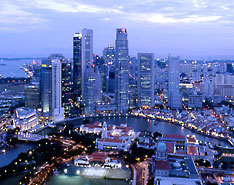
Sophie's note: Please see Singapore's marketing pitch for Marina Bay, the centrepiece of the Lion City.

Tuesday, January 30, 2007

Tranquility

Uncle Fatso sent a whole batch of postcard-like pictures again but I have decided to pick the best of the lot instead of posting everything due to time and space constraints. The latest pair of pictures somehow evoke a sense of tranquility. Hope everyone will find tranquility in a world that is full of chaos and injustice.

Sunday, January 28, 2007

Malaysia Cup-like Fever

It's heartwarming to see the zest in yet another football encounter between Singapore and Malaysia in the Asean Football Championship fight last night.

Singapore edged Malaysia in a 5-4 penalty shoot-out (1-1 after 90 minutes, 2-2 on aggregate). Singapore will meet either Thailand or Vietnam in the finals. The first leg is at the National Stadium on Wednesday, with the return leg in Bangkok on Sunday.

According to The Sunday Times, some 55,000 fans went to the Kallang Stadium, decked in Singapore red and braving the evening showers as shown in the top left hand pix (top right hand pix from The Star shows the Malaysian crowds in predominantly yellow). ST captured the mood well by saying:

There was an outpouring of emotion on the grey National Stadium terraces, home of the Kallang Roar and so often the arena of Singapore-Malaysia rivalry.
Malaysian news reports are naturally more subdued in acknowledging the Singapore victory. The New Straits Times said Singapore would have to "fight till the very end in their own backyard", while The Star said Malaysia "let slip another win".

It doesn't really matter who won last night as long as it was good fun and entertainment for football fans on both sides of the causeway.

What's more important is the clear sign that football fans in Singapore and Malaysia starved of Malaysia Cup football ever since the great tradition was halted in 1995. The Singapore-Malaysia encounter last night was reminiscent of a classic meet between Singapore and Selangor, in terms of the size of the crowds and the national pride as shown by the partisan colours and flags.

But politicians and technocrats on both sides of the causeway will not revive Malaysia Cup due to narrow self-interest in protecting their feeble local leagues. The officials are still saying no despite very clear indication of the strong yearning for the return of Malaysia Cup.

It will definitely be good to revive Malaysia Cup for football fans and even politicians. Politicians on both sides are less likely to squabble or quibble over petty details if they are more sporting!

Thursday, January 25, 2007

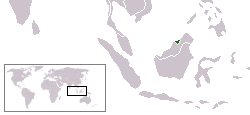
Hiccup in Singapore-Brunei Ties?

Could Singapore be having problems with Brunei -- one of its best friends -- in the midst of its stand-offs with three other bigger neighbours?

In an odd development on Wednesday, Singapore's state-controlled port operator PSA International said it was returning the operations of the Muara Container Terminal in Brunei to the local government prematurely. PSA had only managed the greenfield port in Brunei for six years although the contract was supposed to run for 25 years until 2025. The ostensible reason by PSA was the achievement of its goals and Brunei's on-going review of Muara's longer-term capacity needs.

But it sounds more like a clash of the vision for the port industry in Brunei although PSA had worded the statement nicely. The possible clash could be partly explained by a report that said Brunei's Economic Development Board had identified a nearby island called Pulau Muara Besar in 2002 for another new terminal.

Whatever the real reason for the parting of ways, the development has great political significance as the two countries have very strong and deep-rooted ties.

Brunei is the only country in the world that has its currency pegged to the Singapore dollar. Their currencies are interchangeable. Even the Malaysian currency is no longer interchangeable with the mighty Singapore dollar since the two countries separated in 1965.

In fact, Singapore and Brunei had agreed to join the formation of Malaysia in the 1960s. But Brunei dropped the idea following an internal revolt, while Lee Kuan Yew's Singapore was booted out of the federation by the Malaysian administration of Tunku Abdul Rahman after a brief merger of two years.

Since then, the two small former British colonies have forged very close political and economic ties. They enjoy deep-rooted military and bilateral ties although they are often downplayed. The Sultan of Brunei is known to have many assets in Singapore but the fact is never played up in Singapore.

With the deep ties, one would have expected political considerations to override any differences in the state port deal. In other words, one would have imagined that PSA would continue performing national service regardless of any commercial differences due to the paramount political considerations.

Despite the botched port deal, Singapore and Brunei are expected to continue their warm and friendly ties.

The same cannot be said about Singapore's current soured ties with Thailand, Malaysia and Indonesia.