Showing posts with label shin. Show all posts

Sunday, March 02, 2008

Thai political drama continues

The Thai political drama has resumed with the sudden return of former PM Thaksin Shinawatra and the lifting of the country's badly-implemented capital controls.

The two developments may seem unrelated but they have the combined effect of showing the continued influence of the man who was embroiled in the controversial deal with Singapore government investment arm Temasek Holdings in 2006.

Despite criticisms against Thaksin over a host of issues, the Thai strongman had run the country better than a bunch of generals.

Although the Thai election has concluded, Thaksin could still play a significant role in the national political theater through his proxies. He's got strong and interesting ideas like owning Manchester City Football Club, where he is the chairman. And he has plenty of money, especially from the Temasek deal, to bankroll any fresh campaign.

While the Thai saga continues, some of the basic questions about the Shin deal may re-surface. Why did Temasek buy Shin in the first place? Although Singapore politicians had said ad nauseam that it was simply a commercial deal, nobody was convinced.

As mentioned earlier, there was one sexy theory that could help explain the whole saga. According to the theory, the payment of S$3 billion by Temasek and partners to Thaksin for his holding company was part of a quid pro quo to abandon Thailand's long-cherished dream to build the Kra Canal.

According to one wit, Thaksin had wanted to build the canal and resolve two issues at one go -- turn Thailand into a major shipping hub, and isolate the Islamic separatist movement in southern Thailand. A canal will literally divide Thailand into two distinct regions.

Will Thaksin stick to the purported deal? Or will the Kra Canal idea resurface? Any such deal would have been conditional on Thaksin remaining in power.

But Thaksin the civilian businessman can now theoretically push for the construction of the canal, which will enable ships to bypass Singapore and sail from South China Sea to Andaman Sea and Indian Ocean.

After all, nobody expected a 'commercial' deal to trigger a military coup that toppled the country's leader.

Note: The p
ix from the website of Singapore's BT showing Thaksin paying homage to his country outside the airport in Bangkok on Feb 28.

Monday, November 19, 2007

Temasek not guilty

As expected, Singapore government investment arm Temasek Holdings has been found guilty of unfairly dominating and manipulating Indonesia's telco market.

Temasek issued a terse but strong statement to say it is not guilty of the charges and will appeal the sentence.

Simon Israel, Temasek’s executive director, stated: “We are not guilty. The decision makes no sense. It ignores the facts. The charge against Temasek is groundless – Temasek has no shares in Indosat and Telkomsel, and we play no role in their business decisions and operations.

Telkomsel is controlled by the Indonesian Government which also has a golden share in Indosat. The telecommunications industry in Indonesia is regulated. It is inconceivable that the Indonesian government and the telecommunications regulator would allow the prices to be fixed or cause a loss to the consumer. Temasek will fight this decision.”

Sophie's World agrees that the Indonesian ruling doesn't quite make sense as the Indonesian government has a bigger say than Temasek in the two Indonesian telcos. The ruling will no doubt dent Indonesia's image among foreign investors. Will leave it to Indonesian experts to talk about this.

Temasek is technically correct though to say it doesn't own shares in the two telcos. The shares are held through two Temasek subsidiaries. Temasek owns 56 per cent of Singapore Telecommunications which in turn owns 35 per cent of Telkomsel, Indonesia's largest mobile phone carrier. Temasek owns all of Singapore Technologies Telemedia which, along with Qatar Telecom, owns a 41.9 per cent stake in Indosat, the second-largest telecommunications company in the country.

Although Temasek is probably sound on the technical and legal fronts, the ruling has wider implications on Temasek as a sovereign wealth fund. This is not the first time that Temasek has had missteps in the region.

Last year, Temasek caused an uproar in Thailand when it acquired Shin Corporation from the family of former PM Thaksin Shinawatra. The Thai court ruled against a unit of Temasek-controlled Shin following the takeover by Temasek.

Thailand is still involved in the protracted review of its foreign ownership rules to ascertain whether Temasek did indeed breach the rule in the deal, which subsequently triggered a military coup that ousted Thaksin.

It seems that some quarters are determined to whack Temasek at all cost as it is seen as the vehicle of the Singapore government.

There is definitely no shortage of volcanic problems within the Asean family.

Saturday, November 17, 2007

Asean a happy family?

The ten Asean members will sign a charter in Singapore to mark yet another commitment to build a stronger community with over 500 million people.

According to news reports, the charter marks the first time that the 40-year-old bloc, which has often been described as a family by its member nations, will codify its basic principles and organisational rules.

The Straits Times said the 31-page Charter includes provisions for leaders to meet twice a year, new rules for settling disputes peacefully, more flexible decision-making processes, and steps to beef up the organisational structure of the grouping so that it is able to monitor and implement what members have agreed to do together.

Sophie's World has not seen the implementation details but is curious about the provision to resolve disputes. Will it be a motherhood statement about the need to resolve disputes peacefully without resorting to violence? Or will the charter spell out something concrete like all neighbourly disputes be referred to an international court or arbitrator if affected parties are unable to come to terms after 10 years of bilateral negotiations?

The provision is definitely an important point because there is no shortage of disputes within the so-called Asean family. Some of the family tiffs include:

1. Asean members' inability to rehabilitate the dumb generals and killers of Myanmar;
2. Malaysia and Singapore are crossing swords at the ICJ over a rock known as Pedra Branca or Pulau Batu Putih in the South China Sea;
3. Singapore and Malaysia still can't resolve their bilateral problems after nearly two decades;
4. Malaysia and Indonesia are still banning sale of sand to Singapore;
5. Indonesia and Singapore couldn't seal a treaty to extradite any Indonesian criminal in Singapore;
6. Singapore and Indonesia could not seal a defence cooperation agreement;
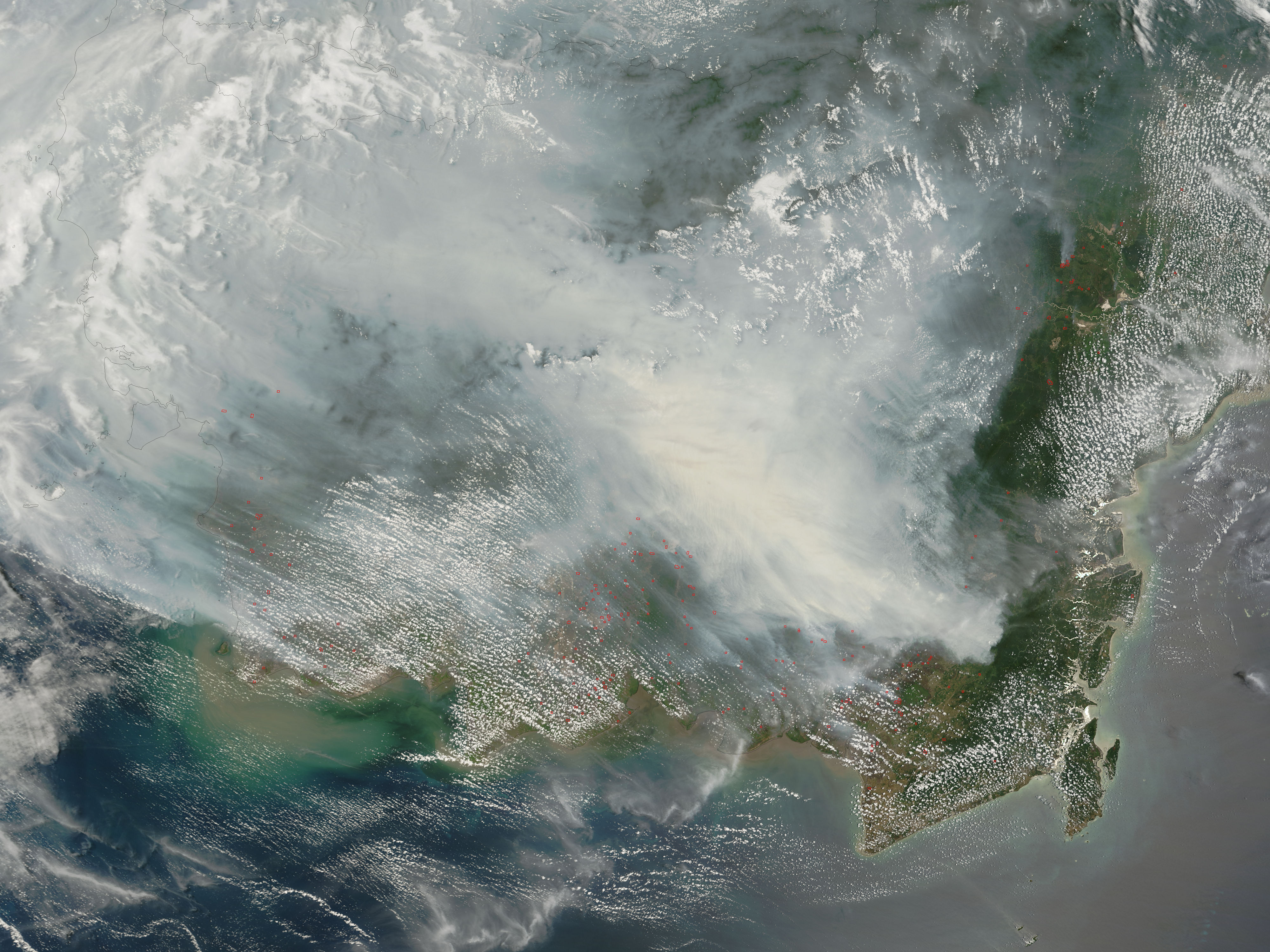
7. Nearly all Asean members are pissed off with Indonesia's annual haze;
8. Thailand is still seething over Singapore government investment arm Temasek Holdings' controversial deal with former Thai PM Thaksin Shinawatra's Shin Corp;
9. Indonesia and Malaysia have not fully embraced each other after another round of Konfrontasi;
10. Malaysia and Singapore can't even agree on a new overhead bridge to replace the old causeway to help improve the massive cross-border flow of goods and people, although Asean dreams about a region with free movement of goods, services, investment, skilled labour and freer flow of capital by 2015.

The Singapore charter is definitely a step in the right direction to set up a proper framework for the interaction of its ten family members.

But individual members of the Asean family must look at wider interests, not just their narrow self-interest.


Sophie's Note: Wikipedia
entry showing
satellite image of the 2006 Southeast Asian haze over Borneo.

Tuesday, April 24, 2007

Updated: Brothers again?

Singapore is suddenly back on good terms with its two immediate neighbours -- Indonesia and Malaysia.

The Straits Times ran a page one story today on Singapore striking a deal with Indonesia to resolve the protracted extradition treaty. The paper also ran a picture of Singapore Foreign Minister George Yeo (back to camera in the ST pix) hugging his Indonesian counterpart Hassan Wirajuda after the agreement was announced.

The signing of the extradition and defence pacts will take place in the Indonesian island of Bali. Singapore PM Lee Hsien Loong and Indonesian President Susilo Bambang Yudhoyono will witness the actual signing of the agreements.

This will definitely come as a relief to the two countries after two long years of negotiation. But details of the two agreements have not been disclosed yet.

ST said Indonesia has said previously that an extradition pact is crucial in its fight against corruption and would pave the way for going after Indonesians allegedly involved in graft cases who fled the country. The Defence Cooperation Agreement was proposed to restore defence cooperation after Indonesia froze the use of a joint military training area in 2003.

And there are signs of warming ties between Singapore and Malaysia. Hsien Loong and several ministers will visit Malaysia next month. Earlier this month, the National University of Singapore awarded an honorary doctorate to the Sultan of Johor.

Is the rapprochement real and lasting? Will it translate into real balance of benefits for Singapore and its two close neighbours? Can Singapore also resume strong ties with Thailand following the Shin-Temasek debacle? Will Singapore resolve its myriad outstanding bilateral problems, especially with Malaysia?

Will big brothers Indonesia and Malaysia finally resume the sale of sand to Singapore?


Update (17 November 2007): The proposed extradition and defence pacts between Indonesia and Singapore have since been unraveled.

Saturday, February 03, 2007

Singapore-Thailand Clash

Singapore's Mustafic Fahrudin scored the controversial penalty, after an unprecedented walkout by the Thai football team in the emotionally charged game in Singapore last Sunday. Singapore beat Malaysia to reach the finals. Pix source: The Straits Times

All eyes will be on the second leg of the soccer finals in Bangkok tomorrow night between Singapore and Thailand in the Asean Football Championship. Singapore is leading 2-1 following the controversial penalty and the unprecedented walk-out by the Thai football team in protest last Sunday.

Tension is running high, amidst the controversial win and the strained bilateral ties between the two countries. Bilateral ties had been strained by a series of events in the last one year -- Singapore government investment arm Temasek Holdings' purchase of national asset Shin Corp from former Thai PM Thaksin Shinawatra, street protests over the non-payment of tax by the vendor in the deal, the military coup that ousted Thaksin, Temasek's blunders in Thailand, Thai unhappiness over Thaksin's 'private' visit to Singapore, and spying charges levelled against Singapore.

Against this backdrop, security will be stepped up considerably at the Bangkok stadium, which will host at least 2,000 Singapore fans. The two sides will do their utmost to help avert a clash of their fans. A clash of the fans would be an unfortunate and unforgettable personification of the clash between the two countries.

It would be extremely unfortunate if bilateral dealings affect people-to-people relationship. It will truly be sad if football saga does imitate real life, as captured in this tongue-in-cheek article in Bangkok newspaper The Nation today.

Football saga imitates real life
Singapore's dodgy soccer win fires talk of eavesdropping, use of foreign nominees

Even Prime Minister Surayud Chulanont was curious to know whether Temasek United Football Club had used underhand tactics to win the first leg of the Asean Football Championship. The Thai national team lost 2-1 to the Temasek team in a highly emotionally charged atmosphere.

"Were we cheated?" the PM asked reporters yesterday. He had missed the match broadcast from Singapore on Wednesday night.

The latest clash between Thailand and Singapore has turned into a political issue. It comes hot on the heels of deteriorating relations, with the Kingdom suspecting that Singapore is now able to listen in on its calls because the former prime minister sold control of ShinSat, the sole national satellite company, and the country's biggest mobile-phone firm (AIS) last year to Temasek Holdings, a state investment firm in the city-state.

Army chief and coup leader Gen Sonthi Boonyaratglin voiced concern that Thai military information was no longer secure because control of key telecommunications firms had been lost with the controversial Shin deal.

"You pick up the phone and it goes to Singapore," he reportedly remarked. The military installed government is also afraid that the sale of ShinSat might enhance Singapore's capacity to eavesdrop on calls here. Premier Surayud said they were looking into whether Thailand may be able to buy back control of the firm or if a new satellite needs to be launched.

The joke going around the Thai team is that their game plan might have been "discovered" by their opponents prior to the match.

After all, how come the Singaporeans knew that Thai star Kiatisak Senamuang would be absent from the game? And how did the Singaporeans players know just to mark Thai midfielder Dassakorn Thonglao, who became the most frequently fouled play by his opponents? Mmm ......

Well, the loss was not entirely attributed to Malaysian referee C Ravichandran's decision to award that hotly disputed penalty to Singapore with just nine minutes remaining.

Was the referee, like Dr Mahathir Mohamad, the former Malaysian leader, just trying to drive a wedge further between Thailand and Singapore, knowing the penalty would drive us nuts?

A more deserving question may be how the Singaporeans managed to respond so well to our game plan.

But, what's done is done. The Thai team lost and Thai football fans are now left hoping their team can win the second leg on their home turf - on Sunday.

Looking around the pitch though, the Thai national team won't enjoy a huge advantage in the second leg as the physique of the Singaporeans suggests they're in a different league.

Although the title of the tournament described it as a competition for the Asean region, the appearance of some Singaporean players conjured up an image of nominees - as they seem to come from all over the world.

Take the Caucasian-looking guy with the pierced-nose - the tall Mustafic Fahrudin, who scored their winning goal. Fahrudin, formerly Serbian, rewarded his adopted country handsomely with victory from the penalty spot. In fact, Fahrudin is far from the only nationalised player for Singapore. Exceptional skill was not the factor that made Precious Emuejeraye stand out from the crowd. Emuejeraye is black, originally from Nigeria, and towered over everyone on the pitch. Daniel Bennett is not Singapore-born either - but another imported player from the UK wearing Singaporean colours. A fourth - Si Jia Yi - was once Chinese, but is now Singaporean.

These players were influential in providing the backbone for their team's performance. Temasek Holdings has been accused by some of using Thai nominees to acquire control of Shin Corp on behalf of foreigners. And when it comes to football, the Singaporean team has shown the world it can use foreign "nominees" to improve its playing strength.


There is nothing wrong with this. But the next challenge for Temasek is how to truly nationalise Shin Corp without being caught using local nominees. Or… maybe that's just sour grapes.

Sunday, January 21, 2007

Singapore's Failed Coup?

So much has happened in Thailand ever since former premier Thaksin Shinawatra sold his flagship Shin Corp to Singapore government investment arm Temasek Holdings last year.

The deal sparked widespread protest over the non-payment of capital gains tax by Thaksin although it was a common practice in Thailand. Bangkok saw widespread protests and the unprecedented burning of effigies of Singapore PM Lee Hsien Loong and wife Ho Ching, who also heads Temasek. Incidentally, Temasek reports to the Finance Ministry, which is headed by PM Lee. The entire Singapore government machinery backed the Temasek deal despite the disastrous outcome.

That's not the end of the saga. The ageing Thai King backed the military in ousting Thaksin in yet another coup d'etat in the country's history. The military-backed government was incensed when Thaksin made a private visit to Singapore last week. Singapore defended its right to host Thaksin although it's highly questionable whether it was indeed a private visit.

While the saga unfolds, the basic question remains unanswered: Why did Temasek buy Shin in the first place? Although Singapore politicians have said ad nauseam that it was simply a commercial deal, nobody was convinced. Why did the Singapore government arm rush into a badly structured deal with the former Thai premier?

One sexy theory has since surfaced that could help explain the whole saga. According to the theory, the payment of $3 billion to Thaksin for his holding company was part of a quid pro quo to abandon Thailand's long-cherished dream to build the Kra Canal.

According to one wit, Thaksin had wanted to build the canal to resolve two issues at one go -- turn Thailand into a major shipping hub, and isolate the Islamic separatist movement in southern Thailand. A canal will literally divide Thailand into two distinct regions.

The canal project, which has been on the drawing board for more than 300 years, will have major impact on Singapore and even Malaysia should it take off. This is because ships can sail from South China Sea to Andaman Sea and Indian Ocean straight, bypassing Singapore and the Straits of Malacca. The role of Singapore as a shipping hub will be greatly diminished should the Thais finally build the canal.

But not everyone buys the theory. One counter argument: The costs outweigh the benefits of such a project. Furthermore, the time saved for shippers and liners is minimal, unlike the more crucial Panama Canal. Another counter argument: It would have been cheaper for Temasek's port operating arm PSA International to take a stake in the Kra Canal project should it materialise.

Whatever the truth is, events in Thailand are truly fascinating. It's got all the right ingredients for a Hollywood movie!

Wednesday, December 13, 2006

Temasek's Thai Blunder, Part 3

Singapore government investment arm Temasek Holdings has suffered another setback in Thailand following its disastrous foray in acquiring Shin Corp from former Thai prime minister Thaksin Shinawatra this year.

The highest court in Thailand today ordered iTV, which is under Shin, to pay unspecified fines that could lead to the bankruptcy of the country's sole private TV station.

From the website of Bangkok Post today:
iTV loses case - faces fine, bankruptcy
(dpa) - The Supreme Administrative Court this afternoon ruled against iTV - the country's sole private TV channel - in forcing the now Singapore-owned company to pay a higher concession fee and fines. The ruling is likely to bankrupt the operation.

The verdict upheld a decision by the Central Administrative Court of May 9, 2006, that forces iTV to change the news content to 70 per cent, up from 65 per cent, and pay a higher concession fee to the government.

The decision, which was not appealed by iTV, could force the company to pay a fine of up to 94 billion baht ($2.6 billion), effectively bankrupting the company which is now majority-owned by Temasek Holdings, the investment arm of the Singapore government.

ITV was previously owned by Shin Corp, the family-held business conglomerate of former Thai prime minister Thaksin Shinawatra, which sold its 49 per cent holding in Shin Corp to Temasek Holdings for 1.9 billion dollars, tax free, on January 23 of this year.

The purchase outraged many Thais who saw the Shin Corp sale as handing over sensitive nationals assets to a foreign company. Besides iTV, Shin Corp also ran the country's largest mobile phone service and the national satellite network.

Four months after the Temasek purchase of Shin Corp, when the political tide was moving against Thaksin, Thailand's Central Administrative Court overturned an arbitration panel's 2004 decision to lower iTV's concession fee and its news content to 65 per cent. Entertainment shows earn higher advertisement revenue in Thailand.

The iTV saga is rich in recent Thai political history. The channel was intended to be an independent news station providing the public with unbiased reporting. All other TV stations in Thailand are owned by the state.

However, after running into financial difficulties in the wake of the 1997 economic crisis iTV was snapped up by Shin Corp and turned into a pro-government station when Thaksin came to power in 2001.


Please see earlier postings on Temasek's blunders in Thailand. Some observers reckon that the series of missteps in Thailand may have cost Temasek's top deal maker his job.

The Straits Times, 7 Dec 2006
Temasek changes chief investment officer
By BRYAN LEE

TEMASEK Holdings has replaced its all-important chief investment officer, who oversees all of the Singapore firm’s investment decisions.

A check by The Straits Times on Temasek’s corporate website shows that senior managing director Jimmy Phoon has taken the reins from Mr Charles Ong. Mr Ong, also a senior managing director, has assumed the newly-created role of chief strategist.

The move comes as Temasek continues to grapple with its controversy-hit US$3.8 billion (S$5.87 billion) takeover of Thailand’s Shin Corp earlier this year.

It led a group of Thai investors to buy a 50 per cent stake in the telecoms company from the family of former Thai premier Thaksin Shinawatra. The transaction eventually led to a mandatory general offer which saw Temasek and its partners emerge with 96 per cent of Shin.

The acquisition, seen by many Thais as a sell-out of strategic national assets to foreigners, was at the heart of widespread protests in the country. These culminated in a September military coup that toppled Mr Thaksin.

Temasek said yesterday that the senior management moves were not related at all to the Shin deal but were “part of regular and ongoing corporate development efforts”.


The iTV problem is definitely not the end of Temasek's woes in Thailand although Singapore politicians have been trying to defend Temasek and mend fences with Thailand following the Shin debacle.