Showing posts sorted by date for query johor floods. Sort by relevance Show all posts

Saturday, September 22, 2007

Flood of money

The Malaysian government is coming up with another big plan to resolve a perennial problem in the southern state of Johor -- flooding. This time, a staggering sum of RM6 billion has been set aside to come up with a comprehensive flood mitigation system.

According to the abridged Bernama report below, the money will be used for digging of drains, deepening of rivers, repair of river banks, building of river bunds, and repair of bridges and estate roads.

It sounds like a lot of money for fancy longkangs and riverbanks. The amount of RM6 billion is more expensive than even the high-tech flood mitigation Smart tunnel system in KL, is equivalent to the cost of building the sprawling LRT network in the Malaysian capital and six times more expensive than the aborted plan to build an overhead bridge to replace the ageing causeway.

Somehow, I suspect that the latest plan, if it is ever implemented, will not be comprehensive enough to resolve the flooding woes in the state. They are still not tackling one serious problem -- cleaning up the clogged and dirty Straits of Johor separating Malaysia and Singapore -- as part of the so-called comprehensive flood mitigation system.

Johor to get $2.6b flood-control system

JOHOR BARU - JOHOR is to have a comprehensive flood mitigation system estimated to cost RM6 billion (S$2.6 billion).

The government has appointed consultants to carry out a study on the measures needed. The project aims to prevent a recurrence of the big floods that hit the state late last year and early this year. More than 100,000 people had to be evacuated and 17 lives were lost during the floods, which were the worst in 100 years.

The local consultants will conduct studies on the six main river basins in Johor before submitting a comprehensive plan for each of the areas. The basins are at Sungai Batu Pahat, Sungai Mersing, Sungai Muar, Sungai Johor, Kluang town and rivers in the Iskandar Development Region.

Saturday, February 03, 2007

Barking up the Wrong Tree

It's not fair for Johor's chief minister Ghani Othman and Malay newspapers in Malaysia to suggest that the massive flooding at the southern town of Kota Tinggi was partly due to Singapore's reclamation works.


He reportedly said that the land reclamation has narrowed the river mouth of Sungai Johor, causing the massive destruction in Kota Tinggi. He was cited by New Straits Times as saying that the narrowing of the river mouth had slowed the discharge of excess rain water into the Johor Straits (infographics from NST).

Singapore's strong response was swift like the flash floods. But the Singapore government merely rebutted the allegation, without giving any reason for the flood due possibly to diplomatic reasons.

The primary reason that caused Sungei Johor to overflow must have been the state of the river itself. It's no secret that rivers in the state are heavily polluted and clogged, making them incapable to discharge sudden surge in rain water efficiently into the open seas, with or without reclamation works by Singapore.

In fact, the five rivers in the state are the main cause of pollutants and toxic discharge into the stale Straits of Johor -- the narrow strip of water separating Malaysia and Singapore. The pollution in the straits is compounded by the land-based causeway, which blocks the natural flow of water in the straits.

Building an overhead bridge to replace the causeway will help water circulate more freely in the straits. But Malaysia and Johor must first step up efforts to clean up the rivers and relocate industries and squatters along the dirty rivers, instead of pointing the finger at its southern neighbour.

Wednesday, January 31, 2007

Letter from Singapore

By Uncle Cheng


Singapore may not seem the most obvious place for Hong Kong people to choose for a holiday but that is where I found myself for family reasons last Christmas and new year. It was a revealing experience and I kept on making comparisons in my mind between Singapore and Hong Kong.

The first thing I learnt, and which becomes obvious in discussions with Singaporeans, is that Singapore is on the verge of an economic boom. After years of slow growth there is great optimism that new government policies are lifting both the economy and peoples’ spirits.

Property prices are rising markedly, foreign bankers are flooding in, huge public infrastructure projects are underway, and investment capital is streaming into local bank accounts from such local nations as Indonesia and even from distant Europe. Suddenly all the ingredients for economic growth are looking good.

One of my sources is a nephew of mine who is in a favourable position to know such things as his work keeps him in close touch with business and economic prospects in Singapore and the nearby region. I was especially interested to hear him explain how the government’s decision to reverse decades of anti-gambling policy and licence two super-casinos has transformed the economic horizon. It reminded me of how Macau’s economic fortunes were totally transformed by the decision to end the old casino monopoly and open the gambling market to virtually open competition.

One argument always used by people who oppose casinos is that they attract crime, triad activity and get poor people into financial difficulty. But as everyone knows the Singapore government has always prided itself on its low crime rate and its very tough treatment of all criminal behaviour. How, I wondered, will the government be able to square its anti-crime reputation with the new casinos. Well, as usual, Singapore has thought the issue through and announced a range of measures which it says will keep the casinos free of crime.

Yet despite its great wealth, efficient government and highly disciplined society Singapore’s miniscule size remains its greatest disadvantage. You cannot flex impressive muscles when you are a dwarf. The city state’s prosperity has to depend on the friendliness of its neighbours.

No neighbour is more crucial than Malaysia for it is from there that Singapore imports fresh water and daily foodstuffs, especially vegetables. It reminds me of Hong Kong’s dependence on the Mainland for the same things. Incidentally, the worst floods in the state of Johor for many years threaten large increases in Singapore vegetable prices through the lunar new year.

An irritating problem between Singapore and Malaysia has been the disagreement about a bridge to replace the existing solid earth Causeway. When no agreement could be reached about the proposed bridge which Malaysia favoured, the Malaysian government decided to spend millions on building new extravagant immigration facilities at its border. As Malaysia had made the case for an overhead bridge, which would have opened up the waterway to small shipping, Singapore hesitated and raised other issues such as the sale of sand and the use of Malaysian air space. Indeed the bridge became such a prickly issue that at one stage Malaysia came up with the bizarre suggestion that the bridge should be built without Singapore's approval. Presumably that would result in the bridge stopping in mid-air at the Singapore border!

Next week I will continue my look at Singapore and in particular I will make some comparisons between Hong Kong and Singapore — comparisons that, I regret to say, are not favourable to Hong Kong.

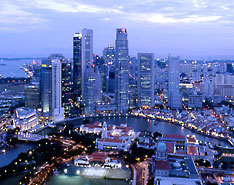
Sophie's note: Please see Singapore's marketing pitch for Marina Bay, the centrepiece of the Lion City.

Saturday, December 23, 2006

Updated: More Malaysia Flood Pix

More pix of floods in the town of Segamat in the southern Malaysian state of Johor, courtesy of Denise's friend.

It's heartwarming to read that some non-governmental organisations from Singapore have started work in Malaysia to help flood victims there on Christmas Eve. But more help is needed to help the Malaysians cope with the disaster.

From Channelnewsasia:
Non-governmental organisations from Singapore started work in Malaysia on Sunday to help flood victims there.

More than 80,000 people have been displaced in the worst flooding Malaysia has faced in a century. Five days after the flood, villagers in Johor are still being evacuated to dry ground. There are still areas which are cut off by the road and are accessible only by boat or helicopter.

One of the worst hit areas in the Johor state is Muar, where close to 19 000 people were affected. Villagers in the area have set up makeshift homes in schools and stadiums. One sports hall, for example, has been home to over 1,800 people in the last few days.

Dr Jemilah Mahmood, President, Mercy Malaysia, said: "The local authorities and their local government have actually done quite well to ensure they get enough food and the basic needs but the critical area is water because a lot of the pumps are now flooded and therefore they have no proper piped-in water being supplied."

To alleviate the situation, Mercy Relief Singapore is working with Mercy Malaysia to distribute 100 water filtration systems.

Mercy Relief Singapore has also distributed 2,000 hygiene kits, which includes items like toothbrush and shampoo.

Helping to transport the items were Land Rover enthusiasts from Singapore.

Frederick Foo, Executive Director, Mercy Relief, said: "We have a team of six men on the ground here and they are here to support Mercy Malaysia. The team leader will also be conducting assessments and he will be giving us daily seed wraps, from there we'll decide on how the situation has either improved or requires more help."

The Singapore Red Cross has also sent a team of nine volunteers and over S$10,000 worth of food and relief items to flood victims.

The situation on the ground is improving everyday and it is believed that the flood waters will subside in about a week's time as long as it does not rain. - CNA/ch


Donations can be made to Mercy Malaysia in the form of crossed cheques:

Malaysian Medical Relief Society
(MERCY Malaysia) - Reg. no. 1155No.
45B Jalan Mamanda 9
Ampang Point
68000 Ampang Selangor
Malaysia
Tel: +603 4256 9999
Email: donation@mercy.org.my

Friday, December 22, 2006

Malaysia SOS?


(Pix source: New Straits Times)

The floods in southern and eastern Malaysia have turned out to be worse than expected. There were reports of massive evacuation of more than 60,000 people, stoppage of train service from Singapore to southern Malaysia, and even looting in Johor.

Although the calamity is not on the same scale as the tsunami that ravaged Indonesia and Thailand during Christmas two years ago, Malaysia could still use a helping hand from some of its Asean neighbours now.

Malaysia had helped its neighbours and other countries in times of crisis. Malaysia had sent money, food, relief and even troops to tsunami-hit or war-stricken countries. Singapore had also done the same to help others in the past.

But how come Malaysia's immediate neighbours -- Thailand, Singapore and Indonesia -- have not come to the aid of Malaysia during this disaster? When do neighbours decide to help without being accused of interfering? What is the diplomatic protocol? Wait for the number of casualties to rise?

There are no hard and fast rules. One thing is clear: Malaysia, or any stricken country, is unlikely to reject any humanitarian assistance that comes without any strings attached.

Wednesday, December 20, 2006

Floods on Both Sides of the Causeway

(Pix source: The Straits Times)

IT rained cats and dogs in Singapore and in the border Malaysian town of Johor Baru yesterday. Singapore's Met Dept said it was the heaviest rainfall in 75 years, while Johor Menteri Besar Abdul Ghani Othman described it as a 'once in 100 years' occurrence.

Parts of Singapore were submerged in water but the damage didn't appear to be too widespread in the developed island nation.

However, the situation was more serious in Third World town of JB. More than 10,000 people were evacuated from their homes after floods hit most parts of Johor.

The flood is a rare phenomenon in Singapore since the flood alleviation programme in the 1980s and 1990s. And such events will be event rarer in Singapore once the Marina Barrage is completed next year to help turn Marina Bay into a fresh water bay and helps regulate tidal flows to stem flooding of inland low-lying areas. Must say it's a simple and brilliant idea.

But the same cannot be said about JB, which will continue to experience massive floods in the future -- definitely more than once in every 100 years. See earlier postings on Johor's woes.