Showing posts with label straits. Show all posts

Sunday, January 27, 2008

No Swimming

THE Urban Redevelopment Authority has unveiled plans to create a coastal promenade and a park in Woodlands, which is on the northern side of Singapore.

According to The Straits Times, residents and those living in nearby residential estates can look forward to a new waterfront recreational playground, right at their doorsteps.

The newspaper said URA will be building a 1.5-km long promenade and a nine hectare park along a tranquil stretch of coastline in Woodlands to improve accessibility to the area and to open up the scenic waterfront. The report added that the promenade, in the form of boardwalk will be built over the seawall to bring visitors closer to the water's edge.

Although it's not clearly stated in the ST report, Sophie's World assumes that the Woodlands coastline promenade will be along the Johor Straits as it is located on the northern side of Singapore.

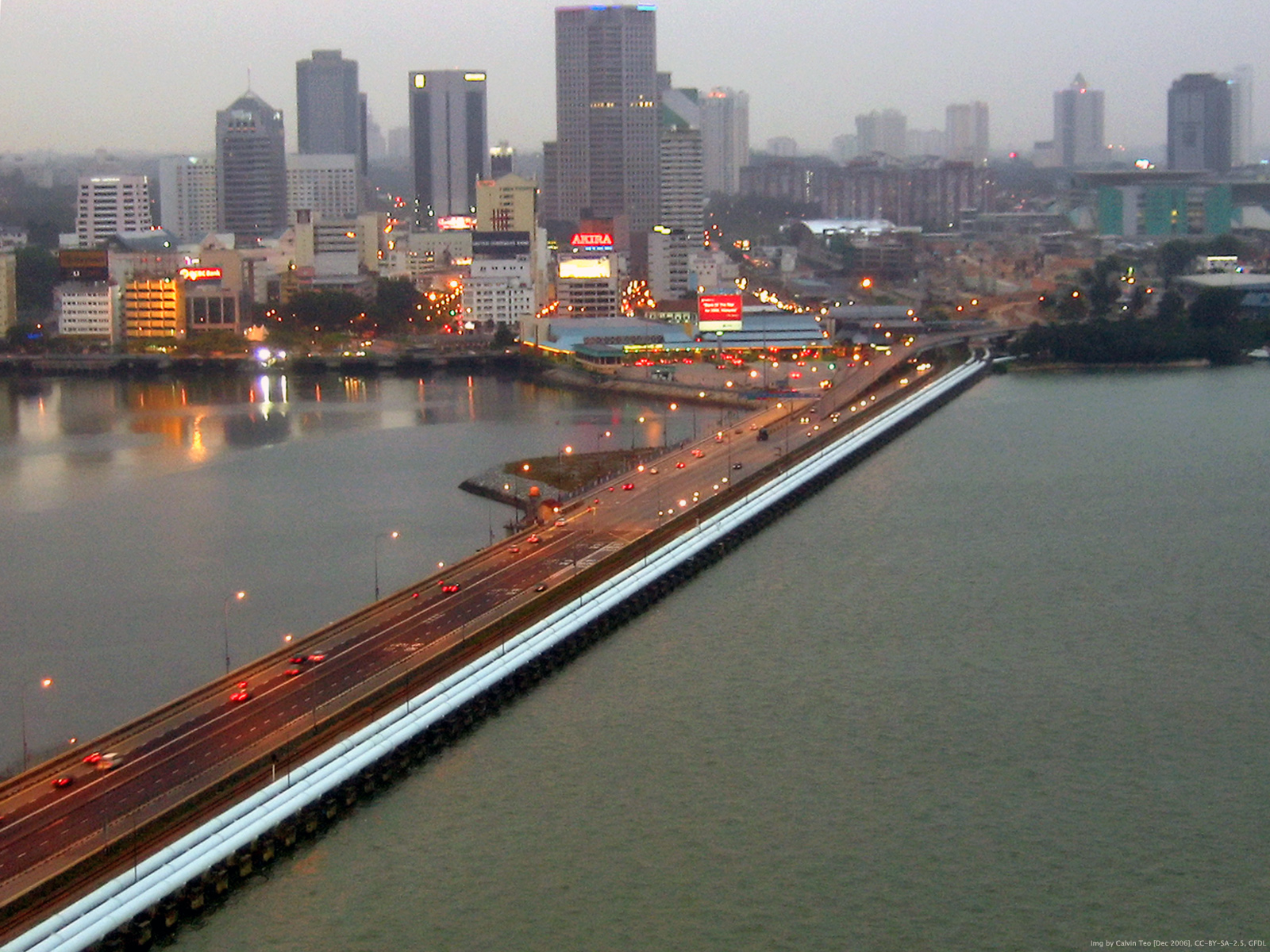
The narrow strip of water separating Singapore and Malaysia is one of the filthiest bodies of water in the region. It's partly due to the land-based causeway, which prevents the natural flow of water in the distressed straits, as mentioned in an earlier posting.

Unfortunately, the two governments have not been able to come to terms to build a new overhead bridge to replace the old causeway. An overhead bridge will allow the dirty water to flow more naturally to the open seas.

In the meantime, the Singapore planning authorities must do the following to help ensure public safety and hygiene along the proposed Woodlands promenade:

1. Fence up the Woodlands coastline promenade. This will stop any person or dog from taking a dip in the giant cesspool and contract any skin disease;

2. Put up 'No Swimming' sign-board clearly along the promenade;

3. Ban fishing as fish in the Johor Straits are probably toxic due to the high levels of lead, mercury and e-coli bacteria;

4. Ban water sporting activities such as kayaking as exposure to the toxic straits could be a health hazard; and

5. Ban all flying objects such as kites or toy planes as they could well infringe the Malaysian airspace and start a new bilateral row!

Sunday, January 06, 2008

Giant cesspools

The Straits Times had a comprehensive report yesterday about the Three Gorges Dam project along the mighty Yangtze River in China -- the biggest dam in the world when completed in less than a year.

Despite the obvious potential of a clean source of energy via the hydroelectric dam, the report noted the tremendous cost associated with the project. One major worry, according to the report, is the long-term accumulation of pollutants in the vast 660km-long dam reservoir. The newspaper said sewage, fertiliser run-off and other domestic waste washed down from populated areas will be locked in instead of being flushed out to the sea.

Someone should do a similar study on major bodies of water in Singapore and Malaysia.

One major project is the Bakun Dam in the Malaysian state of Sarawak. The project will flood an area three times the size of Singapore when it is completed. The project, which will be the biggest hydroelectric dam in Asia ex-China, is still on track despite massive environmental outcry in the last two decades or so.

The most polluted body of water in the region is undoubtedly the distressed Straits of Johor. Flow of water in the narrow strip of water separating the two countries has been blocked for more than eight decades by the land-based causeway that connects southern Malaysia and Singapore.

Massive amount of pollutants continue to be discharged into the straits by drains and rivers at the Malaysian end. A Malaysian newspaper report had earlier said that the straits has high levels of lead, mercury and e-coli bacteria.

Water in the straits has been stagnant as the causeway does not allow water to flow freely. Water in the cesspool will remain stagnant for a long, long time.

This is because the governments of Singapore and Malaysia have not been able to reach an agreement ever since Malaysia mooted an overhead bridge project in 1996 to replace the causeway. That's 12 years ago!

Singapore has always maintained that there is no need to spend extra money as the causeway is still useful. But there is also suspicion that its reluctance is due to fears of opening up the straits to ships. Small ships and barges could theoretically bypass Singapore, which is the major shipping hub in the region, and sail from the South China Sea to the Straits of Malacca via the Straits of Johor.

Such a concern is not entirely valid. There is little time or cost saving from using the Straits of Johor as the new sea lane as the water is shallow and the straits meandering.

But as noted in an earlier posting, there is tremendous benefit from cleaning up the Straits of Johor for people on both sides of the causeway.

Saturday, September 22, 2007

Flood of money

The Malaysian government is coming up with another big plan to resolve a perennial problem in the southern state of Johor -- flooding. This time, a staggering sum of RM6 billion has been set aside to come up with a comprehensive flood mitigation system.

According to the abridged Bernama report below, the money will be used for digging of drains, deepening of rivers, repair of river banks, building of river bunds, and repair of bridges and estate roads.

It sounds like a lot of money for fancy longkangs and riverbanks. The amount of RM6 billion is more expensive than even the high-tech flood mitigation Smart tunnel system in KL, is equivalent to the cost of building the sprawling LRT network in the Malaysian capital and six times more expensive than the aborted plan to build an overhead bridge to replace the ageing causeway.

Somehow, I suspect that the latest plan, if it is ever implemented, will not be comprehensive enough to resolve the flooding woes in the state. They are still not tackling one serious problem -- cleaning up the clogged and dirty Straits of Johor separating Malaysia and Singapore -- as part of the so-called comprehensive flood mitigation system.

Johor to get $2.6b flood-control system

JOHOR BARU - JOHOR is to have a comprehensive flood mitigation system estimated to cost RM6 billion (S$2.6 billion).

The government has appointed consultants to carry out a study on the measures needed. The project aims to prevent a recurrence of the big floods that hit the state late last year and early this year. More than 100,000 people had to be evacuated and 17 lives were lost during the floods, which were the worst in 100 years.

The local consultants will conduct studies on the six main river basins in Johor before submitting a comprehensive plan for each of the areas. The basins are at Sungai Batu Pahat, Sungai Mersing, Sungai Muar, Sungai Johor, Kluang town and rivers in the Iskandar Development Region.

Friday, September 07, 2007

Cleaning up Johor Straits good for S'pore too

Punggol, which is located on the northeastern part of Singapore, will be given a new lease of life. Singapore's Prime Minister Lee Hsien Loong said during his National Day Rally speech on Aug 19 that the masterplan for the area dubbed 'Punggol 21-plus' is 'back on track'.

'Punggol 21-plus' will boast features like a freshwater lake - and a waterway running through the estate with homes and a town centre built on both banks, according to ST. The north-eastern coastal suburb will also get recreational facilities like water sports, gardens and parks with jogging tracks and eateries for al-fresco dining.

It all sounds great, but Punggol and the rest of the northern part of Singapore will never be as vibrant as the southern region of Singapore. The southern region, which has always been the commercial hub of Singapore, is rapidly being transformed into a more fun place.

The southern part of Singapore will have two world-class integrated resorts with casinos within the next three years or so. The government has awarded the Marina Bay site to Las Vegas Sands, which is building also building the world's biggest casino in Macau, and the Sentosa site to Genting International.

That's not all in the Marina Bay area. The new downtown is taking shape and there will be world-class gardens, a giant fresh-water reservoir, and a huge ferris wheel. There will be plenty of activities around the clean and pristine Marina Bay once all the plans are in place.

While the southern part of Singapore is attracting all the big dollars and attention, the northern part of Singapore will continue to be relatively subdued despite the latest plan to rejuvenate Punggol.

As Singapore is small with 704 square kilometres in area, every inch of Singapore, including the northern part, will have to be spruced up eventually. But it won't be easy to rejuvenate the northern coastline.

For a start, water off the northern part of Singapore, which is bounded by a strip of water known as Straits of Johor, is very dirty. The straits is a narrow waterway separating Singapore and its close neighbour Malaysia.

The straits is almost like a giant cesspool that has not been flushed for more than 80 years. Why? This is partly because the causeway, which was built on reclaimed land and cuts across the straits to link the two countries, has been blocking the free flow of water in the straits since it was completed by the British in 1924.

Singapore has done its part to reduce further pollution to the straits, spending $7 billion to build massive tunnels to move sewage to two new waste treatment plants in Changi and Tuas, instead of discharging waste into the straits.

Malaysia is also trying to clean up the straits, although not as successful.

In 1996, former Malaysian Prime Minister Mahathir Mohamad proposed an overhead bridge to replace the ageing causeway in a bid to free up the flow of water in the straits. It is part of a grander plan to turn the southern Malaysian state into a transportation hub. The project would have allowed small ships and barges to traverse the straits.

The bridge project has not taken off after ten years, complicated by internal Malaysian politics and disagreements with the Singapore government. Last year, current Malaysian government led by Abdullah Ahmad Badawi, called off the bridge project. Malaysia could not strike a deal with Singapore, which wanted to buy sand and use Johor airspace as part of the quid pro quo to jointly build a new bridge.

The decision to abort the project incensed Dr Mahathir, who is still on a warpath with his successor despite bouts of heart attacks. The Malaysian statesman had early said he would stop his bickering if the bridge is built. He had continued to criticise the bridge issue as reported in malaysia-today.

The bridge project is expected to remain on the backburner for some time, as the two governments have not been able to resolve all their differences since the two countries separated in 1965.

With or without a new bridge to replace the causeway, Malaysia and the Johor state government must step up efforts to clean up the five dirty rivers flowing into the Johor Straits.

But it will be more ideal if a new overhead bridge could be built to replace the over-utilised causeway and allow water in the stagnant straits to circulate more freely.

A cleaner straits will be good for the long-term development of the coastal areas of both Singapore and southern Malaysia, which will have a new development zone called Iskandar Development Region.

A cleaner Johor Straits could also help make northern Singapore, including Punggol, a more thriving hub one day.

Wednesday, July 11, 2007

Distressed Johor straits

New Straits Times has an interesting article and pix today about the distressed Straits of Johor separating Malaysia and Singapore.

The picture shows a rare and recent phenomenon of shoals of fish leaping into the air due to unknown reasons.

The article hazarded a guess that the phenomenon could be due to the increase in the pollution levels in the straits, which is noted for its high levels of lead, mercury and e-coli bacteria.

The newspaper cited Malaysian Nature Society Johor branch bio-diversity researcher Vincent Chow as saying that it is possible that the water is warming up as a direct result of global warming, causing marine parasites to multiply faster than normal and attack the fish.

"When these parasites attach themselves to the body of the fish, the discomfort causes them to dart about in an effort to dislodge the parasite," Chow said.

Well, it doesn't come as a total surprise that marine life in the straits is distressed. The article didn't give the reason for the high pollution levels in the straits.

As mentioned in a previous post, the straits of Johor is extremely dirty due to two reasons -- continued discharge of waste by Johor rivers into the straits, and the retarded flow of water due to the land-based causeway linking Malaysia and Singapore.

Malaysia and Johor must step up efforts to clean up the rivers and relocate industries and squatters along the dirty rivers.

An overhead bridge to replace the causeway will definitely help water circulate more freely in the straits and flush the toxic water. An overhead bridge project was first mooted in 1996 by Malaysia but sadly, the Malaysian and Singapore governments have not been able to agree to proceed with the project.

Concerted efforts are needed to clean up the dirty straits and help the distressed fish and marine life breathe a little easier.

Saturday, February 03, 2007

Barking up the Wrong Tree

It's not fair for Johor's chief minister Ghani Othman and Malay newspapers in Malaysia to suggest that the massive flooding at the southern town of Kota Tinggi was partly due to Singapore's reclamation works.


He reportedly said that the land reclamation has narrowed the river mouth of Sungai Johor, causing the massive destruction in Kota Tinggi. He was cited by New Straits Times as saying that the narrowing of the river mouth had slowed the discharge of excess rain water into the Johor Straits (infographics from NST).

Singapore's strong response was swift like the flash floods. But the Singapore government merely rebutted the allegation, without giving any reason for the flood due possibly to diplomatic reasons.

The primary reason that caused Sungei Johor to overflow must have been the state of the river itself. It's no secret that rivers in the state are heavily polluted and clogged, making them incapable to discharge sudden surge in rain water efficiently into the open seas, with or without reclamation works by Singapore.

In fact, the five rivers in the state are the main cause of pollutants and toxic discharge into the stale Straits of Johor -- the narrow strip of water separating Malaysia and Singapore. The pollution in the straits is compounded by the land-based causeway, which blocks the natural flow of water in the straits.

Building an overhead bridge to replace the causeway will help water circulate more freely in the straits. But Malaysia and Johor must first step up efforts to clean up the rivers and relocate industries and squatters along the dirty rivers, instead of pointing the finger at its southern neighbour.

Tuesday, December 05, 2006

JB-Singapore MRT?


A new Malaysian company is toying with the idea of building a monorail network in Johor Baru and linking it to Singapore. According to Malaysia's BT today, little-known Jalur Mudra is having talks with Singapore's SMRT Corporation, which operates the Mass Rapid Transit network in Singapore, for a joint venture.

The project definitely sounds useful to help cater to the massive human traffic flowing between Singapore and southern Malaysia. Nearly 10 million Singaporeans entered Malaysia, mainly through JB, last year. This is more than the 8-odd million tourists to Singapore last year.

But can such a project take off? Will it help resolve traffic and straits woes?

Don't bet on it. There are just too many complications surrounding such a project. And even if it does take off, it won't be the ideal solution.

1. The project will most likely need a new link across the Straits of Johor to Singapore as there is simply no room on the causeway for a monorail track, no matter how slim it is.

2. Will Singapore agree to a monorail track from JB to Singapore via the Straits of Johor when the two governments could not even agree on a new bridge to replace the causeway that links JB and Singapore?

3. Will there be complications for immigration clearance? Or will travellers from Singapore zip to JB without passports under the proposed immigration-free zone in JB?

A more ideal solution is for Malaysia and Singapore to jointly agree on a new and wider bridge to replace the causeway, which retards the flow of water in the filthy Straits of Johor.

1. Singapore and Malaysia planners can then allocate space for the monorail project from JB to Singapore on the new bridge.

2. Planners on both sides of the causeway can also discuss the possibility of setting aside space on the new bridge for the bullet train service -- proposed by Malaysian tycoon Francis Yeoh -- from Singapore to Kuala Lumpur.

3. Channelling the human traffic through the current custom and immigration facilities in JB and Singapore will be a neater solution, than possibly building new facilities just to cater to the monorail track.

Building a new bridge to replace the causeway will solve many problems in one fell swoop.

Malaysia and Singapore can make provision for wider roads and space for useful projects such as the monorail and bullet train service to cater to the massive cross-border flow of people. And an overhead bridge will also allow water to flow freely in the Straits of Johor after more than 80 years.