Showing posts with label china. Show all posts

Sunday, January 06, 2008

Giant cesspools

The Straits Times had a comprehensive report yesterday about the Three Gorges Dam project along the mighty Yangtze River in China -- the biggest dam in the world when completed in less than a year.

Despite the obvious potential of a clean source of energy via the hydroelectric dam, the report noted the tremendous cost associated with the project. One major worry, according to the report, is the long-term accumulation of pollutants in the vast 660km-long dam reservoir. The newspaper said sewage, fertiliser run-off and other domestic waste washed down from populated areas will be locked in instead of being flushed out to the sea.

Someone should do a similar study on major bodies of water in Singapore and Malaysia.

One major project is the Bakun Dam in the Malaysian state of Sarawak. The project will flood an area three times the size of Singapore when it is completed. The project, which will be the biggest hydroelectric dam in Asia ex-China, is still on track despite massive environmental outcry in the last two decades or so.

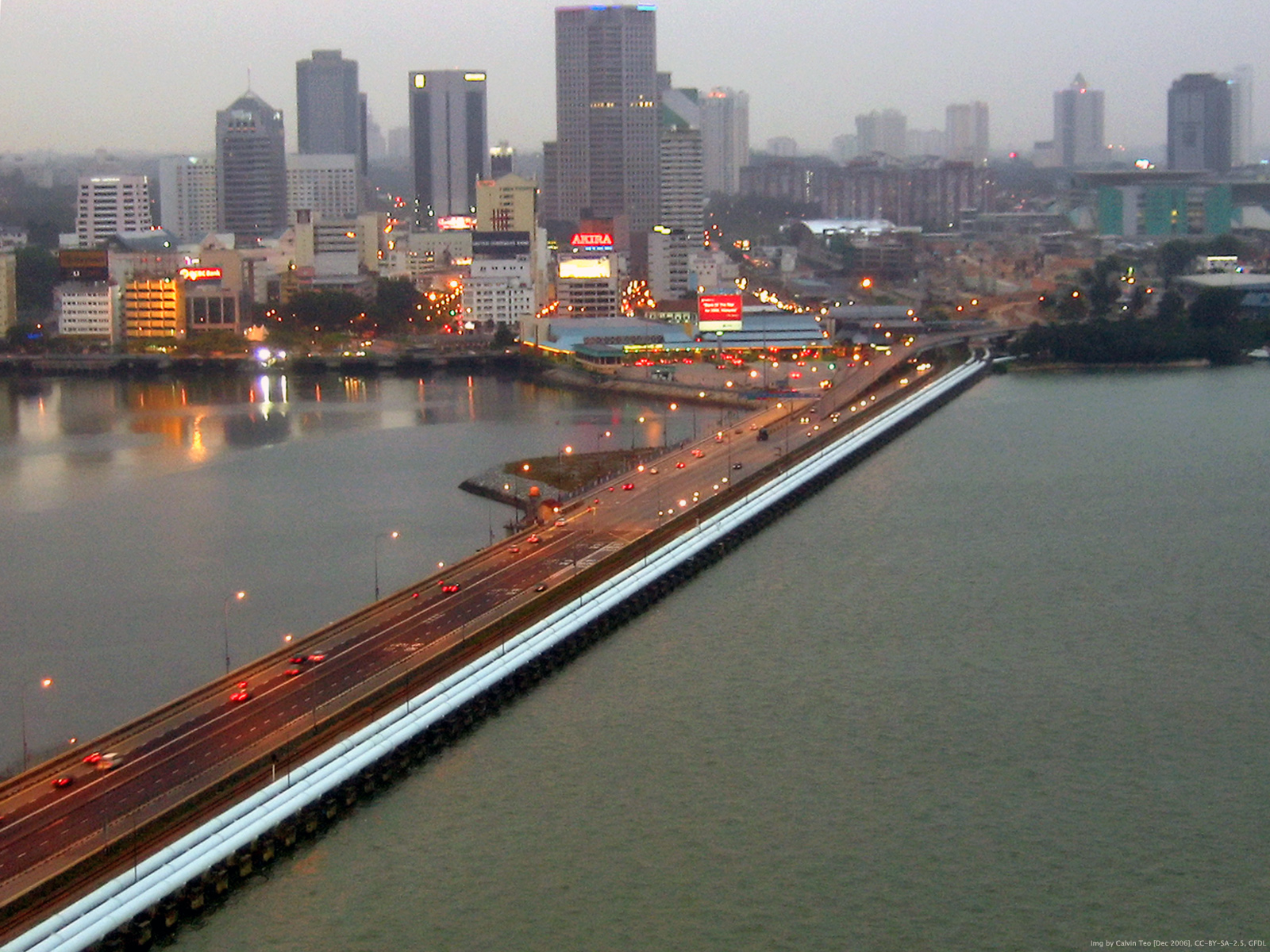
The most polluted body of water in the region is undoubtedly the distressed Straits of Johor. Flow of water in the narrow strip of water separating the two countries has been blocked for more than eight decades by the land-based causeway that connects southern Malaysia and Singapore.

Massive amount of pollutants continue to be discharged into the straits by drains and rivers at the Malaysian end. A Malaysian newspaper report had earlier said that the straits has high levels of lead, mercury and e-coli bacteria.

Water in the straits has been stagnant as the causeway does not allow water to flow freely. Water in the cesspool will remain stagnant for a long, long time.

This is because the governments of Singapore and Malaysia have not been able to reach an agreement ever since Malaysia mooted an overhead bridge project in 1996 to replace the causeway. That's 12 years ago!

Singapore has always maintained that there is no need to spend extra money as the causeway is still useful. But there is also suspicion that its reluctance is due to fears of opening up the straits to ships. Small ships and barges could theoretically bypass Singapore, which is the major shipping hub in the region, and sail from the South China Sea to the Straits of Malacca via the Straits of Johor.

Such a concern is not entirely valid. There is little time or cost saving from using the Straits of Johor as the new sea lane as the water is shallow and the straits meandering.

But as noted in an earlier posting, there is tremendous benefit from cleaning up the Straits of Johor for people on both sides of the causeway.

Thursday, December 27, 2007

Half-Black or Female?

OK, back to serious news analysis after one week of satire and entertainment news.

By Uncle Cheng

Do you worry about the United States? I do. In recent months I have heard quite a few of my Chinese friends say things like “America is going bankrupt” or “America is finished - China is the future.”

But it is not just the constant drop in the value of the US dollar, and hence our own money, that is worrying.

Many Chinese seem to think the U.S. has lost its magic touch. They see the world going in one direction and America in another.
I do not know about you, but I find these feelings very troubling.

This is because, despite its many defects, America remains a very important nation and everyone benefits from a rich, stable America. As the old saying states “When America sneezes, the whole world catches a cold.”


The truth is that America’s reputation in the world has been profoundly damaged by President Bush and his cronies. It seems amazing how quickly America has been able to destroy its accumulated international goodwill but that is what has happened.

About a year ago I explained in a previous column why I favoured Obama. A year later I see Barack Hussein Obama as America’s greatest hope for the future. Why, you may ask, do I support the half-black, quarter-or-so Muslim Obama?

Precisely because he is half black and a bit Muslim. He is the only person who stands a chance of transforming the global image of America. Obama was right to claim: “The day I am inaugurated, the world will look at America differently."

I also think the vast majority of the world’s population outside America will support Obama for President. That’s about 6.5 billion people!

People the world over can identify with Obama because he had a black Kenyan father, a white American mother, an Indonesian stepfather, and a Muslim education in Jakarta followed by an American university.
Obama is the only person who as President can act as a bridge to the Islamic world, and a bridge to the many poor people in the world.

A leading Canadian politician expressed it well when he said: “It's clear Barack Obama would be the first globalized American leader, the first leader for whom internationalism would be in his veins."


I see the image of a Muslim terrorist, who is trained to hate America, switching on his TV and seeing an American President who is half black, has an Arabic middle name, and went to a Muslim school. How can the terrorist hate such a man?


On another matter I was greatly amused to read that Obama’s rival, Hillary Clinton, has been accused of being an opportunist and of lacking integrity. I ask you — are not all politicians opportunists and dishonest? Or will Obama prove to be the exception in that regard as well?

But this is not to say I dislike Hillary Clinton. Actually I like her. I am amused to think of Bill Clinton returning to the White House as ‘First Man’. And Hillary would be America’s first female President — also good for America’s image in the world.

Saturday, December 01, 2007

Olympics

By Uncle Cheng

Next year’s Olympics in Beijing is being heralded as an unprecedented national event of international importance. This, after all, will be the first time the Olympics will have been hosted on Chinese soil.

Apart from Toyko (in 1964) and Seoul (1988), and provided you do not consider Australia (Melbourne 1956, Sydney 2000) a part of Asia, no other Asian country has ever been given an opportunity to stage the games since they were first held over two thousand years ago.


While China’s economic resurgence marches onwards and upwards, it is perhaps understandable that Chinese nationalism treats the Olympics as especially significant. The government in Beijing has been progressively asserting China’s interests internationally.

It has actively cultivated strong economic and political ties in all corners of the world but especially in Africa and Australia, places where China’s understandable self-interest lies in their wealth of natural resources. Raising its international profile can only benefit China’s economic strength.

Against this background there are two aspects to the recent controversy concerning Martin Lee’s recent remarks about the Olympics games. To my mind it is not necessary to come to a definitive view whether Mr Lee was urging foreign countries to boycott the Olympics. As any lawyer might say, he is entitled to the benefit of the doubt.

However, one aspect that worries me is an obvious one. China considers the Olympics to be a matter of “face” and particularly the nation’s international “face”. Directly or indirectly linking the games to China’s record on human rights is fundamentally wrong, and indeed against the spirit of the Olympic ideal that demands the games remain apolitical.

But it is the second aspect that I find more important and crucial if the world is to appreciate the Chinese psyche. Initial strong memories of the 2008 games will necessarily fade in subsequent years but the suggestion that foreign forces and countries can somehow meddle in China’s national affairs is a justifiably sore point for the Chinese.

As any admirer of Chinese history must know, the present government’s approach to foreign influences is no different from that of its predecessors. Since the time of the first emperor 2,300 years ago until today China has always labelled those who seek foreign assistance as traitors. This intolerance of foreign influence is a hallmark of Chinese civilization that has enabled China to remain a unified state with an unbroken civilization for thousands of years.

I do not deny that China has been ruled by foreigners. The Yuan Dynasty of the thirteenth century may have been short-lived but it was essentially foreign. The more recent Ching Dynasty was also foreign but quickly lost its “foreignness” and became utterly sinonised.


To my mind, this is the key to understanding the attitude of the present Chinese government. It really does not matter whether the system in Beijing is feudal, national, communist or democratic. That is not the point. What matters is a full appreciation of China’s ancient and often uneasy relationship with anybody whose interests and loyalties lie outside China.

The classic example of this Chinese political psychology is
Beijing’s strained relationship with the Vatican and its Erastian religion which would require China’s Catholics to maintain loyalty to a foreign government.

Tuesday, March 06, 2007

Chinese Treasures

By Uncle Cheng

From now until March 25th if you wish to see some of the rarest Chinese works of arts, which were taken to Taiwan on the eve of Communist rule in China, you must go to Taipei. The National Palace Museum in the city has just completed a massive programme of renovation which has transformed the museum and enables much more of the priceless collection to be displayed.

So it is worth recalling how it happened that provincial Taiwan came to be the repository of so much of the priceless imperial collection. It is a tale of huge intrigue and great heroism which exemplifies the bitter disputes that raged between two divergent ideologies, Nationalism and Communism, as they battled to be guardian of the Chinese nation’s cultural heritage and hence its very legitimacy.

Incredible as it was given the vicissitudes of much of Chinese history nearly all the great imperial art collection, which had been mainly amassed during the early years of the Qing dynasty, had remained virtually intact and undamaged right up to the Republican era. It is also worth recalling the great irony that most important parts of the collection were assembled, not by the Han Chinese as we might suppose, but by the Manchu emperors, who were most anxious to establish and prove how loyally Chinese they were.


As is well known both Beijing and Taipei now boast their own palace museums although the Taipei one is called the National Palace Museum while the one in Beijing is known simply as the Palace Museum.

It was in 1925 that the Palace Museum in the Chinese capital first opened its doors to the public but at the time most of the items in the collection were without any inventory and it is thought that in those troubled times some items, though not many, were stolen by corrupt officials and made their way to collections outside China. Perhaps the last complete inventory before the modern era was the one conducted in 1816 which documented about 15,000 items of calligraphy and paintings alone that had been collected by the highly cultured Emperor Qianlong.


A major crisis for Beijing collection came in 1911 when the Emperor Puyi was forced to abdicate. When Puyi then became a puppet emperor of Manchukuo he took a substantial amount of the imperial art collection with him.

The collection faced further travails when civil war broke out across China in the 1930s. Worried curators then embarked on an extraordinary endeavour that saved the collection for the nation. They hurriedly packed the bulk of the Palace Museum’s collection into a staggering 20,000 wooden crates. These crates contained just about everything that could be lifted and easily moved. There were bronzes, jades, porcelain, paintings, calligraphy and rare books.


At first the crates were set off on a dangerous journey towards Shanghai from where it was intended to take them on to Nanjing, all the time closely guarded by the dutiful museum curators from Beijing. But as the civil war moved south towards Nanjing the bulk of the 20,000 crates had to be diverted for safekeeping to the nationalist capital of Chungking. Ultimately, only about a fifth of the 20,000 crates, that is some 4,000 crates, were taken by the Nationalists to their final base in Taiwan. It is the contents of those 4,000 crates which now form the nucleus of the Taipei collection.

Although the Taipei museum is home to only a fifth of the collection which the Nationalists took from Beijing, the curators and Chiang Kai-shek were careful to select some of the best artifacts for shipment to Taiwan, which is why many art experts maintain the National Palace Museum houses the cream of the imperial collection such as the large paintings of the early Tang and Sung dynasties.

However, if you go to the renovated Taipei museum, do not expect that you will be able to view the entire collection. For conservation reasons the museum never displays all its treasures at one time. This is because some objects, especially the early paintings are so fragile that they are only displayed for forty days every three years. To see everything you must return to Taipei every three years!

Another celebrated moment in the history of that part of the imperial collection which was left behind by the Nationalists came during the height of the cultural revolution. A group of Red Guards had broken their way into the Palace Museum raising fears that the art collection would be destroyed. In the very nick of time the then Premier Chou En-lai issued his famous directive “the Gugong belongs to the nation and to the people and must be protected”. Both the Forbidden City and the objects it contained were rescued.

Perhaps the greatest irony of all is that we owe the preservation of our nation’s imperial art collection both to the Nationalist Chiang Kai Shek and his ideological enemy Chou En-lai. The unhappy result is that the collection continues to be split between Beijing and Taipei.

Sunday, February 04, 2007

US Bully Tactics Again

The United States is behaving like a bully again in the international arena to placate its populist concerns.

Newspapers today reported that the Bush administration, kowtowing to a more belligerent Congress on China trade, has hauled Beijing before the World Trade Organisation (WTO) over 'illegal' industrial subsidies.

In the page one article of Singapore's The Sunday Times today:
In the largest action of its kind - one that could escalate tensions between the two trading giants - Washington said China has persisted with subsidies that, under WTO rules, distort global trade.

'We are seeking to level the playing field to allow US manufacturers to compete fairly with Chinese firms,' US Trade Representative Susan Schwab said.

She added: 'The United States believes that China uses its basic tax laws and other tools to encourage exports and to discriminate against imports of a variety of American manufactured goods.'

The decision to go to the WTO is the first step in what could be an 18-month process to determine whether Beijing has contravened trade laws.

In the first instance, both sides will try to resolve the dispute through consultation. If these talks fail, the WTO will step in. If it rules in favour of the US, there could be sanctions on China's products - with huge ramifications for Beijing's exports and for ties between the two nations.


It is laughable for Uncle Sam to accuse China of contravening trade laws.

One should not neglect mentioning US has not lived up to its own words in its trade policy. The US, under President George W Bush, has continued to subsidise its corn and cotton farmers heavily. This goes against the spirit of free trade and is hypocritical as developed nations force poorer nations to remove farm subsidies in their own backyard.

Oh yes, don't forget the heavy protection for US steel industry while US trade officials scream protectionism in other countries. Did I leave anything out? Oh yes, sugar cane farmers from the Bush home state of Florida are well protected species.

The rest of the world should paraphrase Schwab and tell the US: "We are seeking to level the playing field to allow the rest of the world to compete fairly with the US."

Another example of its bully tactic is its current Free Trade Agreement discussion with Malaysia.

US House of Representatives Foreign Affairs Committee chairman Tom Lantos has urged trade officials to suspend FTA talks with Malaysia until it halts a US$16 billion deal to develop gas fields in southern Iran, according to wire reports.

Malaysia has rightfully warned that it will drop FTA talks with the US if it is asked to scrap the gas deal with Iran.

The Iran issue is a separate matter from the FTA, as the US is working to sanction Iran over what it believes is an Iranian programme to develop nuclear weapons.

And the US action against Iran is highly dubious as the Muslim country has not used its capability as an overt threat against its neighbours or enemies. One should not forget the fiasco in Iraq when listening to the US.

One should not be easily swayed by US propaganda and its imperialistic design.

Tuesday, January 02, 2007

China Seafood

Uncle Fatso has taken rather vivid pix of seafood in China that is supposedly aphrodisiac. They include things (counter clockwise from top right) like clams, mini squids, fish rich in Omega 3 fat and even fish that are still half alive!!! He must be eating a lot of seafood in China. Haha