Showing posts sorted by date for query causeway traffic. Sort by relevance Show all posts

Saturday, March 22, 2008

Causeway blues again, Part 3

Note: Image from Intelligent Transport Systems Center, LTA (28 Mar 2008, 9:50am)

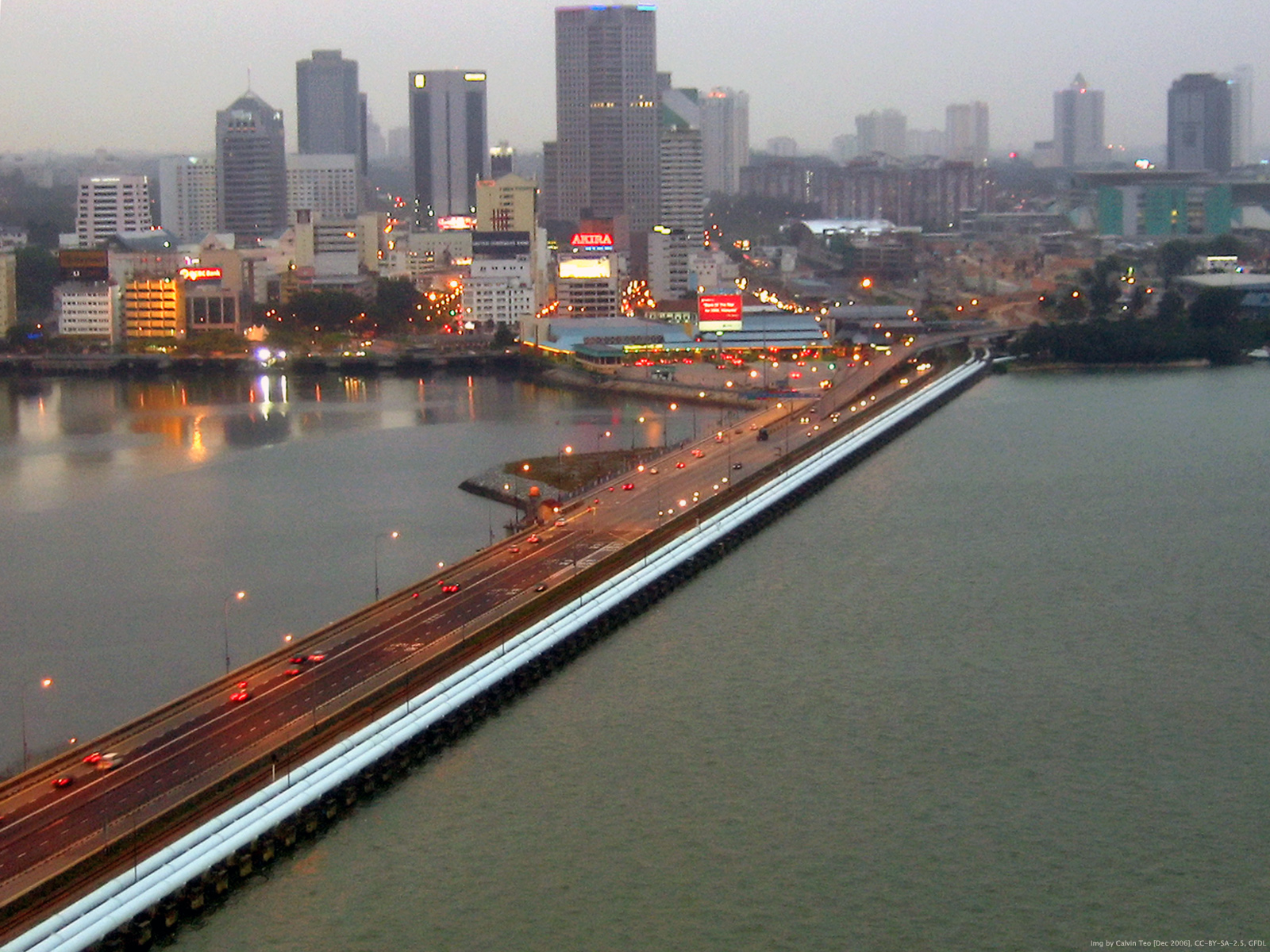
Recent reports, including The Straits Times article below, about the massive traffic jam at the causeway tell only half the story. The gridlock at the causeway, as a result of the search for a missing terrorist in Singapore, has merely highlighted current problems faced at the bridge linking Singapore and Malaysia.

Even without the stepped-up security in the search for Mas Selamat Kastari, many people have had to suffer from the daily crawl at the causeway. Sophie's World has long highlighted the less-than-deal situation at the causeway. See early postings such as Missing MRT link, Causeway blues again, Part 2, and Malaysian bullet train going to Singapore?

Will Singapore and Malaysia work together to resolve the traffic woes at the causeway once they manage to nab the terrorist? Or will they think that things will go back to 'normal'?

March 22, 2008
Tighter immigration checks hit JB businesses
Takings dip by up to 75% as S'poreans avoid massive Causeway jams
By Arlina Arshad

ON A typical weekend, many Singapore cars can be seen at the Mobil petrol station close to the Johor Baru immigration checkpoint or heading for the town's malls.

Yesterday, the petrol station was serving more J-plate vehicles than S-plate ones. The town's restaurant owners, retailers and cabbies have also noticed slacker business over the past few weekends.

Three words explain this: Mas Selamat Kastari.

Petrol station cashier Rozana Mohd Din, 33, is certain that the heightened security following the escape of the 48-year-old Jemaah Islamiah terrorist is responsible for this.

The more thorough checks on travellers and vehicles passing through the Woodlands Checkpoint are keeping Singaporeans away.

Ms Rozana noted that the petrol station usually serves 100 Singapore cars on weekdays and 150 on weekends. She is seeing only half of that number now. 'It's so unfair that businesses here have to suffer because of one man,' she said.

Other JB businesses complained that takings had fallen by 20 to 75per cent. All expect this month to go down as one of the worst sales months in recent times.

When The Straits Times visited JB town centre yesterday, business at the food stalls appeared brisk. But stallholders said the customers were not quite as free spending as Singaporeans.

Hawker Ahmed Abdullah, 45, who sells Indian food, said: 'Singapore customers may come only once a week, but they spend a lot. They come with friends and order whatever they fancy on the menu.

'They can spend RM30 (S$13) in one sitting. Malaysian customers take a long time to decide - and when they do, they spend RM3.'

At City Square, cash registers were not ringing despite the ongoing sale. Boutique assistant Lim Kim Moi, 35, whose boss had chided her for the poor sales, said: 'Now, I am forced to be pushy and get the Malaysian customers to buy.'

Taxi drivers, too, were cooling their heels in a long line of cabs outside the JB checkpoint yesterday.

Cabby Masdan Rudin, 35, said: 'On weekends, I usually take 15 Singaporeans to Senai airport and bus terminals. Now, it's down to 10.'

The worst thing for these businesses is not knowing when the jams will ease and the crowds return.

DVD seller W.Y. Tan, who has suffered a 75 per cent drop in takings, said: 'If it's going to be like this for the next two months, I might have to start selling char kway teow.'

Thursday, March 06, 2008

Selamat caught at causeway?

Hooray!!! Talkingcock (which also designed the funny pix above) has published another piece of satire by Sophie's World. :-)

Do take note that the article below is pure satire. Sophie's World hopes that the authorities will soon nab the real fugitive! The authorities have already stepped up security at the causeway, as reported by The Straits Times today.

Selamat Caught at Causeway
Posted on Thursday, March 06, 2008
by Sophie's World

Singaporean fugitive Tak Selamat has finally been nabbed when he tried to sneak into the notorious Malaysian city of Johor Baru via the congested causeway over the weekend.

This has ended the massive manhunt for the limping Islamic militant, thanks to the tip-off of Woodlands resident and contractor Ker Mit Seng who was in a pirated taxi with Tak Selamat.

Mr Seng felt something was amiss when he chatted with Tak Selamat during a normal three-hour traffic gridlock on the mile-long causeway linking Malaysia and Singapore.

"He not very interested to talk about cheap prostitutes and pirated DVDs in JB. Damn strange. So I SMS police lor," Mr Seng said.

He also disclosed that Tak Selamat was incensed as he was hauled away by security forces of the two countries, ending the nationwide dragnet in 72 hours.

"Pukimak (fucking) causeway. So fucking jam all the time," Mr Seng cited Tak Selamat as saying.

Security forces of Malaysia and Singapore were ecstatic with their joint efforts in nabbing the alleged militant, who was in heavy disguise as an Arab businessman in a flowing robe.

"This shows our wisdom in keeping the causeway as a strategic bottleneck to prevent fugitives from crossing over to Malaysia so easily," crowed Singapore top security man Chin Tuah Kee.

He said Singaporeans and Malaysians should be grateful that Tak Selamat and friends didn't manage to blow up the causeway and other key facilities in Singapore a few years ago.

The increasingly heavy traffic at the causeway has worked to the advantage of the security forces, who were embarrassed by the escape of a string of well-known fugitives via the causeway in the past.

Well-known figures who had fled Singapore to Malaysia via the causeway included the Malaysian murderer of a China girl in Singapore, a Singapore Chinese gangster called One-Eyed Dragon and a former senior executive of the National Kidney Foundation.

Malaysian chief police Ayam Besar joined in the crowing.

"Ya, betul (correct). The causeway is very good despite the traffic jam lah. It would have been susah (difficult) for us to catch Tak Selamat if he had tried to swim across the Johor Straits," Ayam Besar said.

He added: "He may have escaped a toilet, but the Johor Straits has a lot more shit, and Tak Selamat would have drowned in it. We would not have caught him alive."

Tuesday, February 19, 2008

Free up Asean skies!

Singapore Airlines (SIA) and Malaysia Airlines (MAS) are not about to slash fares anytime soon for the popular Singapore-KL sector despite the recent entry of budget airlines, according to The Straits Times tonight.

Competition has had minimal impact on yields and traffic, ST cited SIA chief executive officer Chew Choon Seng and MAS head Idris Jala as telling reporters on Monday on the sidelines of the inaugural Singapore Airshow Aviation Leadership Summit.

The report added that it took six years of lobbying for governments on both sides of the Causeway to clear the runway for a total of four budget flights a day between Singapore and KL, which Tiger Airways, Jetstar Asia and Malaysia's AirAsia started operating on Feb 1.

Between them, ST said SIA and MAS operate a total of 13 daily flights, offering more than 21,000 round-trip seats a week - four times the capacity of the budget boys.

Well, Sophie's World has a simple solution: Time to free up the KL-Singapore air sector completely, instead of waiting for the Asean Open Skies pact to take effect by the end of this year.

There is still a massive bottleneck for long-suffering travelers between the two countries.

Wednesday, February 13, 2008

Missing MRT link, Part 3

The JB-Singapore MRT link has not been given the green light yet, contrary to an earlier Chinese newspaper report.

Instead, the governments of Singapore and Malaysia have set up a working group to look at ways to help improve transport links between the two countries. And one option being considered is to extend Singapore’s MRT network into Johor, according to The Straits Times report today that cited Singapore’s Ministry of Transport. The Transport Ministry has not issued a media statement as at blogging time today. :-)

The news is definitely significant as it shows the intention of the two governments to work together to facilitate the massive cross-border flow of people between Malaysia and Singapore.

But can they really come up with a neat solution? The answers are not so clear due to the lack of information. There are many, many questions and issues.

For a start, the ST report said the proposed MRT link could start at Woodlands in Singapore and end at the Iskandar Development Region in Johor. Where exactly is it in IDR?

The IDR covers a huge area, accounting for more than 10% of the land area of the state of Johor, which itself is some 28 times bigger than Singapore. The state capital of JB, which is the closest link to Singapore, itself is in IDR. So is Senai Airport, which is about 30km away from the Malaysia-Singapore border.

It’s more ideal if the MRT link begins in Woodlands as reported and end in the heart of JB itself, instead of somewhere else within the IDR.

And what’s the working group’s plan to improve traffic flow along the causeway – a 1-km land bridge linking Singapore and Malaysia? As mentioned earlier, this is the main bottleneck and the source of much political angst between the two governments.

But building a new bridge for the MRT without resolving the causeway problem won’t be ideal. It is akin to doing a minor heart surgery without treating the main clogged artery.

The clogged artery must go, eventually. In its place, a new overhead bridge must be built to help resolve many problems in one fell swoop as argued in Cleaning up Straits of Johor good for Singapore too last year.

The working group must work out a holistic plan to improve traffic flow between the two countries. They must take into account all ways to improve road, rail and even sea traffic in the dirty Straits of Johor.

The current causeway chokes the straits and does not even allow boats or sampans to sail from the northwestern coast of Singapore to the southeast side of Johor, without making one big detour.

Another missing link is a high-speed train from KL to Singapore. Will Francis Yeoh build another rail bridge to Singapore? Or will he dig a tunnel under the Straits of Johor?

Sophie’s World hopes that the Singapore-Malaysia working group will triumph over their respective internal politics and come up with a holistic transportation blueprint that will benefit people on both sides of the straits.

Hopefully, such a plan will forge closer ties between the two close neighbours and withstand time.

Tuesday, February 05, 2008

Singapore's glittering Autobahn, Part 2

Note: Wikiepedia pix shows the current causeway linking southern Singapore and Sentosa island. The other causeway, which connects northern Singapore and Malaysia, has been retarding the flow of water in the dirty Straits of Johor for more than eight decades.

It's great to read about the latest plan to improve traffic access to the tourist island of Sentosa from Singapore's mainland.

According to The Straits Times, the roads leading to Sentosa, VivoCity and HarbourFront will be widened to cater to an anticipated increase in traffic into the area. With one of Singapore's two integrated resorts opening on Sentosa and new condominiums to be built in the area by 2010, traffic is likely to go up by 30 per cent, said the Land Transport Authority yesterday.

The ST article didn't mention it, but earlier news reports had said that Genting International's Resorts World at Sentosa -- the developer of the integrated resort and casino on Sentosa -- had started work on the second bridge to link Sentosa and the mainland.

The second bridge is aimed at easing visitor traffic as over 15 million of them are expected to visit the Resort when it opens in early 2010 or 2011. The report said the 710-metre, 3-lane bridge will run parallel to the existing causeway which connects Sentosa to the mainland. And when completed in September 2009, both will be merged.

The latest roadwork and the new Sentosa bridge will be a great addition to the new transport blueprint unveiled by the government in the past two weeks. Apart from plans to improve the public transportation system, the government will build the North-South Expressway by 2020. Singapore's Autobahn will cost S$8 billion, or at a stggering S$381 million per km.

Many locals and foreigners will enjoy seamless travel from Sentosa to the rest of Singapore, thanks to the government's transportation blueprint.

But they will almost certainly hit a major road bump should they wish to cross over to the southern Malaysian city of Johor Baru. The two countries have not been able to work together to jointly build a bridge to replace the old and congested causeway. A new and wider overhead bridge, which will have many benefits, shouldn't cost more than S$1 billion each.

This is a rough estimate based on the two countries' construction bill of over RM2.4 billion (slightly more than S$1 billion based on today's exchange rate) to jointly build the longer Second Link bridge when bilateral ties were a lot warmer in the mid-1990s.

Malaysia's bill came up to more than RM1.2 billion. Singapore's portion was last reported to be about S$600 million.

A new bridge to ease the massive cross-border flow between Malaysia and Singapore makes good sense. ST had earlier estimated about 250,000 people enter Malaysia via the causeway every day. This works out to more than 90 million people each year, which is a staggering number as it is nearly 20 times the population of Singapore. The traffic volume at the causeway is 6 times higher than the projected number of visitors to Sentosa.

It will be ideal if one could travel from Sentosa all the way to Malaysia seamlessly one day via two wide bridges and the glittering S$8-billion Autobahn.

Sunday, February 03, 2008

S'pore-KL budget flights take off but...

The long-protected Singapore-KL air route has finally been opened up, slightly.

Singapore and Malaysia newspapers highlighted the historic entry of budget airlines in the air sector between Singapore and Kuala Lumpur on Feb 1. Three new players -- Malaysia's AirAsia, and Tiger Airways and Jetstar Asia of Singapore -- will operate a total of four flights a day. Most of the flights will still be dominated by the expensive Singapore Airlines and Malaysia Airlines.

Sophie's World has long argued for the liberalisation of the route, which was dominated by the national carriers of Malaysia and Singapore for the past three decades. It just didn't make sense to shield the two national carriers from the new kids on the block since budget airlines came into play in 2003.

Passengers and commentators will continue to analyse the situation and applaud the move as another step towards open skies in Asean. Sophie's World fully endorses Asean's Open Sky pact by the end of this year to hasten economic and social integration of the region with over 500 million people -- more than one-third the population of China, which is the world's most populous country.

But an open sky pact alone will not nudge the region's disparate economies towards greater integration as long as many countries remain highly nationalistic.

In the case of closely-knit Malaysia and Singapore, the long-term solution is not more flights alone as many people still won't be able to travel freely. Why? This is because air travel is still relatively expensive due to the litany of taxes imposed, and the subsequent connection cost to the city.

For example, The Straits Times highlighted the family of 21 who collectively spent S$3,200 on the maiden budget flight from Singapore to KL. It's a lot cheaper than the S$8,800 they would have forked out on either Singapore Airlines or Malaysia Airlines for the same round-trip flight. At S$3,200, it works out to S$152 per person for a round-trip fare, including all the taxes.

The family could have chartered an entire van or bus for far less and used it to ferry them around in KL for one week. But bus was not an option for them as they said they had some toddlers who couldn't stomach the bus journey to KL. That's not the point here.

The point is at S$152 per person (some budget tickets were given away for free as part of the maiden flight promotions), it is still a high price to travel 320km from Singapore to KL. Budget airfare, inclusive of taxes and surcharges, is still at least 50 percent higher than what many luxury coaches charge between the two cities. In fact, ST said many people paid under S$200 each for a budget airline seat. This is more than double the return bus fare of S$92 charged by luxury coach Aeroline.

The long-term solution to facilitate the extremely high traffic volume between the two capitals is a high-speed bullet train service. It's an idea that was mooted by several Malaysian businessmen in the 1990s and revived recently by Francis Yeoh.

Even former Malaysian Prime Minister Dr Mahathir Mohamad had pushed for the idea as a way to further integrate the two countries. As part of the fast train service between KL and Singapore, Dr Mahathir had proposed a rail tunnel under the narrow Straits of Johor, which separates Malaysia and Singapore.

The rail tunnel project was part of the transportation blueprint in the southern Malaysian city of Johor Baru that involved building a new overhead bridge to replace the old causeway, which connects the two countries.

Although Singapore had officially welcomed the rail tunnel idea, negotiation to build a new overhead bridge was almost stillborn from the beginning. Malaysia finally called off the bridge project two years ago as Singapore had made certain demands -- the right to use Malaysia's airspace and buy sand for its land reclamation -- that Malaysia could not fulfill.

Francis Yeoh appears to be still keen to push ahead with the bullet train project although the rail tunnel and bridge components have been derailed. He could build a new fast rail link to Singapore should Malaysia secure Singapore's blessing, or end the rail track in the city of JB.

The answers are still hazy.

What is clearer is that a fast train service could zip from Singapore to the heart of KL in just 90 minutes -- half the time needed to drive on Malaysia's North-South Expressway. The point-to-point travel will be even faster than air travel due to time needed for airport immigration clearance, baggage clearance and the 57-km road or rail connection between the Kuala Lumpur International Airport and the capital.

Of course, demand will hinge on the eventual price of a train ticket. Sophie's World is hopeful that the price ticket for a fast train service, should it materialise, will be competitive compared to full-fledged airlines or even budget airlines.

But planners in Singapore and Malaysia must not ignore the ultimate bottleneck for road and rail travelers between the two countries -- the jointly-owned causeway.

Monday, January 28, 2008

Missing MRT link

Source: The Straits Times

Singapore will one day have the most extensive rail and subway network for any country in the world. The forward-thinking Singapore government has announced plans to spend S$40 billion to double the MRT network by 2020.

According to The Straits Times on Jan 25, Singapore will have 278km of rail link, from 138km today. Its network density will rise from 31km per million residents today to 51km per million - surpassing that of major cities like Hong Kong and Tokyo, and comparable to current densities in cities like New York and London.

Will the Singapore MRT blueprint be completed by then? Unlikely. There's always room for Singapore to create an even more extensive network as the population grows.

A missing link could be a MRT rail track from Singapore to the southern Malaysian city of Johor Baru. It's not a radical idea. In fact, businessmen on both sides of the causeway are toying with the idea.

Such a link will definitely be useful to help ease the massive traffic at the causeway, the land-based bridge that links Singapore and Malaysia.

ST had estimated about 250,000 people enter Malaysia via the causeway every day. This works out to more than 90 million people each year. This is a staggering number as it is nearly 20 times the population of Singapore. The number of people using the causeway is almost one-fifth the 414 million riders who used Singapore's MRT in 2007.

Of course, there is no certainty that Malaysia and Singapore will agree to the proposed JB-Singapore MRT link. There are simply too many complications at the government-to-government level although it is a desirable project. The two governments can't even agree to build a new overhead bridge to replace the aging causeway and resolve a host of other bilateral problems.

And can they agree to a common ticketing system even if they manage to build a MRT link between Singapore and JB? Don't bet on it!

Wednesday, January 23, 2008

One less piece of red tape

It's definitely a welcome sign by Malaysia to do away with the need to fill up the white immigration entry form at the causeway and the Second Link as part of a quiet trial run, according to The Straits Times.

While the Malaysian move may help ease the bottleneck on its end, there is another bottleneck at the Singapore immigration.

The two governments must do something more drastic to help ease the heavy traffic at the overused and congested causeway.

ST estimated about 250,000 people enter Malaysia via the causeway every day, and another 30,000 use the Second Link.

This works out to more than 100 million people a year, which is a staggering number as it is over 3 times the combined population of the two countries.

One solution could be a common immigration system, as Malaysia's earlier plan for a passport-free zone in Johor Baru didn't take off.

A common or joint immigration clearance will help ease the flow of people and goods in cars, lorries, buses and trains that use the causeway.

It's extremely unproductive for millions of people to open their car boots for immigration inspection twice, hand over their passports to unfriendly immigration officials twice, bring their luggage up and down from buses or trains twice, and pay toll twice.

But it's a tall order to expect the two governments to work together for the common good of people on both sides of the causeway.

This is because the two governments can't even agree to build a new overhead bridge to replace the causeway and clean up the filthy straits, and resolve a host of other bilateral problems.

In the meantime, many long-suffering travelers just have to think twice about using the causeway!

Wednesday, January 02, 2008

Causeway blues again, Part 2

As mentioned earlier, policy makers can be real small-minded, failing to take into account the broader interest.

According to The Straits Times tonight, motorists using the Second Link bridge, which connects Singapore and Malaysia on the western side of Singapore, will have to pay more in tolls from next month.

The report cited Singapore's Land Transport Authority as saying that the higher rates are 'pegged to those set by Malaysia'.

At the Second Link, charges will go up by as much as 30 per cent. Tolls for motorcycles, cars and light commercial vehicles will be 70 Singapore cents, S$4.60 and S$10.50 respectively from Feb 1. They were previously 60 Singapore cents, S$3.70 and S$8.30. For big lorries, buses and taxis, Second Link charges will be S$21, S$5.60 and S$3.50 respectively - from S$16.60, S$4.40 and S$2.70. And that's only the toll payable at the Singapore end!

The ST report said "those who opt to use the slightly more congested Causeway will mostly see no change."

Er, slightly more congested? The causeway is way, way more congested than the Second Link. Check out the live webcam provided by one.motoring at the two bridges if you don't believe me, especially in the mornings, evenings, and during weekends.

As argued in an earlier posting, it doesn't quite make sense for Singapore to match the toll imposed by Malaysia simply because the two countries built the second link bridge jointly in the late 1990s.

It also doesn't make sense to increase toll at the under-utilised Second Link as it would merely drive traffic to the already over-utilised and cheaper causeway. Both sides should be lowering toll at the Second Link to encourage more people to use the Second Link, which is not as well located as the causeway for residents of the two countries.

Policy makers of the two countries have obviously failed to take into account the massive cross-border flow of people and goods via the causeway. Both sides have simply acted in their governments' narrow interest without taking into account the hardship imposed on people on both sides of the causeway. The time and productivity wasted as a result of being stuck in the traffic gridlock on the causeway far outweighs the gains to the government in the form of higher toll collection.

Malaysian and Singapore transport officials have obviously not made much headway in easing traffic at the causeway. Malaysian lorries continue to enter Singapore via the causeway although there was a plan to divert them to the Second Link temporarily to facilitate construction work of the immigration complex at the Malaysian end.

Why should we all pay for the two governments' failure to ensure a smooth lane for motorists traveling between the two countries?


Archived posts:
Causeway blues again (1 December 2007)
Causeway blues (20 January 2007)
Cleaning up Johor Straits good for Singapore too (7 September 2007)

Thursday, December 06, 2007

Malaysian bullet train going to Singapore?

Malaysian tycoon Francis Yeoh has made it clear again that he plans to build a bullet train service all the way to Singapore from Kuala Lumpur, according to a report today.

Will he and his YTL Corporation succeed in linking the capitals of Malaysia and Singapore via a fast train that could cut down travel time to less than two hours for many long-suffering travelers between the two countries?

“I am confident (to secure the project) because everybody wants it. The Malaysian government is pragmatic and at the end of the day if the public wants it, why not?,” he reportedly said.

Sure, everybody wants it. But can the two governments agree to such a plan that will greatly benefit the people of the two countries? Can the two governments really cooperate for the benefit of the population of the two countries or will they be driven by their narrow self-interest?

Sophie's World is not sanguine. Apart from problems arising from Malaysia's haphazard railway blueprint, the two governments can't even agree on very basic and long outstanding matters such as the:

1. Renewal of the water agreements between Malaysia and Singapore;
2. Redevelopment of the Malaysian railway land in Singapore;
3. Exchange of land in Singapore for the joint redevelopment of the Malaysian railway land
4. Use of Malaysian airspace by Singapore;
5. Sale of Malaysian sand to Singapore for reclamation;
6. Release of CPF funds of West Malaysians who no longer work in Singapore;
7. Dispute over Pedra Branca/Pulau Batu Putih;
8. Diversion of heavy traffic to the Second Link from the causeway;
9. Plan to build an overhead bridge to replace the old causeway; and
10. Cleaning up the filthy Straits of Johor, which separates the two countries.

Like the current talk (just talk) to build a monorail link between the southern Malaysian city of Johor Baru and Singapore, it will be more ideal to build a new bridge to replace the causeway to facilitate the bullet train project. Please read earlier posting.

Now, where is the new Asean Charter?

Tuesday, November 13, 2007

Mickey Mouse going to Malaysia? Part 2

Can Malaysia's southern state of Johor succeed in luring Mickey Mouse (Image from Wikipedia) when it can't even get the basic infrastructure in place?

According to Bernama yesterday, Johor chief minister Abdul Ghani Othman said there is a need for a better transport network between the state and neighbouring Singapore as investments flow into the Iskandar Development Region in Johor.

The Johor state has grand plan to house a Walt Disney theme park within IDR.

The chief minister said building a rail link to connect to Singapore's Mass Rapid Transit subway system remains crucial. But Johor's own light rail system remains a concept at this stage.

The chief minister also suggested building more ferry terminals to ferry people across the Straits of Johor, which separates the two countries.

Will the ferry plan work? It will have rather limited effect as the Straits of Johor is blocked by the land-based causeway. The two countries have not been able to agree on a simple plan to build a new overhead bridge to replace the old and dilapidated causeway, as noted in a previous posting.

As a result, many people on both sides of the Causeway have had to endure the daily crawl on the overused land bridge, compounded by slow immigration clearance by the two governments.

The new Malaysian Immigration complex, which was supposed to be linked to the aborted bridge project, will soon be completed. Will it help ease the bottleneck? Unlikely. This is because the causeway, which was built more than 80 years ago, simply cannot handle the volume of traffic today.

More tourists will continue to flock to Singapore and Malaysia in the next few years. In the case of Singapore, Las Vegas Sands and Genting International have gone full-steam ahead in building their casino resorts that are expected to be completed in 3-4 years.

But don't expect tourists to Singapore to make a beeline to see Mickey Mouse in Malaysia if Johor can't even fix the basic infrastructure of its southern gateway.

Saturday, January 20, 2007

Causeway Blues

Maybe, it's a good time for the two governments to sit down and discuss ways to help improve the massive flow of people and goods between Malaysia and Singapore via the two bridges linking the two countries.

The current situation has not been ideal, as reflected in the front page article in Singapore's Business Times today.

Possible long-term solutions:

1. To build a wider bridge to replace the ageing Causeway. Allowance must be made on the new bridge for additional infrastructure such as high-speed rail tracks and monorail tracks. Please see earlier postings for context.

2. The toll rate at the two bridges must be reviewed:

a) It's entirely unclear why one must pay toll to use the old causeway that was built by the British in the 1920s. They have the right to collect toll if they can provide a good service, which means seamless travel between Johor Baru and Singapore. Instead, motorists have to bear with constant traffic jam at the causeway that is even worse than Bangkok's infamous traffic woes.

b) In the case of the Second Link, it's also unclear why motorists have to pay toll to use the bridge, which was jointly built by United Engineers Malaysia and the Singapore government. Although it was a half privatised project in the mid-1990s, UEM's parent Renong was awarded a large tract of land at Nusajaya near the Second Link in return for the construction of half of the second bridge linking Malaysia and Singapore.

It's also debatable as to why the Singapore government should collect toll on its end of the Second Link although it was implemented on the principle of matching the Malaysian toll. Why was there a need to match it? The Singapore government had used the money of taxpayers to build the bridge jointly with Malaysia's UEM. At the same time, there are many other direct and indirect taxes on motorists in the Republic -- COE, ERP, road tax and GST.

While the two governments sort out the latest move to divert lorries to the Second Link for about one year starting Sept 1, motorists will continue to bear with the inconvenience and the high price of using the two public arteries.

It doesn't sound quite right.

Detour will hike cost of M'sian goods: business
By PAULINE NG IN KUALA LUMPUR AND JUDITH JACOB IN SINGAPORE

MALAYSIA'S move to divert heavy vehicles to the Second Link from the Causeway for about one year, starting Sept 1, could push up the cost of many essential goods entering Singapore, according to freight forwarders and other businessmen.

The temporary diversion of heavy vehicle traffic is aimed at easing the traffic gridlock to facilitate roadworks at the almost-completed new Customs, Immigration and Quarantine complex (CIQ) in Johor Baru.

But the move will push up business costs on both sides of the Causeway as the toll rate on the Second Link is substantially higher.

'They are shoving it down our throats but we cannot be subsidising, so we have decided to bill back to the customers,' Er Sui See, president of Pan Malaysian Lorry Owners Association (PMLOA), which has 10,000 members, told BT yesterday.

Operators of semi-trailers using the Second Link would have to stump out a total of as much as RM160 (S$70) return using two tolled highways plus the Second Link bridge connecting Tuas in Singapore and Gelang Patah in Johor state.

In contrast, the cost of using the Causeway in Johor Baru is up to RM22 for a two-way trip.

This represents a hike of over 600 per cent, before taking into account the Malaysian government's proposed rebates to truckers for the higher toll at the Malaysian end. The value of these rebates has not been disclosed.

Malaysian lorries ferry a substantial portion of Singapore's food needs on a daily basis.

An estimated 45 per cent of Singapore's supply of vegetables, 40 per cent of fish and 35 per cent of imported chickens come from Malaysia.

The bulk of the Malaysian supply of some 300 tonnes of vegetables daily is transported by lorries via the Causeway. Lorries carrying general goods are not likely to be entitled to the rebate.

Freight forwarders and transport companies were quick to say they will pass on the higher toll charges to end-users as well as the cost of covering the additional distance of some 30km each way from the Causeway to the Second Link.

'Definitely, the costs would be higher for goods imported and exported,' Federation of Malaysian Freight Forwarders (FMFF) secretary-general May Yee told BT.

Both bodies said they had not been consulted on the diversion or informed of the proposed rebate.

On Thursday, Malaysian Works Minister Samy Vellu said lorries providing logistics services between Johor Baru and Singapore would be given a toll rebate for using the Second Link but operators would have to apply for a special identification card to be entitled to the rebate.

He said the government would reimburse the rebate amount to the Second Link concessionaire.

The level of the rebate is currently being worked out but Ms Yee said a previous proposal last year by FMFF for a 50 per cent rebate had been rejected.

Mr Er pointed out that last year's special fleet card rebates for subsidised fuel for transport operators when diesel prices were raised would have involved such onerous paperwork that his fellow lorry owners instead decided to pass on the increased costs.

Singapore's Transport Minister Raymond Lim had earlier said that 'any diversion of traffic from the Causeway to the Second Link will have material implications for Singapore'.

Malaysia is completing a new road to link the CIQ to the Causeway, following the abandoned plans to build a new bridge to replace the Causeway, which was built in the 1920s.

The FMFF said 2,500 lorries use the Causeway each day, with only 900 taking the Second Link, despite Malaysia's attempts in the past to get more heavy vehicles to use it. Vehicles carrying hazardous goods are already required to use the Second Link.

The Malaysian Works Ministry told BT yesterday buses would not be affected by the diversion.

It is unclear how much freight movement is transacted daily between both countries, but estimates by the United Nations Economic and Social Commission for Asia and the Pacific (Escap) in the mid-90s of trans-border trade volumes was 15-20 million tonnes annually, mostly across the Causeway and the Second Link.

With additional reporting by Janice Heng

Sunday, January 14, 2007

Welcome to Singapura!

The incessant traffic snarl on both sides of the causeway has spawned a growing number of cottage industries in the southern Malaysian city of Johor Baru.

Visitors entering Singapore via JB will witness more beggars asking for money from motorists and enterprising boys selling copies of 4-D gaming results, especially after 7pm.

For the first time, dad saw an instant pizza delivery service for motorists today. The young man in the third pix gladly advertised Domino's Personal Pizza for only RM5 apiece or about S$2.20 each. Not a bad service if you are starving while stuck in the jam.

While caught in the traffic crawl, dad thought of other enterprising ideas to help motorists bypass the constant traffic jam since the two governments cannot come to terms to build a wider bridge to replace the old causeway linking Malaysia and Singapore.

Those new ideas include a ferry/boat service to Singapore, a helicopter service to Singapore, a cable car system to connect the two cities, or even a direct budget flight from JB to Singapore via Bangkok or Jakarta. Like the plan to build a new mass rapid transit network in JB and link it to Singapore's MRT subway system, all these ideas will take time as they will involve bilateral discussions.

In the meantime, dad is certain that some enterprising businessmen in JB will come up with a mobile toilet service soon for those who brave the causeway jams daily to enter Singapore.

Tuesday, December 05, 2006

JB-Singapore MRT?


A new Malaysian company is toying with the idea of building a monorail network in Johor Baru and linking it to Singapore. According to Malaysia's BT today, little-known Jalur Mudra is having talks with Singapore's SMRT Corporation, which operates the Mass Rapid Transit network in Singapore, for a joint venture.

The project definitely sounds useful to help cater to the massive human traffic flowing between Singapore and southern Malaysia. Nearly 10 million Singaporeans entered Malaysia, mainly through JB, last year. This is more than the 8-odd million tourists to Singapore last year.

But can such a project take off? Will it help resolve traffic and straits woes?

Don't bet on it. There are just too many complications surrounding such a project. And even if it does take off, it won't be the ideal solution.

1. The project will most likely need a new link across the Straits of Johor to Singapore as there is simply no room on the causeway for a monorail track, no matter how slim it is.

2. Will Singapore agree to a monorail track from JB to Singapore via the Straits of Johor when the two governments could not even agree on a new bridge to replace the causeway that links JB and Singapore?

3. Will there be complications for immigration clearance? Or will travellers from Singapore zip to JB without passports under the proposed immigration-free zone in JB?

A more ideal solution is for Malaysia and Singapore to jointly agree on a new and wider bridge to replace the causeway, which retards the flow of water in the filthy Straits of Johor.

1. Singapore and Malaysia planners can then allocate space for the monorail project from JB to Singapore on the new bridge.

2. Planners on both sides of the causeway can also discuss the possibility of setting aside space on the new bridge for the bullet train service -- proposed by Malaysian tycoon Francis Yeoh -- from Singapore to Kuala Lumpur.

3. Channelling the human traffic through the current custom and immigration facilities in JB and Singapore will be a neater solution, than possibly building new facilities just to cater to the monorail track.

Building a new bridge to replace the causeway will solve many problems in one fell swoop.

Malaysia and Singapore can make provision for wider roads and space for useful projects such as the monorail and bullet train service to cater to the massive cross-border flow of people. And an overhead bridge will also allow water to flow freely in the Straits of Johor after more than 80 years.

Sunday, November 19, 2006

Reposting: Useful Causeway?

The causeway continues to be clogged with monster traffic. Mom and dad went to the border city of Johor Baru for an emergency following the sudden hospitalisation of grandpa last week. But they were caught in a massive traffic jam at 10pm. The volume of motor cycles and cars returning to JB at the end of each of working day was simply too overwhelming.

Fortunately, immigration checks didn't take too long after a one-hour jam, which is quite a short wait compared to other days. Must thank the two governments for making life easier for residents of the two countries?

Can we really expect the leaders of the two countries to understand the hardship undergone by regular users of the causeway? Have they really gone through the gridlock regularly in the first place? Please see earlier postings on issues linked to the causeway.

Apart from making immigration check smoother on both sides of the causeway, the idea of a new and wider bridge to replace the causeway simply cannot be dismissed. The old causeway was simply not designed to help the massive cross-border flow of people -- Singaporeans and Malaysians.

The Singapore government has not felt any urgency to resolve the long-standing problem posed by the 83-year-old causeway ever since former Malaysian Prime Minister Dr Mahathir Mohamad mooted the bridge project in 1996. In fact, Singapore's position has always been that the causeway has continued to be useful, and there is no need to replace it with an overhead bridge, which would have allowed water to flow freely in the dirty straits.

As usual, Singapore won't react unless its narrow interest is at stake. And the traffic woes and roadworks at the Malaysian end of the causeway have finally caught the attention of Singapore's lawmakers.

Business Times - 15 Nov 2006
Diversion of Causeway traffic will affect S'pore
ANY diversion of traffic from the Causeway to the Second Link caused by Malaysia's proposed closing of the Causeway to heavy vehicles will have material implications for Singapore, Transport Minister Raymond Lim said yesterday in Parliament.

Mr Lim was responding to a question by MP for Ang Mo Kio GRC Wee Siew Kim, who had asked for an update on an announcement by the Malaysian government in August that the Causeway would be closed to heavy vehicles from Malaysia so as to facilitate the construction of a new road.

'Naturally, we are concerned about this development, since any diversion of traffic from the Causeway to the Second Link will have material implications for Singapore,' Mr Lim said.

"In particular, we have concerns over the possible impact of the proposal on traffic and checkpoint operations at the Second Link and the Causeway, as well as the economic costs,' he added.

However, Mr Lim said that the government would need more details on the proposed diversion to assess the full impact on Singapore. 'We have already requested from the Malaysians further details on the proposed diversion,' Mr Lim said.

Malaysia's rather cool response to Singapore as reported in The Star today:

Sunday November 19, 2006
Singapore to get enough notice on diversion

SUNGAI SIPUT: Works Minister Datuk Seri S. Samy Vellu has reassured Singapore that Malaysia would give sufficient notice on when it would temporarily divert heavy vehicles from the Causeway to the Second Link.

Addressing concerns raised by Singapore’s Transport Ministry, Samy Vellu said the Government was still discussing the logistics with various agencies.

“Once that's done, we will give the foreign and transport ministries at least two months’ notice.”

The Causeway was to have been closed to heavy vehicles to facilitate construction of a flyover linking the new Customs, Immigration and Quarantine complex to the Causeway.

Wednesday, November 01, 2006

Johor's woes

The Malaysian state of Johor just can't get its act together.

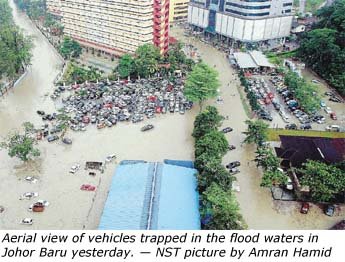
According to New Straits Times today, an half-hour rain yesterday was enough to turn the Jalan Tampoi stretch at Kampung Ungku Mohsin into a river. This is just the tip of the iceberg on problems in the southern Malaysian state bordering the affluent Singapore.

The federal government has not been able to resolve two main problems plaguing Johor and Singapore -- the sale of Johor water to Singapore and the construction of a bridge to replace the dam-like causeway linking the two countries.

As a result of the inability of the two governments to come to terms on water pricing, Johor continues to sell raw water to Singapore at 3 Malaysian sen per thousand gallons until 2011 and 2061 under two agreements. Singapore sells back a small portion of treated water to Johor at subsidised rates.

And instead of trying to secure Singapore's blessing to jointly build a bridge, Malaysian PM Abdullah Ahmad Badawi called off the bridge project completely. The reason? Badawi's cabinet could not agree with Singapore's requests for the so-called "balance of benefits" -- the right to use Malaysian airspace and buy Malaysian sand for Singapore's reclamation purpose -- despite better bilateral relations after the departure of Malaysian premier Dr Mahathir Mohamad.

While Malaysia should have planned the bridge project better, Singapore's position is not so admirable either. This sentiment was well captured in famous Singapore A-level student Gayle Goh's blog, in which she basically criticised Singapore's selfishness in its foreign policy.

In particular, she also cited her school's dialogue session with Singapore's Permanent Secretary of the Ministry of Foreign Affairs Bilahari Kausikan, who was asked by a student as to why Singapore was unwilling to help to build the bridge between Malaysia and Singapore as a gesture of goodwill between neighbours. His reply: "You want to build a bridge? Sure. But make it worth my while."

Gayle's enlightened response to the episode:

This mentality of self-interest -- which, let's call a spade a spade, is really selfishness -- sounds well and good until we begin to consider a few things. Firstly, I'm quite concerned that Singapore's selfish tendencies may just come round to bite us in the behind at some point. Our reluctance to do anything about Burma means that ASEAN is weakened from within, and our reputation as a region tarnished overseas. Our small-mindedness about the matter of goodwill and ties between Malaysia is not only downright obnoxious, but spells out ill omens for diplomatic and trading ties between the nations in the future. And let's not even talk about what will happen when the water agreement expires. With regards to Iraq? Our insensitivity to our neighbours' needs and our willingness to 'suck up to the US', which he essentially conceded, is hardly going to endear ourselves to Islamic radicals in the region.

The two bilateral problems alone will remain unresolved for some time to come. As a result, Malaysia continues to lose out on water revenue. And without the integrated bridge and transportation hub blueprint, Johor will never be able to resolve all its traffic problems.

In the meantime, the state continues to be plagued by other problems -- crime, traffic snarl, corruption, poor city planning, a narrow channel of water with one of highest toxic levels in the world, highest inflation in the country due to massive inflow of the stronger Singapore dollar, and a whole colony of underground industries to cater to Singaporeans and others (DVD piracy and prostitution).

Monday, September 11, 2006

Singapore's Hinterland

Malaysian Prime Minister Abdullah Ahmad Badawi has pitched the southern state of Johor as the Shenzhen for neighbouring Singapore. He said this in his meeting with with its premier Lee Hsien Loong on the sidelines of the Asia-Europe Meeting in Helsinki.

According to ST, Lee said both he and Badawi expressed hope that Singapore and Malaysia would be able 'to continue to develop their cooperation in many areas and move forward'.

Badawi also spoke about ongoing projects to develop Southern Johor, and likened Singapore to playing the role of Hong Kong while Johor would be like Shenzhen in China. The report described it as a mutually beneficially relationship between the two territories.

Lee gave his full support to the plan: 'I said I fully agreed and we supported Johor becoming prosperous and successful with Singapore and we hoped we would be able to work together on this.'

Badawi also said plans to develop the South Johor Economic Region were meant to 'complement' and not 'compete' with the Republic, and that it would be a 'win-win' situation.

Great sound bites. But is it really a win-win situation? Well, almost.

Singapore can continue to count on Johor as its biggest hinterland, moving lower-end factories across the causeway. At the same time, Johor can continue to rake in big dollars by doing very little as it has done in the last three decades, thanks to massive Singapore investments and tourism dollars due to the strong Singapore dollar.

But the HK-Shenzhen kind of relationship also means that Johor will never rival Singapore, as envisioned by former Malaysian premier Dr Mahathir Mohamad. He had wanted Johor to rival Singapore as the new investment destination -- not as a hinterland like Shenzhen. Dr M helped push for the development of Port of Tanjung Pelepas, which captured two of the biggest clients from Singapore's PSA.

Dr M had other big plans for the state -- turn Senai Airport into a major rival to Changi Airport in Singapore, a financial centre, a double-tracking railway network from Johor Baru all the way to southern Thailand, a new city near the Second Link, and a new transportation hub to replace the old causeway.

Badawi has taken some of the ideas and re-packaged them as his South Johor masterplan. But he has scrapped the double-tracking and the bridge projects, among other things.

Johor Baru will remain a relative backwater next to Singapore without all the plans to alleviate the third-world traffic gridlock in the Malaysian city, exacerbated by the big number of Singapore cars in the state.

In other words, Johor will remain a hinterland to Singapore.