Showing posts with label lee kuan yew. Show all posts

Sunday, January 27, 2008

Suharto dies with chequered legacy

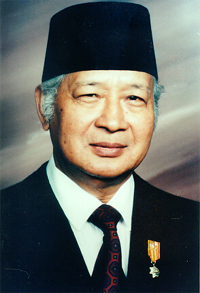
Former Indonesian President Suharto has finally succumbed to his illnesses, according to AP and BBC. According to an AP report, he died at 2.10pm (Singapore and Malaysia time) today. He was 86.

JAKARTA (Indonesia)
: Former Indonesian president Suharto, an army general who crushed Indonesia's communist movement and pushed aside the country's founding father to usher in 32 years of tough rule that saw up to a million political opponents killed, died Sunday. He was 86.

"He has died,'' Dr Christian Johannes told The Associated Press, adding that he died at 1.10pm (2.10pm Malaysian time).

Dozens of doctors on Suharto's medical team had been rushed to the Pertamina Hospital in the capital, Jakarta, after his blood pressure fell suddenly Saturday night. Suharto had slipped out of consciousness for the first time in more than three weeks of treatment, doctors said.

Suharto, had been in intensive care with lung, heart and kidney failure since he was admitted to the hospital on Jan 4. Over the past week his physicians had spoken of a recovery, but by Sunday that had changed dramatically. - AP
Suharto's downfall was triggered by the turmoil during the Asian financial crisis in 1997/1998. Indonesia fell like a house of cards, and he agreed to a bail-out package by the International Monetary Fund.

The strict IMF-mandated fuel price hikes led to riots and deaths in Jakarta, and culminated in the political end of the Indonesian strongman, who ruled Indonesia with an iron fist for three decades.

Former IMF managing director Michel Camdessus acknowledged that IMF was the root cause for the fall of Suharto in an interview with New York Times when he resigned in Nov 1999.

"We created the conditions that obliged President Suharto to leave his job," Mr Camdessus said. "That was not our intention."

Whether the change in the political scene in Indonesia was by chance or design, nobody will forget the chaos in the country.

And nobody will forget the famous picture of Mr Camdessus, with his arms crossed in what was seen as an arrogant gesture, overseeing Suharto signing the agreement for an IMF bailout package worth nearly US$50 billion. The picture was widely used to personify Asia's loss of its independence.

Suharto's funeral will probably be well attended as part of international diplomatic and state protocol.

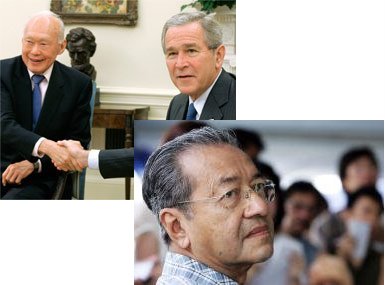
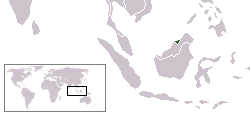
But in reality, he had few friends left during his dying days. Among them were the former PMs of Malaysia and Singapore -- Mahathir Mohamad and Lee Kuan Yew respectively -- and the Sultan of Brunei.

His few friends will always remember the man who ended Konfrontasi, which was a euphemism for the war started by former Indonesian president Sukarno against the creation of an enlarged Malaysia during the 1960s.

But Suharto will not be remembered fondly by the new generation of Indonesians and Asians who despise his regime of corruption, cronyism and nepotism, despite the obvious national economic development during his rule.

Tuesday, January 15, 2008

Old friends

It's gratifying to see two of Asia's greatest leaders and former premiers -- Lee Kuan Yew of Singapore and Dr Mahathir Mohamad of Malaysia -- rushing to the deathbed of former Indonesian president Suharto.

All three former statesmen, who are already in their 80s, were the longest-serving leaders of their countries respectively.

Dr Mahathir served 22 years before stepping down in 2003. Kuan Yew served 31 years and quit in 1990. Former Indonesian strongman Suharto ruled for 31 years as well before he was unceremoniously booted out of office following massive street demonstrations in the wake of the Asian financial crisis in the late 1990s.

It's heart warming to see that both Dr Mahathir and Kuan Yew regard Suharto as a close friend. Dr M reportedly shed tears but didn't say anything publicly in Jakarta, while Kuan Yew defended Suharto's legacy.

In an almost eulogy-like statement, Kuan Yew reportedly said: "In 1965, he acted decisively. He saved Indonesia from further going down that slippery road. From 1967, when he became president, right up to 1997, the economy grew and Indonesia was on the point of taking off."

He added: "And then when confidence was lost after the Thai baht crisis, people wanted to pull their money out, and the whole thing collapsed. It was not his fault. Yes, there was corruption. Yes, he gave favours to his family and his friends. But there was real growth, real progress."

It's unlikely that Suharto will survive as his vital organs have failed. He's not likely to be remembered fondly by the new generation of Indonesians who despise his regime of corruption, cronyism and nepotism despite the obvious national economic development during his rule.

But the grand old men of Malaysia and Singapore will continue to pray for Suharto.

One question remains about the two leaders of Singapore and Malaysia: Will Kuan Yew rush to visit Dr Mahathir or vice versa?

Wednesday, October 10, 2007

"Dumb" Myanmar generals

Free Burma!
This is one of the best comments by Singapore's Lee Kuan Yew on the situation in Myanmar. The Straits Times cited the Asian statesman as saying that the military leaders of Myanmar are "dumb". Kudos to Kuan Yew and Singapore for calling a spade a spade.

Such strong language is absolutely necessary as Singapore has assumed the chair of Asean, a grouping of Southeast Asian nations including the rogue state of Myanmar. The army's action of killing monks and protesters recently cannot be tolerated any more, although Asean has had a policy of non-interference in the affairs of member nations.

Kuan Yew should have added that he would have made the Myanmar generals stand against the wall and give them ten of the best.

"Dumb" Myanmar generals cannot last indefinitely MM
MINISTER Mentor Lee Kuan Yew believes Myanmar's ruling generals, who, he described as being rather 'dumb' when it comes to managing the country's economy, will not be able to survive indefinitely.

But he says the army must be part of the solution to the problems facing their country, because if it is dissolved, all of Myanmar's administrative instruments will go with it and the country will have nothing with which to govern itself.

Mr Lee made these points during a wide-ranging interview at his office in the Istana on Sept 27 with syndicated columnist Tom Plate of the University of California Los Angeles Media Centre and new-media expert Jeffrey Cole of the University of Southern California Annenberg Centre.

Mr Lee said: 'These are rather dumb generals when it comes to the economy... How they can so mismanage the economy and reach this stage when the country has so many natural resources?'

He noted that Singapore hoteliers, who had sunk millions of dollars in Myanmar on his advice, have now found their hotels empty.

Mr Lee disclosed that he has tried to advise the generals and take Myanmar out of its isolation, referring specifically to former junta member Khin Nyunt, who is now under house arrest.

MM Lee said: 'He's the most intelligent of the lot. I sold him the idea, or at least he bought the idea, that the way for them to go forward was to get out of uniform and do it like Suharto, form a party, Golkar and then take over as a civilian party.

'But halfway through, Suharto fell. So, it ended up as the wrong advice, they back-tracked. Then they chucked Khin Nyunt out.'

Wednesday, September 19, 2007

Dr M for Nobel Peace Prize, Part 2

According to a report, the 2007 Nobel Peace Prize could go to a climate campaigner such as ex-U.S. Vice-President Al Gore or Inuit activist Sheila Watt-Cloutier.

I don't know much about the latter but I'm rather biased against Al Gore. I won't support someone who didn't even have the decency to finish his meal as a guest of honour at the Apec conference back in Malaysia in 1998.

Gore not only endorsed the political opposition during the dinner at the height of the financial and political crisis in Malaysia, he walked out of the dinner that was hosted by then Malaysian premier Mahathir Mohamad.

Even Singapore strongman Lee Kuan Yew was then cited as saying that Gore had displayed "unnecessary rudeness".

"I mean, he came in with a stiff shaking of the hands of a few people at the head table, delivery of the speech, another shaking of the hands and off he went...Points could have been made, made without this spitting you in the face, so to speak," Kuan Yew was quoted as saying in November 1998.

Surprisingly, Dr Mahathir had maintained an elegance silence then.

My choice for Nobel Peace Prize? Dr M! The prize will definitely cheer up the retired Asian statesman as he recovers from his latest heart bypass.

Monday, August 06, 2007

Long marriages

Two of Asia's longest-serving leaders also have long-lasting marriages. Former Malaysian PM Mahathir Mohamad celebrated his 51st wedding anniversary yesterday. Another leader with a long marriage is former Singapore PM Lee Kuan Yew, who's been married to Kwa Geok Choo for 56 years.

Dr Mahathir and Kuan Yew were the longest-serving leaders of their countries respectively. Dr Mahathir served 22 years before stepping down in 2003. Kuan Yew served 31 years and stepped down in 1990. Former Indonesian strongman Suharto ruled for 31 years as well.

While Suharto and Dr Mahathir are both rather frail now, Kuan Yew still looks fit and sharp as ever.

Check out the Pioneers of Singapore series by the EDB Society/The Straits Times with Kuan Yew today. I'm still trying to watch the entire webcast.

Saturday, July 28, 2007

Updated: S'pore's bubbly property market

The Singapore private property market is experiencing its biggest boom, after the 1996 crash that pulled the market down for a decade. Prices of private apartments and condominiums have since recovered strongly in the last two years. Public housing is not spared either.

Prices of many private homes in high-end areas such as Districts 9, 10 and 11 have surpassed the previous records with headline prices generally ranging from S$2,500 per square foot to as much as S$4,000 per square foot. The previous record of about S$2,400 per square foot for a posh apartment in the Orchard Road area looks like a steal.

Prices of apartments in less prime areas have also shot up but many are still priced below their peak in 1996. Check out the graph, based on statistics from the Urban Redevelopment Authority, showing recovering prices that are still below the 1996 high.

Such runaway prices have prompted endless speculation that the government is set to step in to cool the sizzling property market.

The speculation was partly triggered by Minister Mentor Lee Kuan Yew's earlier comments that Singapore must check property prices to help maintain the country's overall competitiveness.

"We must check this spike in rents for office and residential space or we will lose our competitiveness," he was quoted as saying on July 9 by The Sunday Times.

The recent hike in the development charge (a charge levied by the government when a developer proposes to enhance the usage of the land) and the government move to step up land sales to help increase supply have lent credence to the view that the government is determined to rein in the property market. Such measures are not likely to cause the market to collapse as property deals will still be market driven.

A bigger concern is whether the government will introduce drastic fiscal measures such as a capital gains tax, which was slapped on property transactions in 1996. The tax and other financing restrictions sent the property market into a tailspin and caused many to suffer negative equity in their property purchases. Instead of cooling it, the government measures sent the property market into a prolonged slumber.

But there is also the view that the government will not unveil drastic measures this time around. The government won't want to be accused of causing the property market to collapse again. After all, it has done so much to help nurture the recovery of the Singapore economy through many new projects and measures to attract foreign capital in the last few years.

While the government is stepping up the supply side to help moderate prices, there is a possibility that it may still press the eject button should things get out of control.

Kuan Yew has again provided the hint that the government may have something up its sleeves. While in Indonesia, he was asked whether the government was planning any regulatory moves to curb prices in the Singapore property market.

His response, reported in BT today: "This is market-sensitive information...surely we are not going to discuss with the newspapers. But I think we also know that there are certain market forces at work, and we just let it run its course."

Instead of an outright denial, his comment about market-sensitive information suggests that there could be some measures in the pipeline. But he also qualified it by saying that the government should let the market run its course, suggesting no government interference.

So the overall message seems to be: The Singapore government will continue to allow the private property market function through market forces. But it may step in should prices hit the roof again.

Disclosure: Sophie lives in a private condominium in a not-so-prime part of the city that has also seen a sharp spike in property prices. Agents have been knocking on our door, offering some 40 per cent more than the purchase price earlier this year.

Latest: Housing rentals in Singapore are still lower than those in other major cities, according to The Sunday Times on July 29. According to a report cited by the newspaper, Singapore is ranked 15th in terms of rentals in the world -- below major cities like Hong Kong, Tokyo and New York. But a recent ST report also noted the trend of expatriates relocating to cheaper areas in Singapore due to fast rising rentals. I guess prices or rentals are all relative.

Saturday, July 14, 2007

Maverick sons

The sons of Singapore Prime Minister Lee Hsien Loong are mavericks.

Writers and bloggers have had field day dissecting the chain of events following Li Hongyi's long letter of complaint against a fellow officer in the Singapore Armed Forces for being absent without leave or AWOL on two occasions. He had sent the letter to the Defence Minister, senior governments officials and broadcast the letter to many fellow servicemen who were not involved in the case.

To cut the long story short, Lee's son (pix from Simple is the Reason of My Heart) earned a reprimand for not following the proper channel in lodging his complaint. The other officer was also court martialed and reprimanded.

Public reaction has been mixed. Many praised him for blowing the whistle, but some lambasted him for his brash act.

Another son of Hsien Loong and second wife Ho Ching of Temasek Holdings also came into the limelight during the last elections in 2006. Hsien Loong disclosed that his youngest son Haoyi had attended the rally of the Opposition during the hustings.

The young sons of Hsien Loong appear to be quite independent minded. They are willing to speak up, quite different from many Singaporeans who simply toe the official line. Maybe, they can afford to be different due to their privileged background. To be sure, they are not above the law as shown in the Hongyi case.

There's no doubt that they will go far in the Singapore society, due to their ability and pedigree. But will the third generation of Lees be able to follow the footstep of their PM father and their grandfather -- former PM Lee Kuan Yew?

The jury is still out.

Thursday, May 03, 2007

Malaysia's brain drain or trouble drain?

There's nothing new about Malaysia's massive brain drain woes, especially to neighbouring Singapore. Malaysia's Tony Pua (pix from his blog) wrote about it eloquently in an article that was first published in the country's New Straits Times. The article subsequently appeared in Singapore's The Straits Times.

What Tony said is true. He lamented at how the Malaysian economy is marginally bigger than resource-scarce Singapore although the island is 480 times smaller than Malaysia. He pointed out that while Malaysia’s economy of US$130 billion is still larger than Singapore’s US$117 billion, the latter is only smaller by some 11 per cent.

"And if the rate of growth currently experienced in both countries persists for the next decade, then our tiny neighbour could soon boast a larger economy than Malaysia," Tony wrote.

He said that it all boils down to one simple single factor — human capital. Or more precisely, Singapore's "near compulsive obsession" with human capital, both in terms of enhancing its local citizenry as well as attracting the best foreign talent. This, Tony said, has probably resulted in Singapore having the highest concentration of top brains per square foot in the region, if not the world.

Tony should know Singapore well. He founded Singapore-listed IT company Cyber Village and is now the economic adviser to Lim Guan Eng, who is the secretary-general of Malaysia's opposition party Democratic Action Party.

But what was not mentioned explicitly in the article was Malaysia's race-based policy known as the bumiputra policy. The point was probably left out deliberately to help avoid stirring the hornet's nest in Malaysia, which is always emotionally charged when it comes to racial and religious issues.

The bumiputra policy, which was aimed at improving the livelihood of the predominant Malay community after the racial riots in 1969, has simply alienated many non-Malays in the country. The policy has persisted until today although the social re-engineering policy was supposed to have a shelf life of twenty years.

It's therefore unsurprising that many Malaysians -- especially Chinese and Indians -- have moved to Singapore and elsewhere. Some have given up their Malaysian citizenship, as mentioned in Tony's article.

Tony -- who has a degree in Philosophy, Politics & Economics from Oxford University --correctly pointed out that Malaysia must do more to boost the "all-important qualitative element of uncompromising search for the best-qualified educators and an education policy which rewards academic rigour, critical thinking and analytical intelligence."

But will the Malaysian government do so? I doubt it despite all the rhetoric.

After so many years, there is still a lingering feeling that the Malay political leadership sees the outflow of Chinese and Indians to Singapore and elsewhere not as a brain drain.

The outflow of well-educated non-Malays is probably still seen as a "trouble drain; it drains trouble out of Malaysia," as quipped by the late Malaysian PM Tun Razak in the 1970s. The quote was captured in former Singapore PM Lee Kuan Yew's memoirs.

Tuesday, March 20, 2007

How to live in JB with so much crime!!!!


The southern Malaysian city of Johor Baru is just next to Singapore but they are definitely worlds apart. Unlike Singapore that is very safe, the crime level in JB doesn't seem to be abating despite efforts to beef up security in the state.

Former Singapore PM Lee Kuan Yew was definitely correct when he said in a defamation suit in 1997 that the Malaysian state was "notorious for shootings, muggings and car-jackings". Although Kuan Yew had expunged the remarks in order to maintain friendly relations between Singapore and Malaysia, the remarks still strike a chord among residents in the state.

Third Aunt was robbed recently. Sixth Aunt was also robbed recently by a knife-wielding man in front of her house behind the popular Holiday Plaza mall. She highlighted this story in The Star on March 19 in which a businessman -- Low Ee Chong (as shown in The Star pix) who is the brother of Pengkalan Rinting state assemblyman Low Teh Hian -- was badly injured and robbed in front of his house.

The headline of Sixth Aunt's e-mail: How to live in JB with so much crime!!!! Indeed. There are many other horror stories.

But it's not time to talk anymore. It's time to go on a massive anti-crime blitz in the MSC state -- not the Multimedia Super Corridor but Mugging, Shooting and Car-jacking state.

Thursday, March 08, 2007

Li and Lee

Why is Hong Kong tycoon Li-Ka-shing pouring so much resources into Singapore?

Today, his foundation and listed companies pumped a record S$100 million into the Lee Kuan Yew School of Public Policy at the National University of Singapore. The school is, of course, named after his good friend -- Minister Mentor Lee Kuan Yew, who was also Singapore's longest-serving Prime Minister from 1959 to 1990.

They also have great things to say:

“Globalization posts new complexities for governments worldwide. Policymakers everywhere need to develop policies that embrace the importance of diversity and integrate it within a structure of unity. This is certainly an important task and a formidable challenge. By bringing together policymakers from different countries to think about these issues together, I hope the scholarships might sow seeds of perpetual prosperity and peace.”
Li Ka-shing

"Dr Li Ka-shing and I are old friends. By his generous donation of S$100 million to the LKYSPP, I am happy that his name will be on one of the three blocks of buildings on the campus of the school that is named after me."
Lee Kuan Yew

Apart from the generous donation, the Hong Kong tycoon has given S$20 million to another university in Singapore, and is part of the consortium that is spearheading the development of the New Downtown in Singapore.

Of course, Li's port business has forged close ties with PSA International, which is part of Singapore government investment arm Temasek Holdings.

Last year, PSA paid US$4.4 billion for a "20% equity and loan interest in Hutchison Whampoa Limited’s portfolio of ports." The deal, which was PSA's biggest investment, came shortly after it failed in the bidding war for UK's P&O Ports, which was snapped up by Dubai's DP World for an even more staggering US$6.8 billion.

Will we see more partnerships between Singapore and Li's empire?

Monday, February 26, 2007

Vision 2020

This little montage is quite apt to describe the current state of world affairs.

It shows an old pix of United States President George W Bush and a more recent pix of Israeli Defence Minister Amir Peretz trying to watch military manoeuvres through binoculars with the lens caps still on.

Obviously, they don't have Vision 2020: They have not been able to resolve the Middle East problems despite their military might.

They are also unlike visionary Asian statesmen such as former premiers Lee Kuan Yew of Singapore and Mahathir Mohamad of Malaysia who obviously can see things more clearly.

Thursday, January 25, 2007

Hiccup in Singapore-Brunei Ties?

Could Singapore be having problems with Brunei -- one of its best friends -- in the midst of its stand-offs with three other bigger neighbours?

In an odd development on Wednesday, Singapore's state-controlled port operator PSA International said it was returning the operations of the Muara Container Terminal in Brunei to the local government prematurely. PSA had only managed the greenfield port in Brunei for six years although the contract was supposed to run for 25 years until 2025. The ostensible reason by PSA was the achievement of its goals and Brunei's on-going review of Muara's longer-term capacity needs.

But it sounds more like a clash of the vision for the port industry in Brunei although PSA had worded the statement nicely. The possible clash could be partly explained by a report that said Brunei's Economic Development Board had identified a nearby island called Pulau Muara Besar in 2002 for another new terminal.

Whatever the real reason for the parting of ways, the development has great political significance as the two countries have very strong and deep-rooted ties.

Brunei is the only country in the world that has its currency pegged to the Singapore dollar. Their currencies are interchangeable. Even the Malaysian currency is no longer interchangeable with the mighty Singapore dollar since the two countries separated in 1965.

In fact, Singapore and Brunei had agreed to join the formation of Malaysia in the 1960s. But Brunei dropped the idea following an internal revolt, while Lee Kuan Yew's Singapore was booted out of the federation by the Malaysian administration of Tunku Abdul Rahman after a brief merger of two years.

Since then, the two small former British colonies have forged very close political and economic ties. They enjoy deep-rooted military and bilateral ties although they are often downplayed. The Sultan of Brunei is known to have many assets in Singapore but the fact is never played up in Singapore.

With the deep ties, one would have expected political considerations to override any differences in the state port deal. In other words, one would have imagined that PSA would continue performing national service regardless of any commercial differences due to the paramount political considerations.

Despite the botched port deal, Singapore and Brunei are expected to continue their warm and friendly ties.

The same cannot be said about Singapore's current soured ties with Thailand, Malaysia and Indonesia.

Saturday, December 23, 2006

Updated: Malay Land Railway

The massive rains have caused havoc to southern and eastern Malaysia. The country is still cleaning up the mess.

As widely reported, the rail service from Singapore to certain parts of Malaysia has been disrupted due to the floods. The service disruption is aptly captured in this rather interesting picture in New Straits Times. Several observations can be made about the disruption of the train service in Malaysia:

1. First, the current single track system operated by the anachronistically named Keretapi Tanah Melayu (Malay Land Railway or Malayan Railway instead of Malaysian Railway) is obviously inadequate. Malaysia needs a double-tracking system to allow two-way traffic. The second line can still be used in the event of disruption to the first line. How can Malaysia move goods and people fast using a rail network that was built by the British in the late 19th century?

2. It's perhaps better to embark on a fast train service project in Malaysia that will require a stronger foundation for the tracks. Such tracks won't be as easily dislodged as the old gravel system to support the single track.

MMC and Gamuda had proposed a double-tracking railway system for a fast train service but the RM14.5-billion project was shelved by Prime Minister Abdullah Ahmad Badawi three years ago. Malaysian tycoon Francis Yeoh of YTL is now proposing a bullet train service between KL and Singapore but it's not known if the train service will materialise as well.

3. The disruption of the rail service has raised an interesting academic conundrum for bilateral ties between Malaysia and Singapore.

It is well known that Malaysia has legal title to the railway land in Singapore to operate a railway service through KTM. However, under the terms of the lease, should Malaysia stop operating its railway service to Singapore, the Malaysian railway land in Singapore reverts to Singapore (That is why KTM had been runing the shabby train service to Singapore although it was probably losing money from carrying so few passengers on each trip!)

The point is probably moot because Malaysia and Singapore had signed the so-called Points of Agreement to jointly re-develop the Malaysian railway land in Singapore in 1990. However, the two governments have not been able to come to terms on basic points in the POA in the past 16 years.

In fact, Malaysia's former PM Dr Mahathir Mohamad didn't quite recognise the POA, saying it was not ratified by the Malaysian Parliament -- eight years after it was signed by former Singapore PM Lee Kuan Yew and ex-Malaysian Finance Minister Daim Zainuddin.

So what will happen to the Malaysian railway land in Singapore if Malaysia uses the damage caused by the flood as an excuse to stop its unpopular* train service to Singapore indefinitely?

*The train service is not the most popular mode of transport between Singapore and KL as it takes more than seven hours on the current single track. Furthermore, it's faster to travel by highway (4 hours) and planes (45 minutes). The KTM service will become even more anachronistic once the Asean open-skies pact takes effect in 2008, a move that will allow budget airlines to fly more freely between KL and Singapore and other Asean cities.

Latest: KTM has resumed train service since Christmas Eve, according to Singapore TV channel Channel NewsAsia. But KTM is still a shabby service!